

Military Conflicts with Afghanistan, Verbal Battles with India
News Summary
Compiled and editorially reviewed.
- Military clashes have erupted along the border between Pakistan and Afghanistan, resulting in the deaths of hundreds of soldiers and civilians.
- The Pakistani Air Force reportedly bombed the Omid Edison Treatment Hospital in Kabul, with claims of 400 fatalities.
- India condemned Pakistan’s attack, calling it a cowardly act, while Pakistan accused India of sponsoring terrorism.
March 18, Kathmandu – The long-standing conflict between Pakistan and the Taliban-led government in Afghanistan has escalated into military confrontations. Despite a historically hostile relationship, the situation had not previously reached the level of open military conflict.
Currently, both nations’ militaries are engaging in offensive operations against each other. However, neither country has officially declared a formal state of war.
Notwithstanding the absence of a declared war, troops from both sides have crossed borders to conduct attacks, leading to the deaths of hundreds of soldiers and civilians.
The primary catalyst for this conflict is the Tehrik-e-Taliban Pakistan (TTP), a militant group engaged in an armed struggle against the Pakistani government for an extended period, operating from Afghanistan.
On February 6, a terrorist attack targeted a Shia mosque in Islamabad, killing 36 people. Subsequently, on February 16, another attack at Bajaur checkpoint resulted in the deaths of 11 Pakistani soldiers and one child.
Pakistan has long pressured the Taliban government in Afghanistan to act against the TTP, but the Taliban, aligning with the TTP’s ideology and Pashtun identity, resisted this pressure, leading Pakistan to accuse the Afghan Taliban of harboring terrorists.
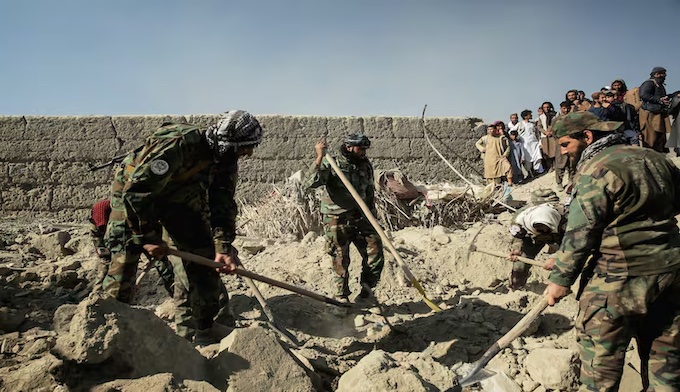
Following the major attacks in Islamabad and Bajaur, Pakistan responded angrily. On February 22, the Pakistani Air Force conducted bombings within Afghan territory.
Pakistan claims that its airstrikes targeted key locations of the TTP and the Islamic State-Khorasan Province (ISKP). Afghanistan claims that 18 civilians, including 11 children, were killed in the assault.
In retaliation, on February 26, the Afghan Taliban forces crossed into Pakistani territory for the first time, reportedly capturing 19 Pakistani border posts.
These actions further heightened tensions. Pakistan then launched heavy bombing raids on Darul Aman in Kabul and Kandahar Airport.
Since then, Afghan forces have continued incursions into border areas, while the Pakistani Air Force has repeatedly bombed locations within Afghanistan. Bomb explosions have been reported at Jalalabad Airport and Kabul’s Intelligence Ministry due to Pakistani airstrikes.
Attack on Hospital and India’s Involvement
On March 16 (Monday), the Pakistani Air Force reportedly bombed the Omid Edison Treatment Hospital in Kabul, with reports of 400 deaths. However, this figure has yet to be independently verified.
Pakistan claims that TTP commanders were hiding inside the hospital, prompting the bombing. However, the attack has drawn widespread condemnation.
The United Nations Assistance Mission in Afghanistan (UNAMA) described it as an unacceptable attack on civilian infrastructure.
At this juncture, India, a longtime adversary of Pakistan, has entered the discourse. India condemned Pakistan for the incident.
Following India’s public condemnation of Pakistan’s actions against Afghanistan, Pakistan has opened a verbal confrontation against India.
India-Pakistan Verbal Exchanges
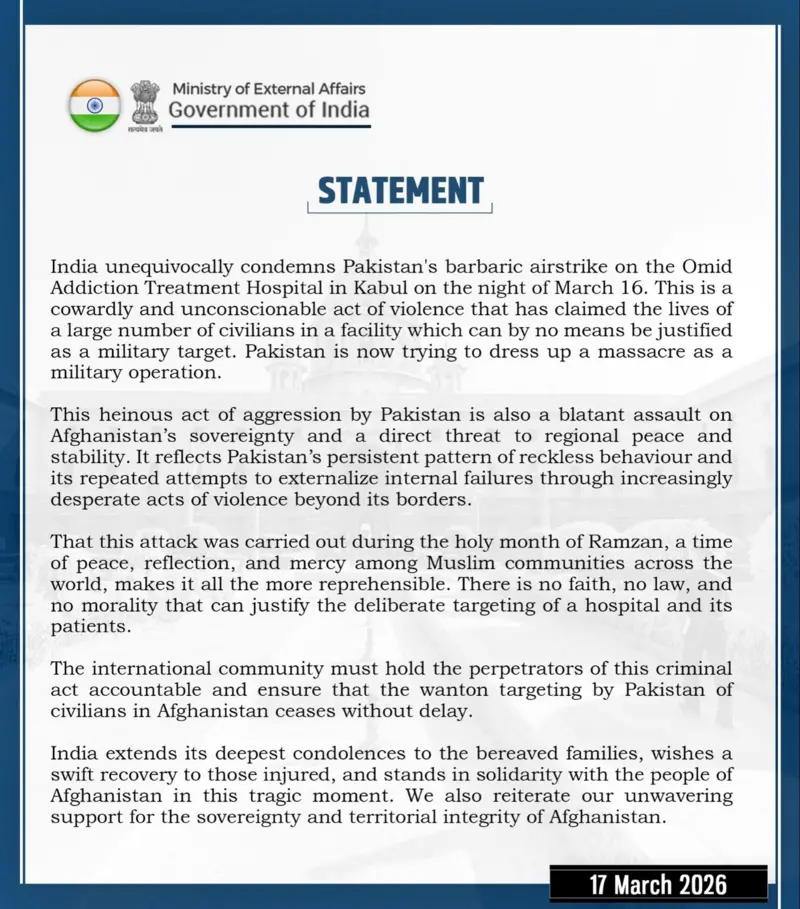
After the Pakistani airstrike on the hospital in Afghanistan, India’s Ministry of External Affairs issued a statement on Tuesday condemning the attack and calling it a cowardly act.
“This is a cowardly and inhumane act of violence that has claimed a large number of civilian lives,” the statement read. “Under no circumstances can this be justified as a military target.” India described the attack as a massacre.
“This heinous act by Pakistan is not only a clear assault on Afghanistan’s sovereignty but also a direct threat to regional peace and stability,” the statement asserted. India also accused Pakistan of using cross-border violence to distract from its internal failures.
India condemned the attack occurring during the Muslim holy month of Ramadan as particularly reprehensible and called on the international community to hold the perpetrators accountable.
“We express solidarity with the people of Afghanistan during this tragic time and reaffirm our unwavering support for Afghanistan’s sovereignty and territorial integrity,” the Indian Ministry of External Affairs added.
Following India’s critical statement, Pakistan’s Foreign Ministry spokesman, Tahir Andarabi, issued a sharp response on Wednesday.
The Pakistani statement asserted that it had taken action against terrorist networks in Afghanistan and rejected India’s comments as baseless and misleading.
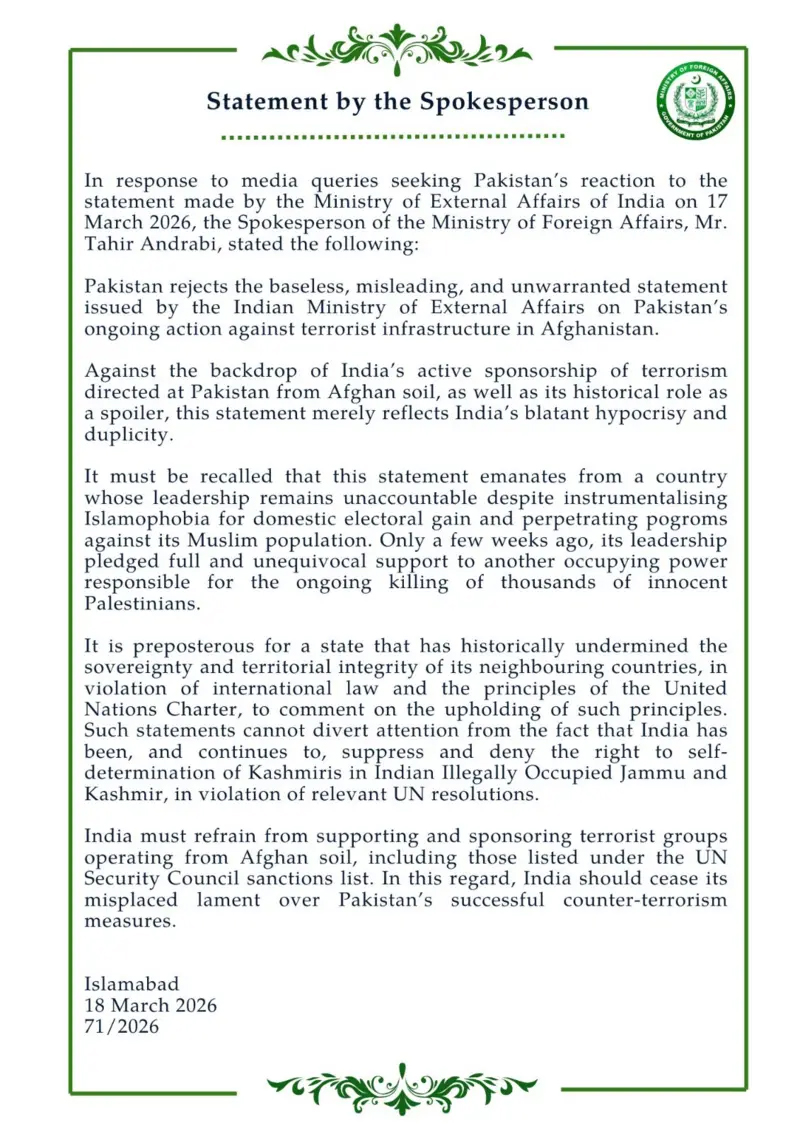 Conversely, Pakistan accused India of sponsoring terrorism from Afghan territory against Pakistan. The statement remarked, “Considering the historical role, this statement reveals India’s hypocrisy and dual standards.”
“It is noteworthy that this statement comes from a country whose leadership has exploited Islamophobia for domestic electoral gains and remains unaccountable despite violence against its own Muslim population,” the Pakistani ministry added.
Pakistan also accused India of undermining the sovereignty and territorial integrity of its neighbors, violating international law and UN Charter principles, calling India’s remarks absurd.
“India should cease its unnecessary comments on Pakistan’s successful counter-terrorism operations,” said the Pakistani Foreign Ministry.
–With contributions from international media