
What Does the Acting Chief Justice’s Written Order Mean?
News Summary
Prepared after editorial review.
- Acting Chief Justice Sapana Pradhan Malla issued a written order on Monday directing the judicial administration to register writs and petitions.
- There has been controversy over registering writs and petitions in the Supreme Court following the President’s ordinance and the Constitutional Council’s Chief Justice recommendation.
- The order notes that Chief Registrar Bimal Paudyal under the direction of the proposed Chief Justice Dr. Manoj Sharma did not register writ petitions.
May 18, Kathmandu – Expressing dissatisfaction over the refusal to register writs and other petitions filed at the Supreme Court, Acting Chief Justice Sapana Pradhan Malla on Monday issued a written order directing the judicial administration to accept these petitions.
She accused Chief Registrar Bimal Paudyal, Case Registrar Man Bahadur Karki, and staff of the writ registration branch of obstructing judicial processes and issued the written order against them.
The order requires the registration of writs and other petitions by Monday, 1 PM, and scheduling hearings for these petitions on Tuesday, May 19. It is a rare instance that the Acting Chief Justice had to give written instructions to her own judicial administration to ensure normal court proceedings.
How Did This Situation Arise?
There appear to be two main causes: the ordinance issued by the President and the disagreements within the judiciary following the Constitutional Council’s recommendation for Chief Justice. The Acting Chief Justice’s Monday order is a direct outcome of this sequence of events.
On April 5, 2022, President Ram Chandra Paudel issued the first ordinance concerning the Constitutional Council. According to it, quorum in the six-member council was considered fulfilled if four members were present, with the chairman (Prime Minister) and at least two other members supporting, allowing proposals to be approved.
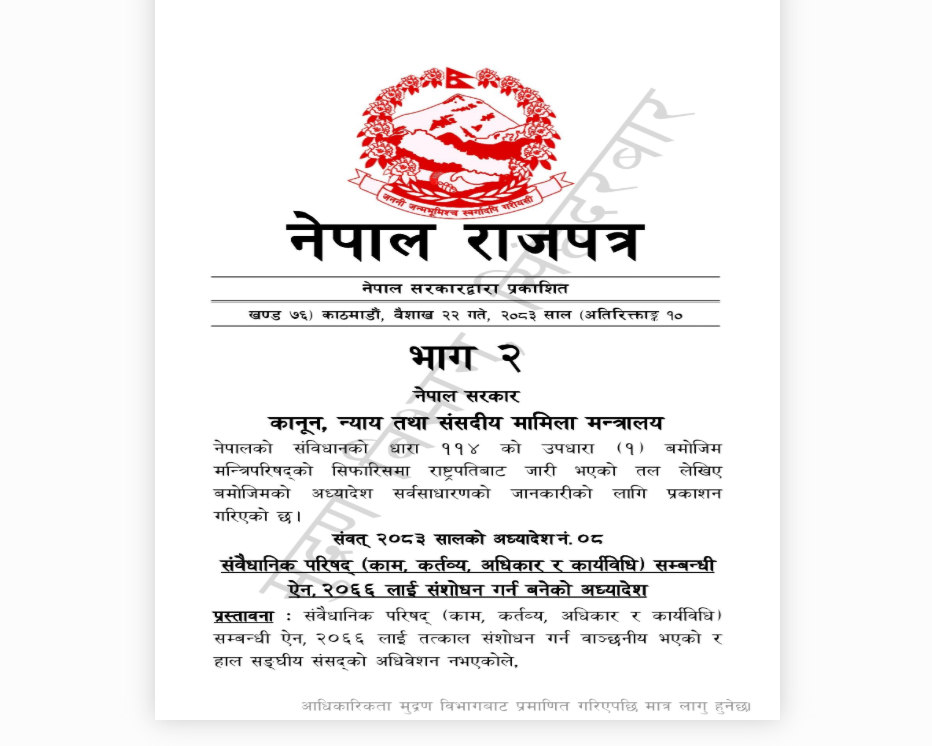
According to the ordinance, the Constitutional Council meeting of April 6 recommended Judge Dr. Manoj Sharma, the fourth senior most judge, as Chief Justice. Despite two dissenting members, the council broke past practice and tradition by endorsing this judge.
The Two Categories of Blocked Writ Petitions
Following the President’s ordinance and the Constitutional Council’s recommendation, two types of writ petitions were filed in the Supreme Court challenging these decisions. The court administration has hesitated to register writs filed by Dr. Prem Silwal and Geeta Thapa, while an order to reject a writ petition against the Chief Justice recommendation has already been issued.
As per judicial procedure, petitions submitted must be registered by the court administration; if not registered, an order explaining the refusal (dismissal) should be given. According to legal professionals, no decision has been made on the writ against the ordinance, while the writ against the Chief Justice recommendation has already been dismissed.
If court administration refuses to register a petition, petitioners can submit another application, which must be registered and heard directly before a bench.
Senior advocate Dinesh Tripathi mentioned the initial dismissal order was delayed, and the subsequent petition filed against that dismissal has yet to be registered, although it must be registered and presented before the bench.
Due to the failure to register petitions, legal professionals repeatedly approached Acting Chief Justice Sapana Pradhan Malla to complain. The Nepal Bar Association also issued a statement opposing the actions of the court administration.
On Monday as well, a team of lawyers met with the Acting Chief Justice. Shortly thereafter, she issued an order under Article 136 of the Constitution.
Article 136 of the Constitution vests the Chief Justice with the ultimate responsibility to ensure effective judicial administration of the Supreme Court and subordinate courts. It is a rare occurrence that the judicial leadership has to issue a written directive to the judicial administration to resume routine operations.
What Are the Underlying Reasons?
https://www.youtube.com/watch?v=WizE0OpUSVk[/embed>
According to sources and staff connected to the Supreme Court administration, during Chief Justice Prakash Man Singh Raut’s tenure, Chief Registrar Bimal Paudyal sought appointment as a judge. He aimed to become a judge by first serving as Chief Registrar of a High Court and progressing in the seniority list for Chief Justice succession.
However, Senior Justice Sapana Pradhan Malla did not approve this proposal. When she led the Judicial Council, the likelihood of recommending Chief Registrar Paudyal as a judge was low.
After Raut retired, Sapana Pradhan Malla became Acting Chief Justice. Meanwhile, Dr. Manoj Sharma was unexpectedly recommended as Chief Justice.
According to discontented judges at the Supreme Court, Chief Registrar Paudyal deployed his subordinates to obstruct registration of writ petitions that could trouble the government and proposed Chief Justice Dr. Sharma.
Acting Chief Justice Malla’s written order also alludes to this issue. The order states that when judges questioned Chief Registrar Paudyal about the refusal to register writ petitions, he replied that the directive came from the proposed Chief Justice Dr. Manoj Sharma.
Following the Constitutional Council’s recommendation, the trust deficit between the group led by proposed Chief Justice Dr. Sharma and the acting Chief Justice Sapana Pradhan Malla has deepened.
Dr. Sharma’s group advocates for the registration of petitions against the ordinance and the Constitutional Council’s recommendation and issuing interim orders from a single bench. If that happens, it may challenge the legality of the Constitutional Council meeting as per the Constitution.
Moreover, granting interim orders against the Constitutional Council’s recommendation risks stalling the process of Chief Justice appointment itself. Dissenting judges also fear that if such petitions progress, the constitutionality of the ordinance and recommendation will be questioned.
Distribution of Responsibilities Among Staff
At the time of this briefing, there was no indication that the Supreme Court administration intended to register writs and other petitions. Chief Registrar Paudyal has been absent from the Acting Chief Justice’s office since Monday morning, reportedly attending meetings.
Case Registrar Man Bahadur Karki is also not present at his workplace, while Case Division Head and Co-Registrar Arjun Koirala is at training. Under their direction, the Deputy Secretary and staff of the writ branch had been registering writ petitions, and their absence has caused a bottleneck.
“If compliance with the order is not seen within a few hours, the judges will hold discussions to decide the next strategy,” a source close to the Supreme Court said. “Further decisions will be made following those discussions.”