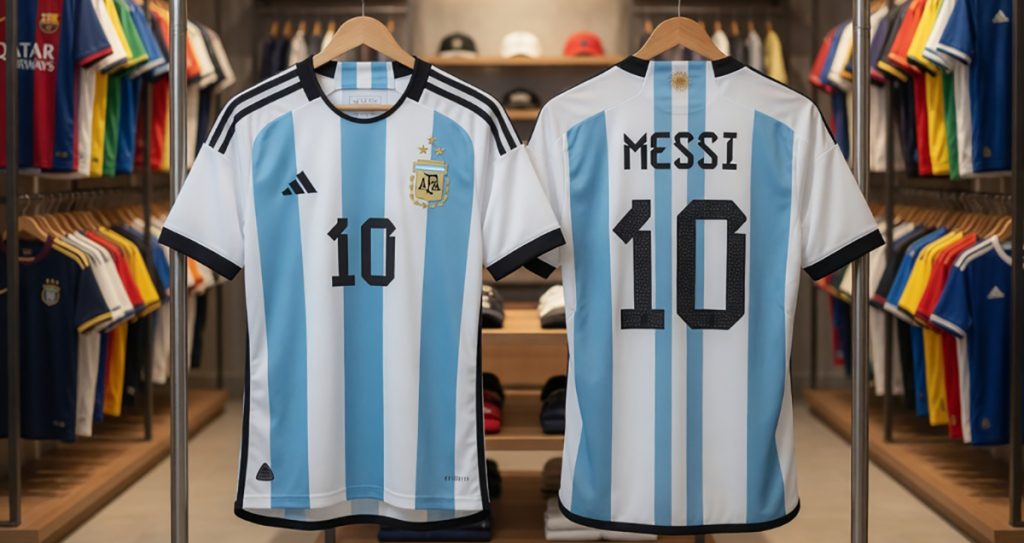
News Summary
- During the World Cup, demand and sales of football jerseys from Argentina, Portugal, and other countries have notably increased in Nepal.
- The most popular jersey in the market is Lionel Messi’s number 10, which fans are also using as a fashion statement.
The FIFA World Cup is not just a sports competition; it is also a grand celebration of fashion and style, creating a major stir in the global fashion market.
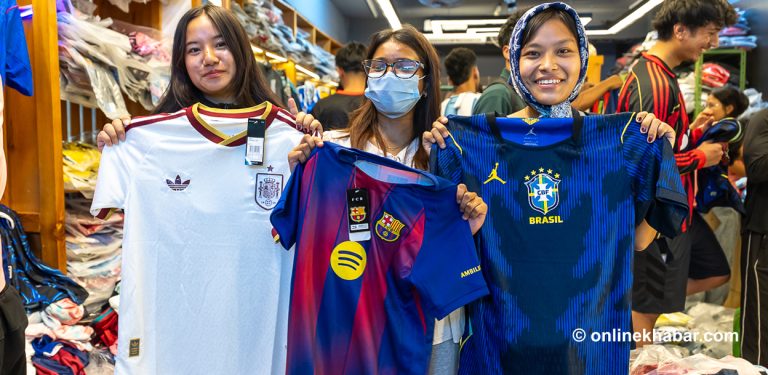
Markets in Nepal have also caught the colorful spirit of the World Cup, showcasing a wide variety of football jerseys. Among these, the number 10 jersey stands out with particular fascination.
It barely needs to be asked whose jersey it is—even those who aren’t football experts can easily answer: ‘Lionel Messi’s.’
Currently, this is the most sought-after jersey in the market. Traders report, ‘Everyone who visits, whether children or elders, looks for this jersey. Though some young buyers might have slightly different preferences.’
Merchants say that demand for Argentina and Portugal jerseys has risen across various markets and online platforms throughout Nepal. Jerseys of standard quality start at approximately NPR 850, while higher-quality fabric and print jerseys range from NPR 1,000 to 2,000 or more. Sales surge significantly as the World Cup and major tournaments approach.
Why is Number 10 special?
In football, the number 10 jersey is considered special. Traditionally, it is assigned to the team’s most creative, talented player who controls the game’s tempo. Many legendary players have famously worn this number throughout history.
Lionel Messi has worn the number 10 jersey for Argentina, whether during his time at Barcelona or now with Inter Miami. Thus, the number 10 is globally associated with Messi.
However, the history of the number 10 jerseys predates Messi by many decades.
In 1958, Brazilian legend Pelé wore the number 10 jersey when Brazil won the World Cup, marking the start of its legendary status.
Diego Maradona also donned the number 10 for Argentina. His number 10 jersey from Argentina’s 1986 World Cup victory is among the most iconic jerseys in football history.
France’s star Zinedine Zidane wore number 10 as well, playing a crucial role in France’s first World Cup win in 1998.
Brazilian great Ronaldinho wore number 10 and was part of the 2002 World Cup-winning team.
Since then, Messi has taken this number to new heights.
With Messi leading Argentina to major international titles, the number 10 has become more than just a number; it symbolizes success. For many fans, number 10 epitomizes Messi, Argentina, and football magic.
Why do even non-football fans search for Messi’s jersey?
During the World Cup, the jersey transcends being just a sports item; it becomes a fashion statement. Many youths wear jerseys to show support for their favorite team or player. For some, it’s a means to take photos for social media, watch matches with friends, or immerse themselves in the World Cup atmosphere.
Messi’s popularity has gone beyond sports among today’s generation. Because of his name, style, success, and humble personality, many who aren’t deeply interested in football still prefer wearing his jersey. This sentiment often gets summarized as, “Whether I understand football or not, I want Messi’s number 10 jersey.”
Not only his jersey, but his hairstyle, beard style, and tattoo designs are also followed by fans.
Appeal of Other Jerseys
While Messi’s number 10 receives the most attention during major football tournaments, fans remain attracted to other player and team jerseys as well.
In particular, Cristiano Ronaldo’s Portugal number 7 jersey is regarded as one of the world’s most popular. For his supporters, ‘CR7’ is not just a number but a unique identity.
Similarly, jerseys of players like Kylian Mbappé for France, Neymar for Brazil, Jude Bellingham for England, and exciting new stars like Lamin Yamal are highly popular among the youth.
While some buyers purchase jerseys to support favorite players, others choose based on colors and designs. Consequently, football jerseys have become integral to youth fashion, style, and identity, beyond merely watching the games.
The World Cup’s Impact Beyond Sports
The World Cup influences not only sports but also commerce, fashion, entertainment, and social activities. Jersey sales increase, viewing gatherings grow, social media is flooded with football content, and players emerge as global fashion icons.
Hence, as the World Cup begins, demand rises for jerseys of teams like Argentina, Brazil, Portugal, and France. In recent years, Lionel Messi and his number 10 jersey have consistently dominated the buzz.










.jpg "Land for sale in Lubhu")

%20-%20Copy.jpg "4 Bedroom House for rent in Bhaisepati")





.jpg "Residential land for sale in Imadol")
Comments 4