Farmers Protest by Dumping Tomatoes on Streets as Agriculture Minister’s Promise to End Middlemen Fails
Summary
- Farmers in Kathmandu’s Maitighar protested by dumping tomatoes on the street, citing failure to receive fair prices that cover production costs.
- The protesters demanded agricultural insurance, guaranteed minimum support prices, and an end to middlemen from the government.
- Local tomatoes at Kalimati Market were selling for less than NPR 10 per kilo, leaving farmers unable to recover costs.
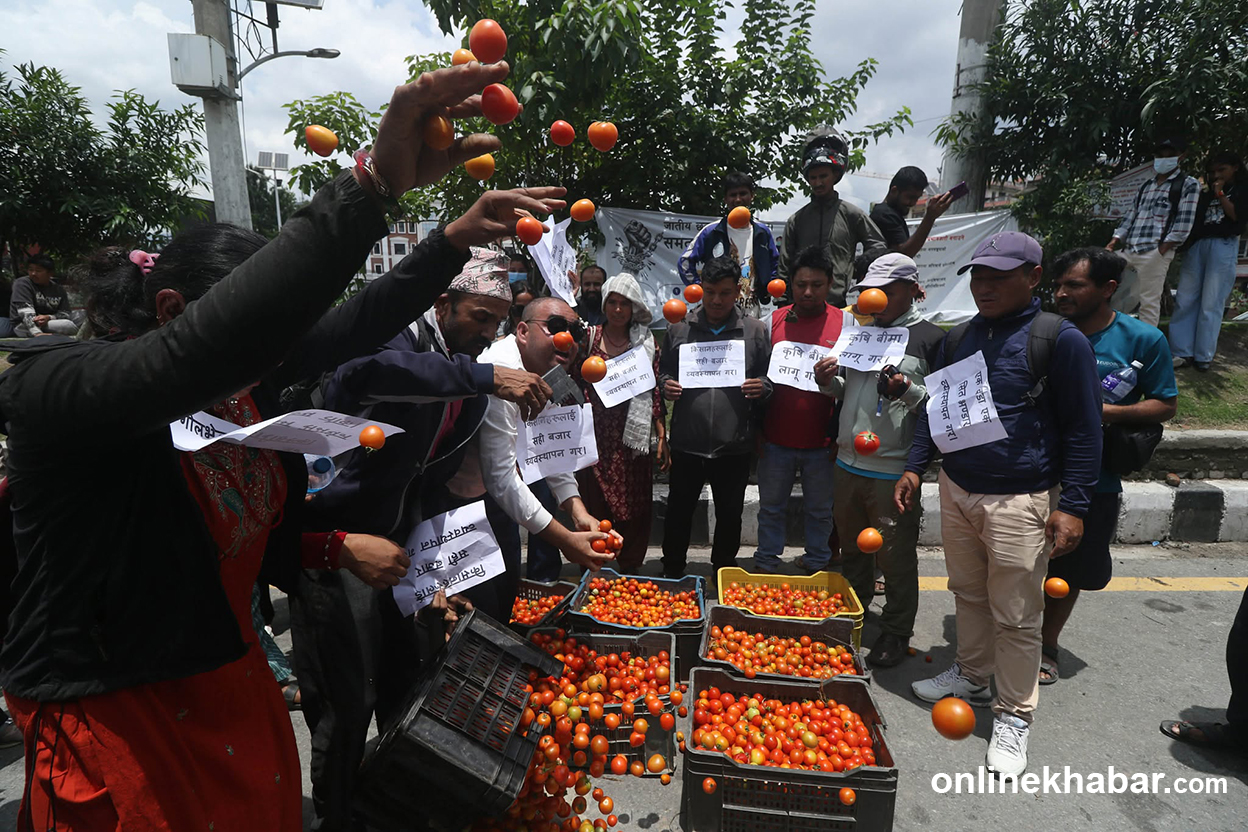
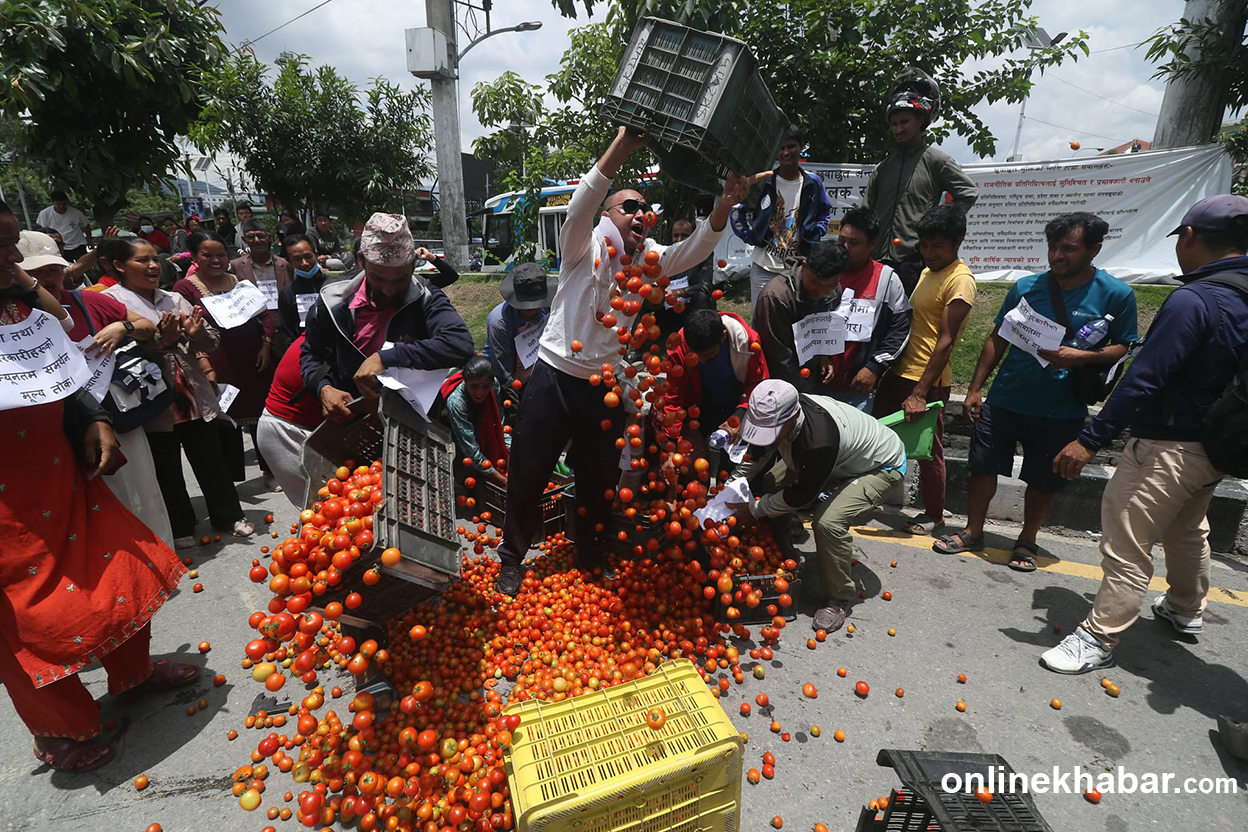
June 15, Kathmandu—Around noon on Wednesday, Maitighar area in the federal capital was scene to red-stained roads as farmers dumped tomatoes on the street to protest the lack of fair prices.
Rising production costs and inability to sell tomatoes even at NPR 10 per kilogram compelled farmers to throw their produce on the streets near Maitighar in protest.
For farmers, working hard in the fields is challenging, but receiving an adequate price for their produce is an even greater hardship.
With deep frustration and anger, the farmers expressed their dissatisfaction by dumping their hard-earned tomatoes on the road, highlighting the government’s failure to ensure fair prices.
Local cultivators from the Kathmandu Valley, who lease land and use tunnel farming techniques, were the protesters on the streets.
“We have no associations or leadership; we are all individual farmers sweating in our fields. Today, in pain, we have taken to the streets with that fire,” protesters said.
Among the farmers shouting slogans atop piles of tomatoes was Bam Lama Tamang, whose face showed clear signs of despair and anger. Along with him, over a hundred farmers carried a banner that read “Green Revolution.”
They chanted, “Let farmers earn a living. Government, manage pricing, remove middlemen from markets, provide concessional loans, implement agricultural insurance, pay fair prices for farmers’ labor, and ensure timely supply of fertilizers, seeds, and rights!”
Farmers also voiced strong discontent with Agriculture, Forest and Environment Minister Gita Chaudhary.
According to farmer Tamang, the cost to produce one kilogram of tomatoes is at least NPR 25, but with prices dipping below NPR 10 per kilo, they were forced onto the streets.
“Selling at NPR 10 means a loss; this is not a new problem — we have been incurring losses for nearly a month,” he said. “We grow local tomatoes in tunnels using polythene sheets and bamboo with heavy investment. How is survival possible?”
Farmers complain that ineffective market regulation without middlemen’s control allows Indian tomatoes to flood markets, pushing out local produce.
They also criticized the Kalimati Fruit and Vegetable Market Development Committee for failing to track and regulate imported Indian vegetables.
“What we want is for Kalimati to stop daily price fluctuations,” Tamang added. “Whether tomatoes or other vegetables, setting fixed prices would greatly help farmers.”

Millions Invested, Employment at Risk
The farmers protesting in Maitighar are not just subsistence farmers, but also operate commercially, cultivating 80 to 100 tunnels.
“In these 80 to 100 tunnels, each employs 5 to 10 workers,” Tamang said. “We pay land rent, workers’ wages, and expenses for fertilizers and seeds — how can we cover costs selling tomatoes at NPR 10 per kilo?”
The previous day, protests targeting vehicles carrying vegetables failed to make an impact, leading farmers to gather at Maitighar for a more visible demonstration.
All farmers participating agreed, “We sweat in the fields to produce, but price-setting is controlled by middlemen. Selling at a negligible price is worse than dumping the produce on roads.”
The Same Old Story
This is not the first time farmers have dumped vegetables to protest. This is neither a new problem.
Recently, farmers in Ghyalkochok, Ward 8 of Gandaki Rural Municipality, Gorkha, were forced to dump winter beans and yard-long beans on roads and fields after middlemen offered them only NPR 5 to 12 per kilo — too low to cover costs.
Transportation costs of NPR 600 to 700 to reach markets, combined with poor sale prices, forced farmers to this desperate act.
Across the country, farmers frequently protest by dumping tomatoes, cauliflower, beans, and other produce on roads, highlighting systemic state weaknesses that remain unaddressed by successive governments.
On June 10, Agriculture Minister Chaudhary, marking 100 days in office, had assured at a press conference on June 11 that middlemen would be eliminated and farmers would receive fair prices.
She had committed to making agriculture the country’s economic backbone and introducing policy reforms to remove middlemen’s influence.
She promised minimum support price determination, farmer-friendly market management, working late into the night to hear farmers’ grievances, and taking action against black marketing.
The government led by Prime Minister Balendra Shah had also pledged in its 100-day agenda to enforce payment of agricultural product purchase loans to farmers within 25 days, with buyers required to pay interest if payments are delayed.
However, farmers say these decisions remain unimplemented in practice, forcing them into protests.
Farmers assert these promises are limited to speeches and that despite policy reforms, middlemen’s control remains entrenched — a problem still affecting both farmers and consumers.
Consumers Pay More as Farmers Receive Less
The wholesale price report released by the Kalimati Fruit and Vegetable Market Development Committee on Wednesday confirms that farmers are not getting fair prices.
According to official data, the minimum wholesale price for small local tomatoes is NPR 8 and the maximum is NPR 12 per kilogram, with an average around NPR 9.50 — insufficient to cover farming costs.
Tunnel-grown small tomatoes average NPR 14.60 per kilo, and large Nepali tomatoes are priced at NPR 38.75 wholesale.
But consumers pay between NPR 50 to 70 for these tomatoes at retail.
Traders often claim farmers are getting good prices while charging consumers more.
Vegetable Traders Deny Farmers’ Allegations
Despite the protests, vegetable traders have rejected farmers’ claims that they are not receiving fair prices or are being exploited by cartels.
Bharat Prasad Khatri, President of the Nepal Fruit and Vegetable Traders Federation, denied any price-fixing and attributed price drops to excessive production.
“Tomato prices do not drop every year due to external factors. Rather, many areas in Nepal are producing in excess, causing prices to fall,” Khatri said. “There is no concern of cartel behavior.”
He said prices of large tomatoes used in salads are higher, but ample supply of tunnel and local small tomatoes lowers prices in those categories.
He argued that higher retail prices result from the distance between wholesale markets and retail outlets.
“Common people live far from wholesale markets. Outer markets such as Suryabinayak, Jorpati, Baneshwor, and Lagankhel operate differently,” Khatri added. “Consumer prices in wholesale markets do not typically exceed NPR 30–35, but outside prices in retail shops are less regulated.”
He stated that wholesale tomato prices fluctuate widely between NPR 300 and 400, which appears contradictory.
Though farmers blame Indian tomatoes for driving down prices and limiting local produce sales, Khatri said Nepal’s local production is currently in surplus and that Indian tomatoes have not flooded the market. The Kalimati vegetable market list does not include Indian tomatoes.
How Long Must We Keep Dumping? Farmers’ Demands
Farmers’ demands are straightforward: agricultural insurance, minimum support prices, easier market access, and control over middlemen.
In an agriculture-driven country, the state’s failure to timely manage markets forces farmers to repeatedly dump produce on roads to protest — a sharp indictment of government agricultural policy.
Stakeholders say the government must urgently intervene in market structures to genuinely eliminate middlemen and prevent farmers from having to resort to such desperate measures, as Minister Chaudhary pledged.
Photo: Aryan Dhimal