
Why Did Modi Government Ministers Rush to Meet Rahul Gandhi After His Sudden Sit-In Protest?
Summary
Based on compiled data. Editorial review completed.
- Rahul Gandhi unexpectedly staged a sit-in protest outside the Prime Minister’s residence in New Delhi on Tuesday, prompting the Modi government to immediately send Minister Jitendra Singh for talks.
- The government has indicated readiness to discuss the issue of the NEET exam paper leak in Parliament, which political analysts say reflects pressure on the government.
- The government’s courteous response to an opposition leader protesting outside the Prime Minister’s residence is seen in public perception as a sign that the government is on the defensive.
6th July, Kathmandu – On Tuesday, Rahul Gandhi unexpectedly staged a sit-in protest outside 7 Lok Kalyan Marg, the Prime Minister’s residence in New Delhi. The move took many by surprise, as the media only became aware after he had already begun the demonstration.
Many opposition leaders were heading towards Jantar Mantar to participate in a protest against the Citizenship Amendment Act (CJP) and Sonam Wangchuk’s campaign. But Rahul decided to hold his sit-in outside 7 Lok Kalyan Marg instead.
That day, senior leaders like Sharad Pawar of the Sharad Pawar faction of the NCP and Arvind Kejriwal from the Aam Aadmi Party (AAP) were already at Jantar Mantar, where they met the protesters.
Supriya Sule also arrived at 7 Lok Kalyan Marg, where Rahul Gandhi and Priyanka Gandhi were staging the sit-in. They were later taken into custody and removed from the site.
The most significant aspect was that the Modi government promptly sought dialogue with Rahul Gandhi. Since Narendra Modi became Prime Minister in 2014, such an active approach from the government in response to opposition protests has been rare.
Minister of State in the Prime Minister’s Office Jitendra Singh was entrusted with the responsibility to engage in talks with Rahul on the government’s behalf.
Jitendra Singh stated that the government was prepared to discuss the administrative conduct during the NEET paper leak controversy and the protests led by the CJP.
Although Rahul initially agreed, he later withdrew from the negotiation as per Singh’s account.
Delhi Police eventually removed Rahul from 7 Lok Kalyan Marg and took him into custody.
Why This ‘Courtesy’ from the Government?
Jitendra Singh commented, “Upon reaching there, I politely and respectfully requested Rahul that protest is not the solution. If the government is willing to debate the NEET exam, paper leak, and related matters in Parliament, then we are prepared to halt the protest, signaling possible cooperation.”
Many political analysts consider the Modi government’s behavior highly significant.
According to Professor Ashutosh Kumar from Punjab University’s Political Science department, the government’s readiness to discuss in Parliament is a clear indication of being under pressure.
Prof. Kumar said, “The government is under pressure. India has a large young population, many of whom are voters and were Modi supporters. But the situation is shifting. The BJP fears loss of votes. The NEET issue concerns the middle class, 20 to 25 percent of whom had been Modi supporters.”
“The middle class is very ambitious. The government’s immediate response is not out of goodwill toward the opposition but driven by fear. The illusion of ‘neither I will take it nor will I let others have it’ is breaking down. This has affected the government’s image. It is a wake-up call for the government.”
“The paper leak has hurt the urban and middle class. The government’s strong image has weakened. Now the government is ready for public debate.”
Rahul’s protest received prime coverage across all major Indian TV channels on Monday evening. TV channels in India have a significant influence on shaping public opinion.
Rahul chose a different venue for his protest than the CJP’s demonstration at Jantar Mantar.
Modi Government’s Strategy
On Tuesday evening, senior journalist Rajdeep Sardesai wrote on X (formerly Twitter), “This is one of those rare days where Rahul Gandhi is front and center in nearly all the news. The difference this time is that it is not the opposition but the government that is compelled to answer questions.”
Prof. Kumar suggests that the government’s immediate attempt to engage in talks and then withdrawing could be a strategic move.
Kumar explains, “Rahul’s statements were starting to gain media traction. Modi could not allow this to continue unabated. The game is still ongoing.”
Rajdeep Sardesai interprets public perception as seeing the government on the defensive.
He told BBC Hindi, “Parliament is in session and the CJP’s Parliament march drew a huge crowd. Opposition leaders were outside the Prime Minister’s residence. Under such circumstances, the media cannot support the government for long. Public perception views the government as under pressure. Therefore, it cannot be said that the government is unwilling to talk.”
He added, “The government had to negotiate. In today’s environment, perception is extremely important. Nadda met CJP’s spokesperson. Jitendra Singh went to engage in talks with Rahul.”
“I can’t say Modi’s image has weakened. The BJP will win elections. There is fatigue among the people. People are raising questions. Once Generation Z regains awareness, no one else but Modi is seen as Prime Minister. Whether this fatigue turns into anger remains uncertain.”
Why Did Rahul Choose 7 Lok Kalyan Marg Instead of Jantar Mantar?
Monday’s CJP Parliament march had a massive turnout.
Rahul had already launched a campaign concerning the NEET paper leak issue, but many people were aligned with the CJP’s movement.
This posed a challenge for the Congress and Rahul. Abhijeet Deepak’s prior association with the Aam Aadmi Party had made Congress uncomfortable. He had also mocked Rahul’s Bharat Jodo Yatra.
According to Prof. Kumar, Rahul did not want to give credit for his cause to others. Abhijeet’s past was a liability for Congress.
Rajdeep Sardesai said, “The CJP march had a big impact on Monday. It brought freshness. On the other hand, Rahul began to feel that the issue was being claimed by others. AAP was supporting CJP. Congress feared being overtaken and thus opened a different front.”
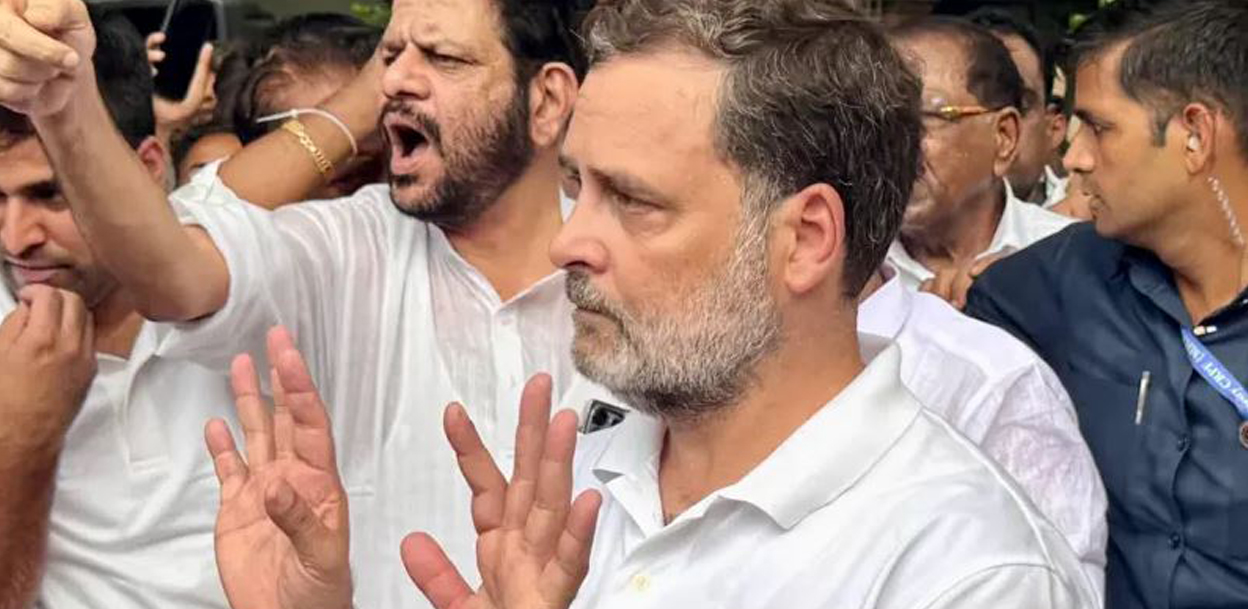
Rajdeep notes, “Because the opposition leader protested outside the Prime Minister’s residence, the media gave it vital coverage. It also benefited the media—it couldn’t be ignored.”
Since Narendra Modi came to power, questions have persisted on whether Rahul is capable of challenging him.
Before the start of the monsoon session of Parliament, Prime Minister Modi had directed remarks aimed at Rahul.
Criticism Against Rahul
There are two main criticisms of Rahul Gandhi. First, he belongs to a political family. Indian politics has moved beyond dynastic leadership, with many leaders emerging from common backgrounds; Narendra Modi is a prime example.
Second, Rahul is perceived as not being politically sharp. Congress has tended to overlook this weakness or perhaps some leaders recognize it but the party as a whole is not in a position to replace the Gandhi leadership — Rahul, Sonia, and Priyanka.
Recently, historian Ramachandra Guha has provided intellectual support for this political view. Guha, a vocal critic of Modi and a respected historian in India, expressed his opinion about the Gandhi family in an article published in The Telegraph.
Guha’s sharpest criticism is directed at Rahul. He acknowledges that Rahul is a good person but states that he lacks discipline, seriousness, and solid political experience.
Guha notes discipline was shown only during the Bharat Jodo Yatra. Rahul works hard but lacks consistency, exerting effort only sporadically.
Opponents of the BJP are tirelessly working. Guha believes Rahul should channel the energy he spends on social media into strengthening his party.