
Nagdhunga-Sisnekhola Tunnel Highway Officially Opened
News Summary
Editorial review completed.
- Nepal’s first and longest Nagdhunga-Sisnekhola road tunnel officially commenced operations on Monday.
- The inauguration was jointly conducted by Infrastructure Development Minister Sunil Lamsal, Japan International Cooperation Agency (JICA) Chairman Dr. Tanaka Akihiko, and 63-year-old Purna Joshi, who was involved in the tunnel’s construction.
- Initially, only emergency service vehicles are allowed during the trial run, with full access to all vehicles expected shortly, according to the ministry.
11 Shrawan, Kathmandu – Nepal’s first and longest road tunnel, the Nagdhunga-Sisnekhola tunnel, was officially opened for traffic on Monday.
During the initial phase, access is restricted to emergency vehicles only. After a trial period, the Infrastructure Development Ministry has indicated that the tunnel will open to all types of vehicles.
The tunnel, located on the Tribhuvan Rajpath, was inaugurated jointly by Infrastructure Development Minister Sunil Lamsal, Japan International Cooperation Agency (JICA) Chairman Dr. Tanaka Akihiko, and Purna Joshi, aged 63, who took part in its construction.
Prime Minister KP Sharma Oli laid the foundation stone on October 22, 2019, and the construction work began on November 14, 2019.
The main tunnel ‘breakthrough’ was achieved on April 16, 2024, by then-Prime Minister Pushpa Kamal Dahal. The total tunnel length is 2,688 meters.
At the ceremony, Minister Lamsal stated that the country has entered a new phase of infrastructure development and anticipated many more tunnels being constructed in the future.
Ministry Secretary Gopal Prasad Sigdel described this as a new chapter in Nepal’s modern infrastructure growth and a significant achievement given the challenging geographical conditions.
He expressed confidence that with political will, technical cooperation, and perseverance, Nepal can successfully complete major infrastructure projects.
Japan provided concessional loan assistance for this venture. JICA Chairman Tanaka Akihiko highlighted this tunnel as a key milestone in Nepal-Japan strong relations and cooperation.
He also recalled that heavy rains two years ago underscored the importance of this tunnel. Despite the major challenges faced in the Himalayan terrain, the project reached completion.
Japanese Ambassador to Nepal Maeda Toru described the tunnel as a historic moment for Nepal’s infrastructure development and a symbol of the solid friendship between Nepal and Japan.
From Churiyamai Tunnel to Diverse Tunnel Development
Nepal’s first road tunnel is considered to be the Churiyamai Tunnel in Makwanpur district, constructed during the Rana era in 1917 by Chandra Shamsher. After that, tunnel road development stagnated for a long time.
The Upper Marsyangdi Hydroelectric Project in Lamjung operated a 340-meter-long tunnel but this was not a commercial road tunnel.
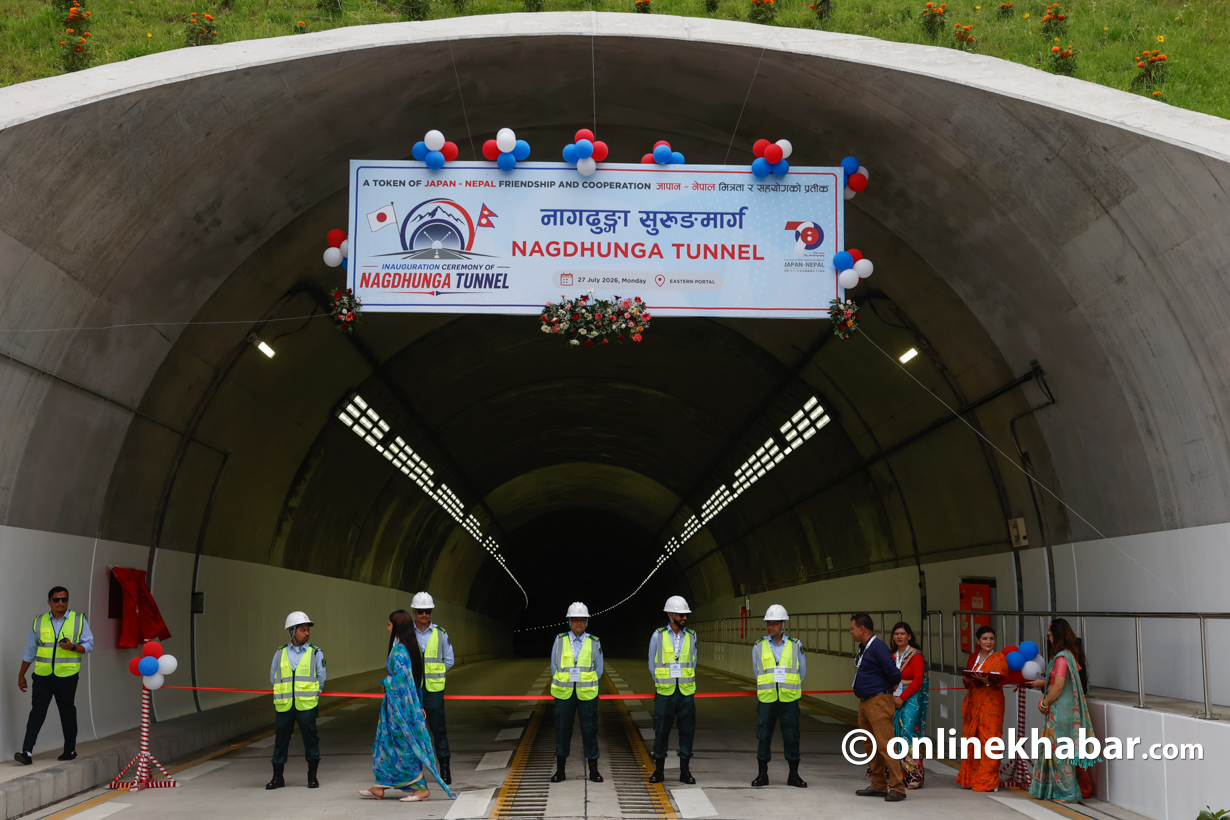
The Upper Tamakoshi project constructed a 337-meter long tunnel which is also in use for traffic. However, Nagdhunga tunnel is the first and longest tunnel on the busy highway and ranks as Nepal’s fourth largest tunnel.
Most modern tunnels in Nepal have been constructed for hydro-power projects. There are currently around 280 kilometers of tunnels completed, with about 250 more kilometers under construction across various projects.
Future tunnel projects are expected to play a critical role in transferring technology to Nepali technicians.
Structure of Nagdhunga-Sisnekhola Tunnel
The total length of this tunnel is 2,688 meters, including a 2,557-meter-long rescue tunnel. Along with the tunnel, multiple structures such as flyovers, bridges, box culverts, underpasses, and overpasses have been constructed.
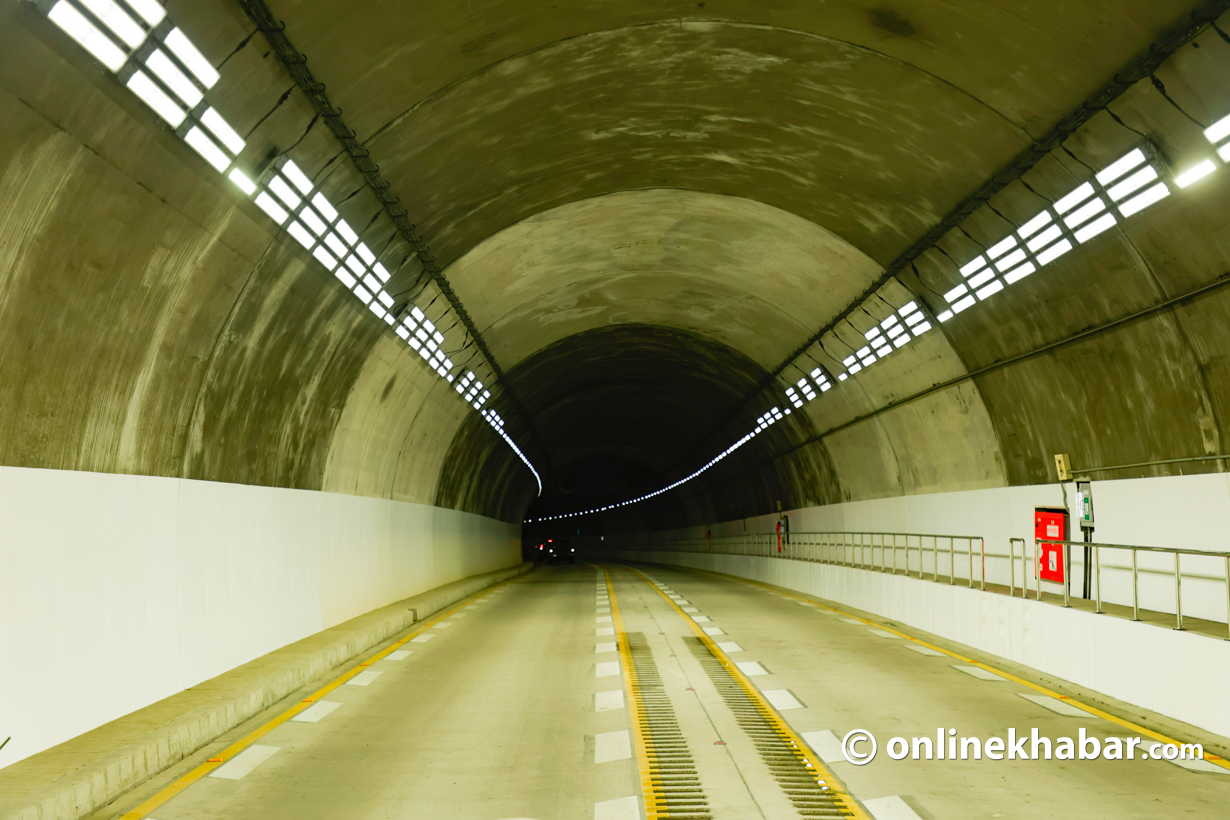
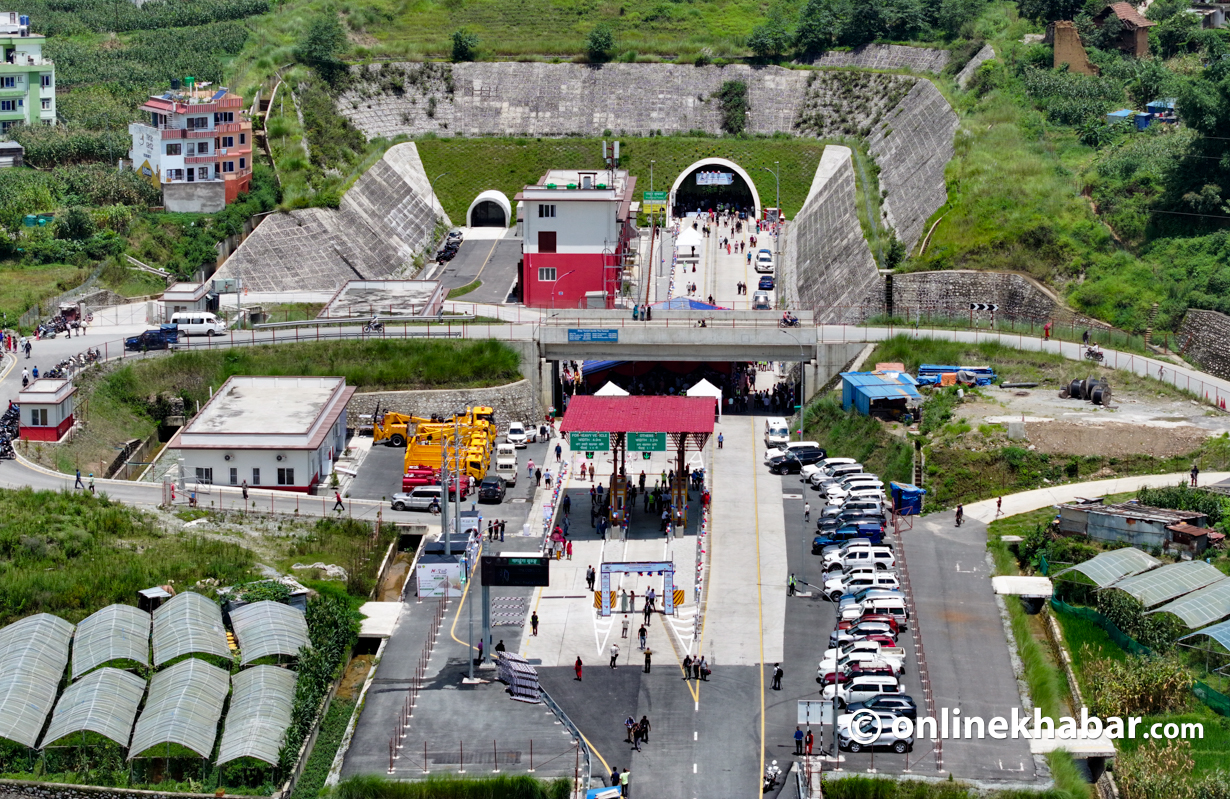
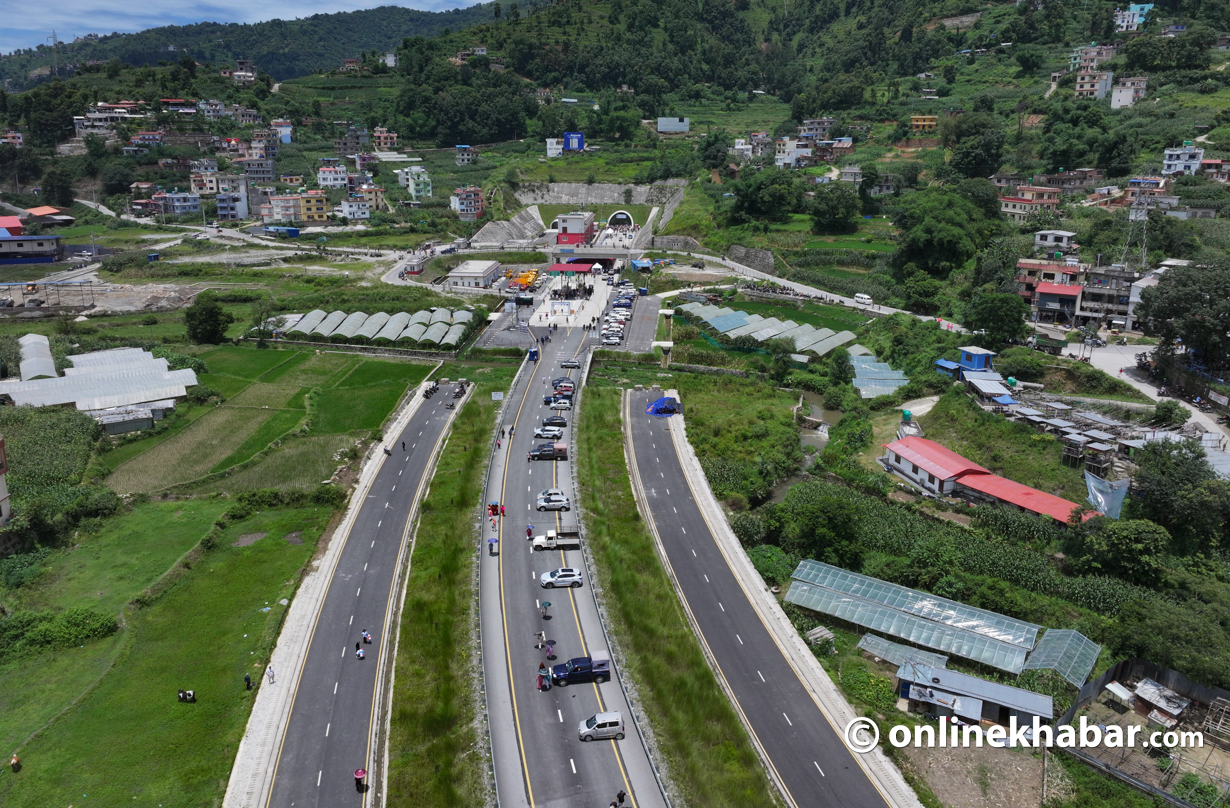
To connect the tunnel with Tribhuvan Rajpath, a 2.87-kilometer access road was constructed. A 610-meter long flyover was built near Balambu Chowk.
The study for this project took place in 2014, and Japanese contractor Hazama-Ando JV completed the construction in 2017. Tunnel Boring Machines were used, and the tunnel was constructed without explosives.
Before the tunnel’s opening, travelers coming from Naubise to Kathmandu faced hours of traffic jams due to minor road blockages; with the tunnel operational, travel time is expected to be reduced by 4-5 minutes.
Motorcycles and vehicles carrying flammable materials are prohibited from entering the tunnel. Other vehicles can enter Kathmandu via the Dhading Sisnekhola route through the tunnel.
Some vehicle restrictions are in place for safety reasons. State-of-the-art rescue equipment and fire trucks are stationed within the tunnel. Continuous CCTV surveillance will be maintained 24/7.
Marking a 25-Year Journey
At Nepal’s request, JICA conducted a feasibility study on Kathmandu-Naubise road widening in 2001. Since a four-lane road was deemed unfeasible, an alternative road tunnel was suggested.
In 2012, the government led by then-Prime Minister Jhalnath Khanal decided to construct a tunnel at Nagdhunga with budget allocations. The preliminary study report was finalized in 2013, and work to build the tunnel advanced.
In 2016, during Japanese Foreign Minister Nobuo Kishi’s visit to Nepal, Japan pledged concessional loan support for the tunnel project. A loan agreement was signed between Nepal and Japan on December 16, 2016.
The entire project, including the tunnel and access roads, cost approximately NPR 2.2 billion, although expenses and timelines extended due to land acquisition, the COVID-19 pandemic, and local obstacles.
Operating rights have been granted to Yushin ART JV Company for five years, and the tunnel’s design life is set at 30 years.
Vehicle Entry Fees
Vehicles using the Nagdhunga tunnel are required to pay toll fees. The rates were fixed on September 11, 2025, and officially published in the government gazette.
Cars, vans, pickups, tractors, microbuses, and other light vehicles must pay NPR 65 entering Kathmandu and NPR 60 when leaving. Minibuses and mini-trippers/trucks are charged NPR 115 entering and NPR 80 exiting.
Buses and single rear axle trucks pay NPR 260 on entry and NPR 200 on exit. Multi-axle trucks and heavy equipment are charged NPR 600 entering and NPR 250 when exiting.
Toll collection will be managed by the Road Board Nepal using Radio Frequency Identification (RFID)-based ‘N-Tag’ technology for automatic toll deduction.
Other Tunnel Projects in Progress
Two major tunnel projects in Nepal are the Nagdhunga and Siddhababa tunnels. Nagdhunga tunnel is now operational, while Siddhababa is in its final construction phase.
The Gwarko-Satdobato flyover is also operational. Additionally, various tunnels such as Dharan-Leuti, Dumkibas-Bardghat, Hemja-Nayapul, Majhimtar-Shaktikhor are in study or construction phases.
According to the Ministry of Infrastructure, other tunnel projects include Chorepatan-Gudikhola, Baglung-Narethanti, Kushepatna-Imichla, Sunmai Rajdubol, Besishar-Nalum, Jajarkot-Byaulidunga-Topla, and Tokha-Chhahare at various stages.