

Exploitation of Kaligandaki River Continues, Threatening Riverine Civilization
News Summary
Reviewed.
- Over the past five decades, selfish groups have exploited the Kaligandaki River, altering its natural condition.
- Baglung Municipality has issued contracts for extracting riverine materials contrary to standards, increasing exploitation.
- The District Coordination Committee has intensified monitoring to halt exploitation and has warned of legal action.
March 16, Baglung – For the past fifty years, selfish groups have been operating crusher industries along the Kaligandaki River. The extraction of stones, gravel, sand, and cobbles through contract allotments has led to serious exploitation putting the river’s existence and surrounding civilization at risk.
Exploitation of the Kaligandaki River is on the rise. The entire river has effectively been seized by a few individuals driven by vested interests. Local authorities have also contributed to the increase by awarding contracts arbitrarily. Conservationists express deep concern as the sacred Kaligandaki’s natural form is increasingly distorted.
Baglung Municipality has granted contracts for extraction of river materials in violation of environmental impact assessment standards, leading to unregulated removal of stones, gravel, and sand from the riverbed.
During the rainy season, unauthorized exploitation occurs at midnight, and in winter, the river’s course itself is diverted to extract stones and sand in contravention of established norms. For example, at Kalakhola gravel area, Ward No. 13, the river has been redirected toward the mountains for material extraction.
The excessive extraction of stones, boulders, gravel, and sand has severely damaged the Kaligandaki River. Illegal digging, dumping of sewage and waste, encroachment of public land, deforestation, and sand smuggling have increased annually.
Despite awarding contracts for areas such as Kalakhola gravel, Bhatekhola, and Galuwa streams, the municipality’s arbitrary management has been cited as a cause for the ongoing crisis by concerned stakeholders.
Alongside river exploitation, areas within the Kaligandaki Corridor including Parbat, Baglung, and Myagdi districts — encompassing gullies, forests, pastures, sacred sites, and public school areas — have also become victims. Hills and mountains are being deformed everywhere.
Most crusher industries are co-owned by district leaders, municipal officials, and businessmen. For more than four decades, flood, erosion, and exploitation problems have persisted in the river’s riparian zone.
During winter when the river narrows at Baglung’s Galuwa (Ward 10) and Kalakhola gravel (Ward 13), the river’s course is reversed for extraction purposes.
Though the municipality issues contracts for winter extraction, unsanctioned practices against standards lead to intensified monitoring efforts.
Ignoring laws, environmental assessments, and proper procedures, reckless exploitation of Kaligandaki is putting local settlements and the environmental cycle in peril.
This exploitation causes soil erosion, floods, landslides, and damages riverside communities in both Baglung and Parbat districts.
Conservationist R.K. Adipta Giri explained that mafias have effectively occupied the river. “Excessive extraction of natural resources like stones, boulders, gravel, and sand is destroying the Kaligandaki River. The sustainability of the river has been reduced by two-thirds. This is a crime against our heritage and civilization,” Giri said.
He added that the regulatory agencies are aware yet silent despite rampant, unregulated exploitation violating standards.
“It’s an ongoing cat-and-mouse game. The Kaligandaki River is in grave danger due to personal interests and profit motives,” he stated. “Rivers and streams are vital foundations of our civilization and life. It is crucial to establish a dozer-free Kaligandaki.”
Giri warned that the extraction and trade of non-renewable natural resources by nature is illegal. Without public awareness and sincere efforts in conservation, the situation could worsen. “To save Kaligandaki from existential threat, a citizen’s campaign must become a collective movement. Those destroying heritage and civilization must face stringent punishments and criminal proceedings.”
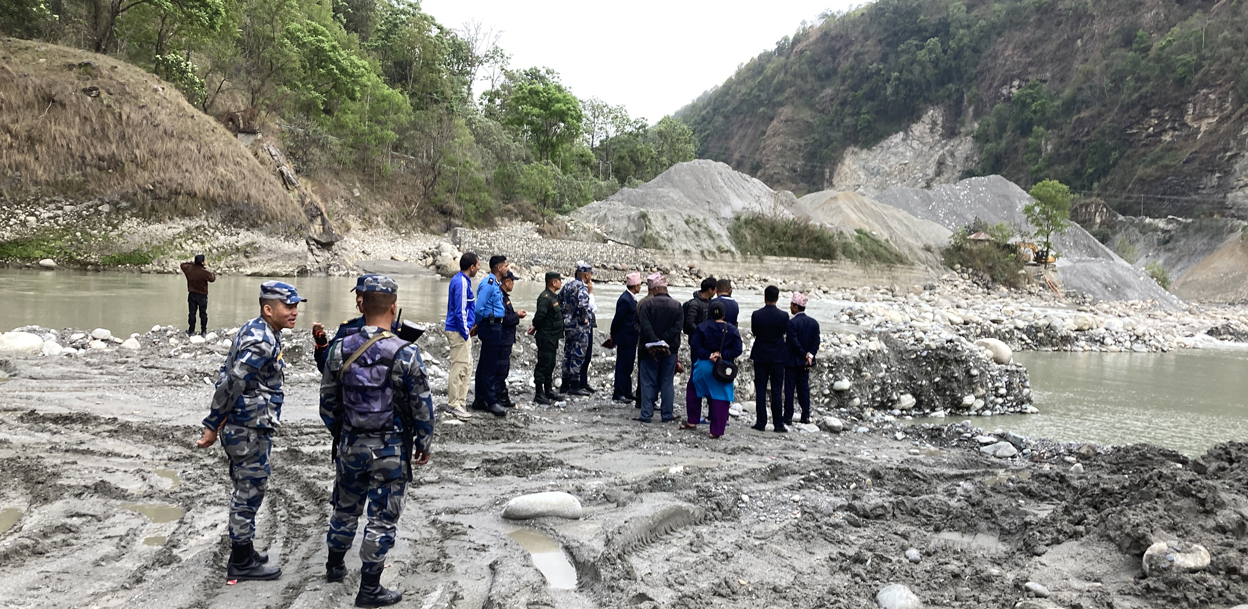
Monitoring reports indicate that at Kalakhola gravel, over 250 meters in length, 50 meters in width, and 7 meters deep extraction of river material using heavy machinery has occurred, said District Coordination Committee Chief Amar Bahadur Thapa.
“If this exploitation continues, riverside communities may need to be relocated. Deep erosion caused by extraction is creating a landslide-like condition in cultivable land. Private lands along streams and rivers are facing erosion risk, turning them into gravel beds,” he added.
More than 40 licensed and unlicensed crusher industries operate in Parbat, Baglung, and Myagdi districts, with over 100 enterprises active. Unregistered crushers undertake extraction, processing, and crushing of river materials without official records at the Inland Revenue Office.
Chief Thapa noted that due to use of fully mechanized equipment rather than manual labor, the river’s structure has dramatically changed. “Stopping exploitation requires coordination among all stakeholders. Although the municipality collects revenue, violations of standards in extraction have been observed.”
He issued a warning: “If exploitation is not halted, legal action will follow. Joint monitoring by the Chief District Officer, police, and the municipality will enforce restrictions. Exceeding permitted extraction will result in penalties.”
Extraction-related impacts have begun to damage tourist sites, community platforms, suspension bridges, and pilgrimage centers. Silence on these issues is no longer acceptable.
On Sunday evening, officials including District Coordination Committee Chief Thapa, Chief District Officer Krishna Prasad Acharya, Baglung Municipality Deputy Mayor Raju Khadka, and security personnel conducted monitoring and surveying of three gravel areas within the municipality.
The heaviest exploitation has taken place at Kalakhola and Galuwa. Environmental Impact Assessment (IEE) has allowed Baglung Municipality to authorize extraction of 300,000 cubic feet of river material with a maximum depth of 2 meters. However, monitoring shows illegal extraction reaching depths of up to 8 meters, said Chief District Officer Krishna Prasad Acharya.
“Previously, extraction occurred even where no contract was issued. Now, despite contracts, unauthorized exploitation persists. To prevent river crisis, stopping and regulating extraction within standards is vital,” he stated. “Extraction continues even from places without contracts. For protecting Kaligandaki, the districts of Baglung, Myagdi, and Parbat must unite.”
The monitoring committee concluded that technical studies and detailed public disclosure are required, along with penalizing violators and auctioning irregularly extracted materials. Officials noted this is the first technical survey combined with depth measurement conducted directly in the river.
District Coordination Officer Krishnaraj Gautam added that spatial maps of exploited areas and technical details of collected materials will be compared with the IEE report to develop policies to prevent further exploitation.
Permits for extraction in Kalakhola were granted to Pratik Nirman Sewa and in Maldhunga to Vidhi Nirman Sewa by the municipality.
window.fbAsyncInit = function () {
FB.init({
appId: ‘280041239029772’,
xfbml: true,
version: ‘v2.7’
});
};
(function (d, s, id) {
var js, fjs = d.getElementsByTagName(s)[0];
if (d.getElementById(id)) {
return;
}
js = d.createElement(s);
js.id = id;
js.src = “https://connect.facebook.net/en_US/sdk.js”;
fjs.parentNode.insertBefore(js, fjs);
}(document, ‘script’, ‘facebook-jssdk’));