Rising Patient Crowds Worsen Service Chaos at Bir Hospital OPD
News Summary
- Following a two-day closure, Monday saw an overwhelming surge of patients at Bir Hospital OPD, resulting in long lines just to obtain tickets.
- Doctors warn that the closure has disrupted patient treatment and increased the risk of delays in surgical procedures.
- Healthcare workers not receiving staggered days off has contributed to the disorganized service system according to medical professionals.
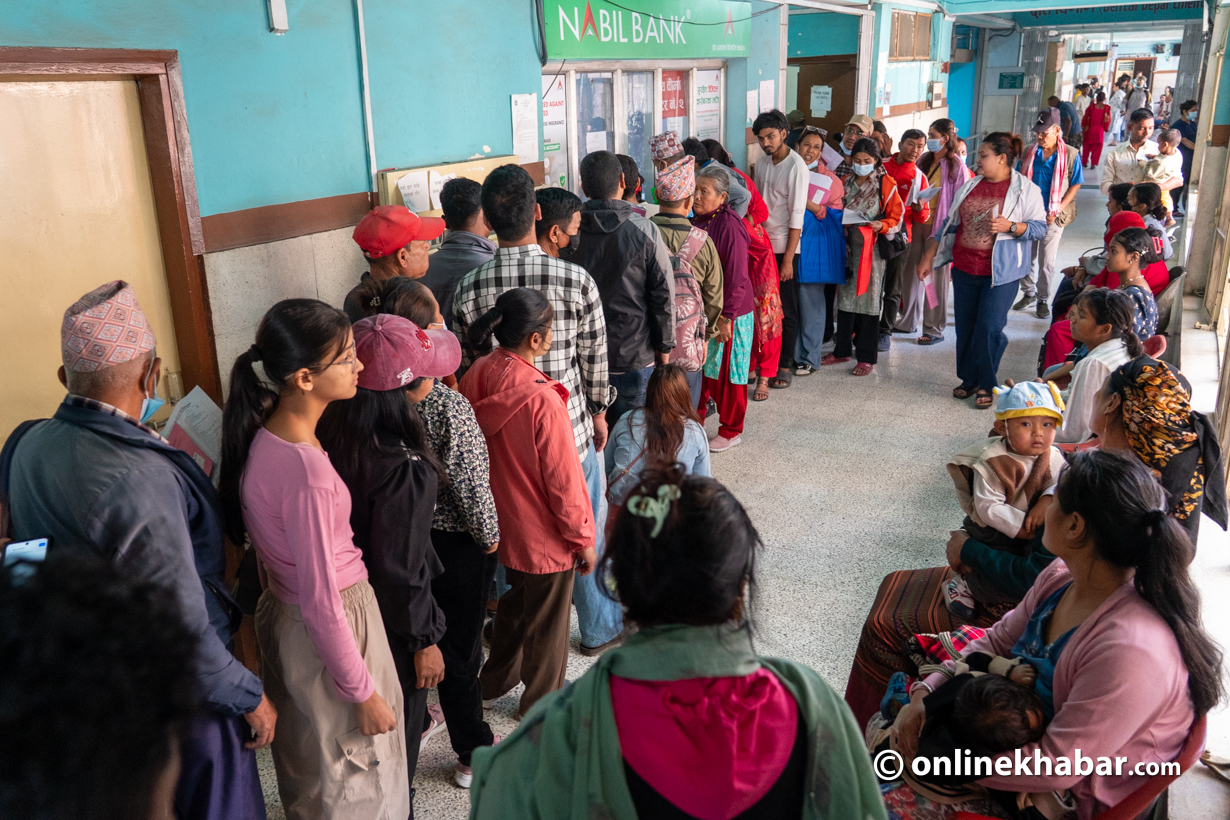
April 21, Kathmandu – Even before 6 a.m., crowds gathered around the main entrance of Bir Hospital. Many patients arrived clutching old prescriptions, while others carried medical reports. Patient relatives steadily advanced through lines, supporting those seeking care.
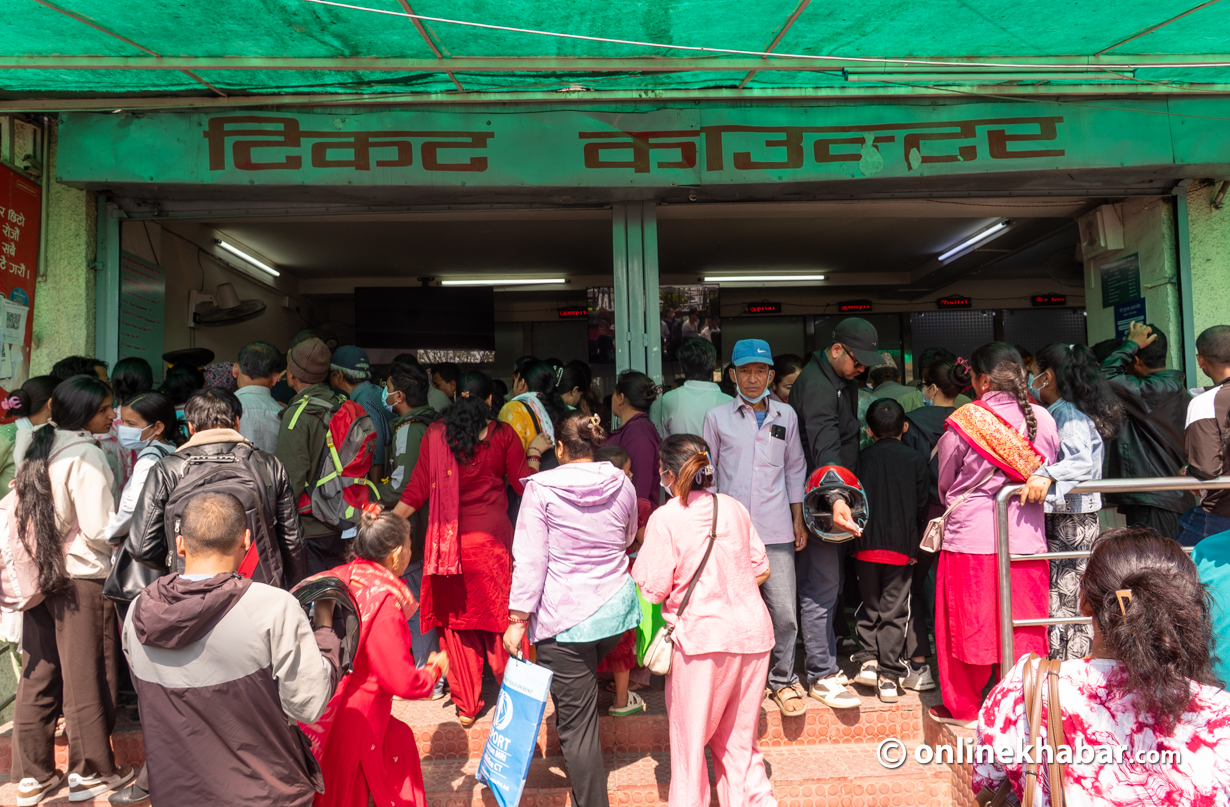
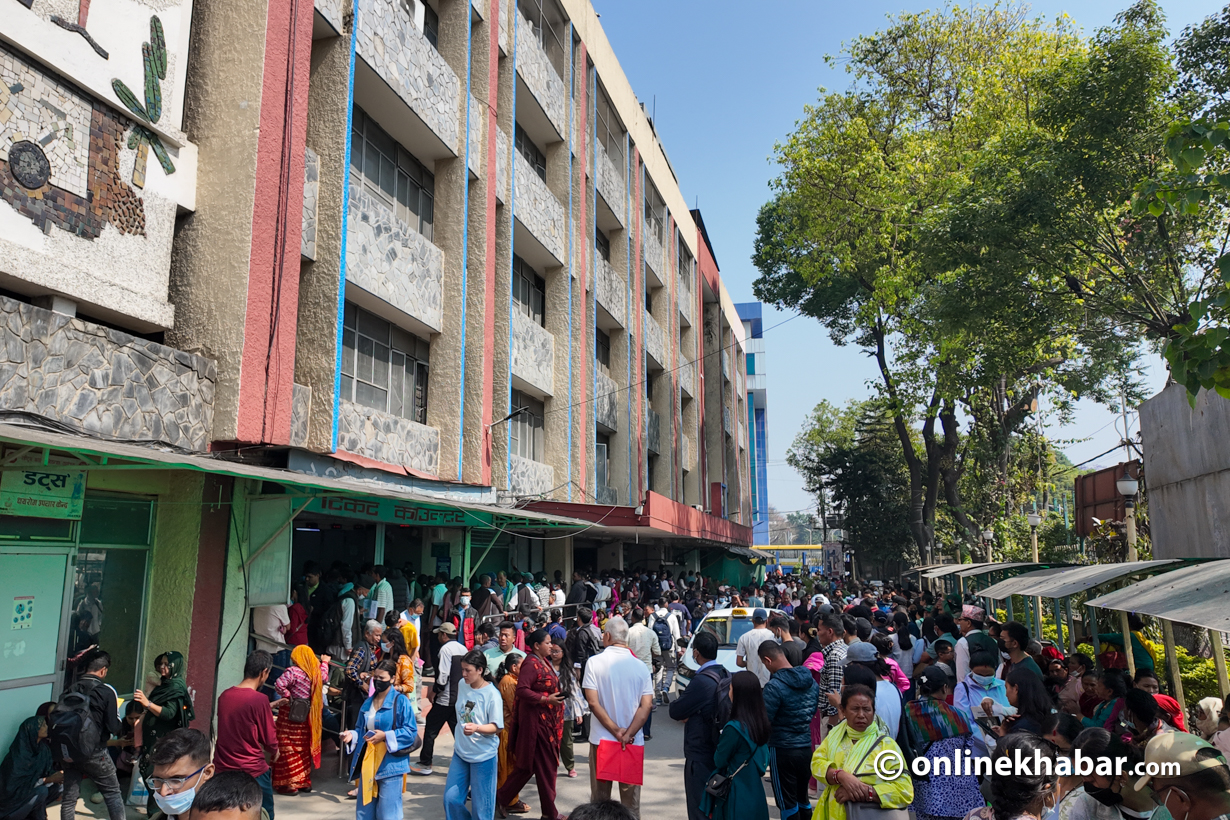
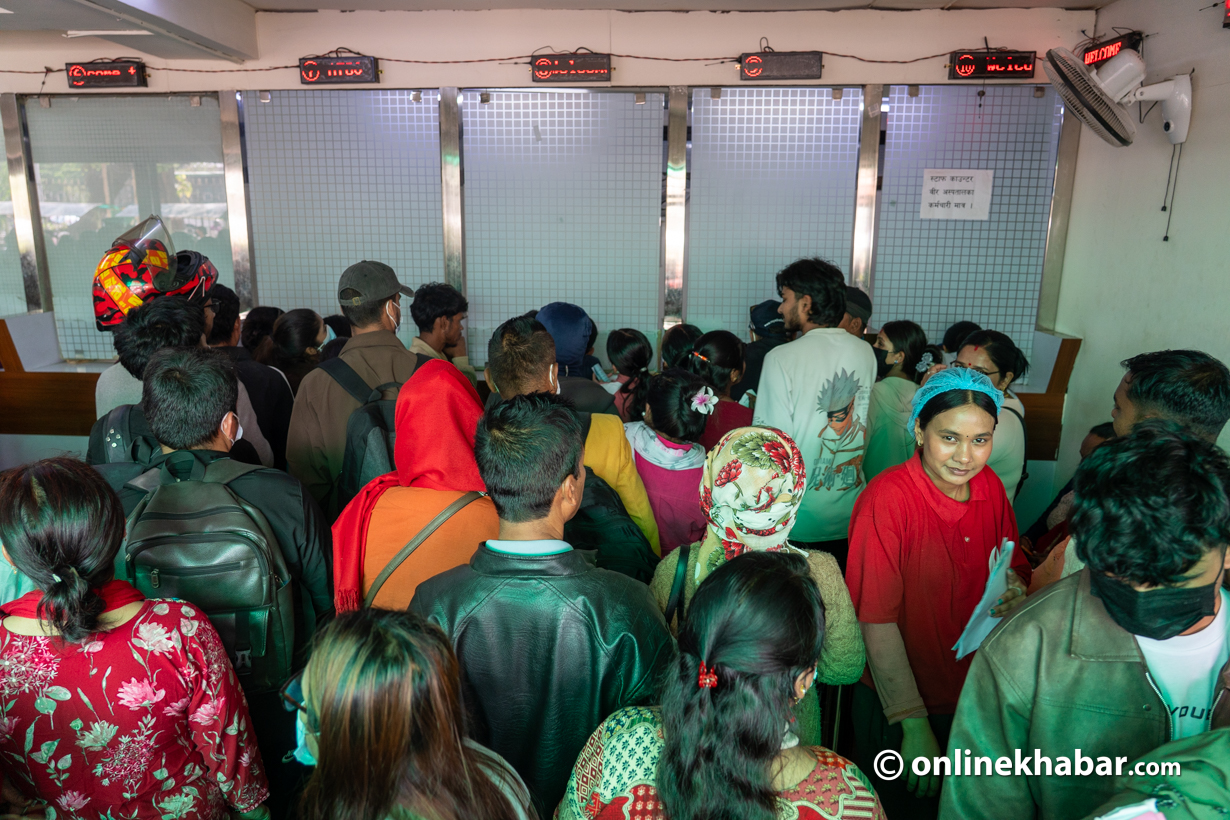
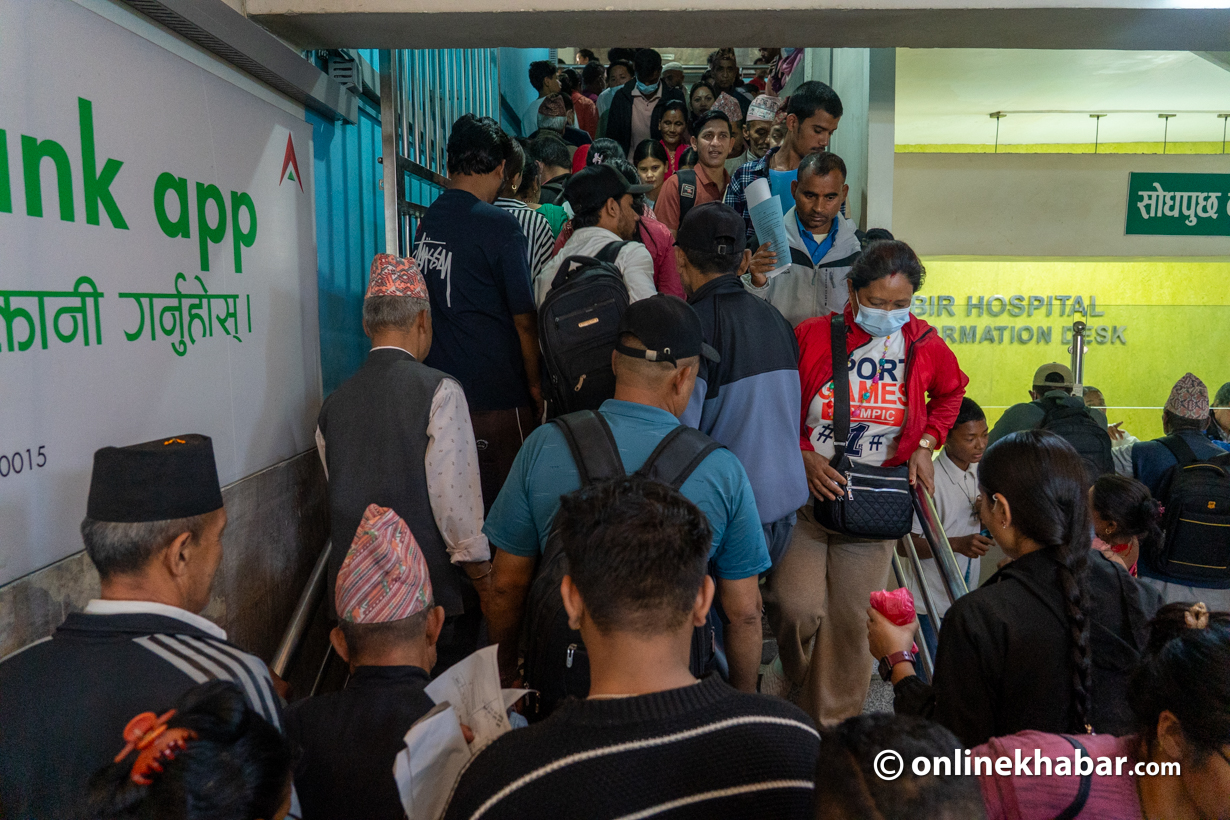
Everyone was united by a single goal – to reach the OPD ticket counter. The area near the ticket booths was heavily congested, with long queues stretching throughout the hospital premises.
This scene followed a two-day closure of the hospital on Saturday and Sunday, resulting in an overwhelming influx of patients on Monday.
The hospital closure led to a backlog of patients requiring treatment all at once. Lines had already grown long before ticket counters opened, with many arriving early in the morning.
Pramod Mukhiya, 37, who traveled from Janakpur, showed his old medical file and said, “My body aches, and I feel like I might faint. The hospital was closed on Sunday, so I could not get treatment. Now I have to wait for hours again today.”
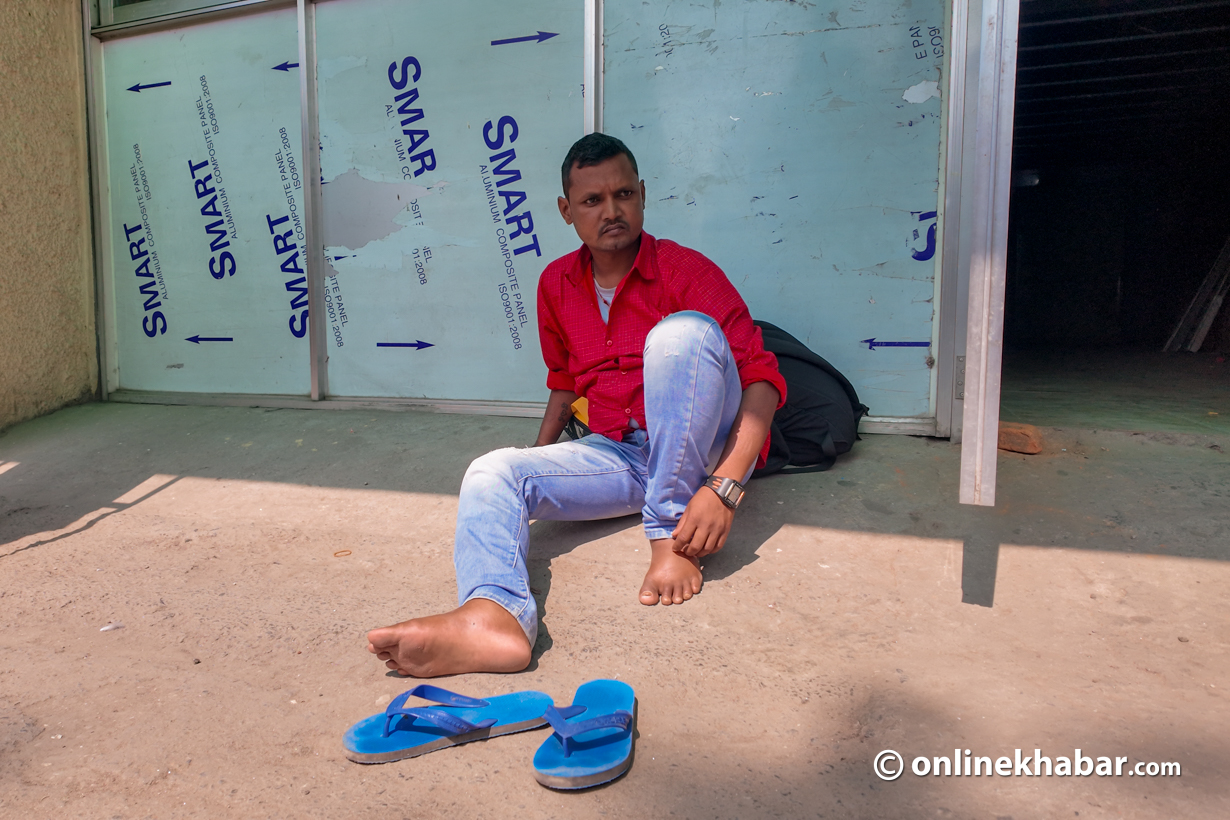
Pramod’s hands and feet were numb as he sat on the ground, speaking softly. He was accompanied by his elder brother Surendra Kumar Mukhiya and his wife.
He developed sudden health problems three weeks ago, including vomiting blood and numbness. He received initial treatment at a private hospital in Janakpur, where doctors identified liver issues and advised further treatment in Kathmandu. As a farmer and laborer, the medical expenses totaling 120,000 NPR were a significant burden.
With loans from relatives and villagers, Pramod arrived in Kathmandu on Thursday night.
On Friday, he visited the emergency department at Tribhuvan University Teaching Hospital but was denied admission as a general patient. Without connections, he stayed at a hotel near Gaushala.
All hospitals ceased operations on Saturday. On Sunday morning, he took a vehicle from Ratnapark to Bir Hospital, only to find the OPD ticket counter closed. A security guard told him, “The OPD is closed today, please come tomorrow.”
Confused, Surendra accompanied Pramod to the emergency ward, but he was not accepted.
With no other options, Pramod went to a private hospital. On Sunday afternoon at Kathmandu Medical College, his various tests and medicines cost over 20,000 NPR. Doctors advised additional liver tests at Bir Hospital and Teaching Hospital.
Waiting in line at Bir Hospital OPD on Monday, Surendra expressed frustration, “We arrived at 7 a.m., but only after 795 patients will we get tickets. There was no service like this on Sunday.”
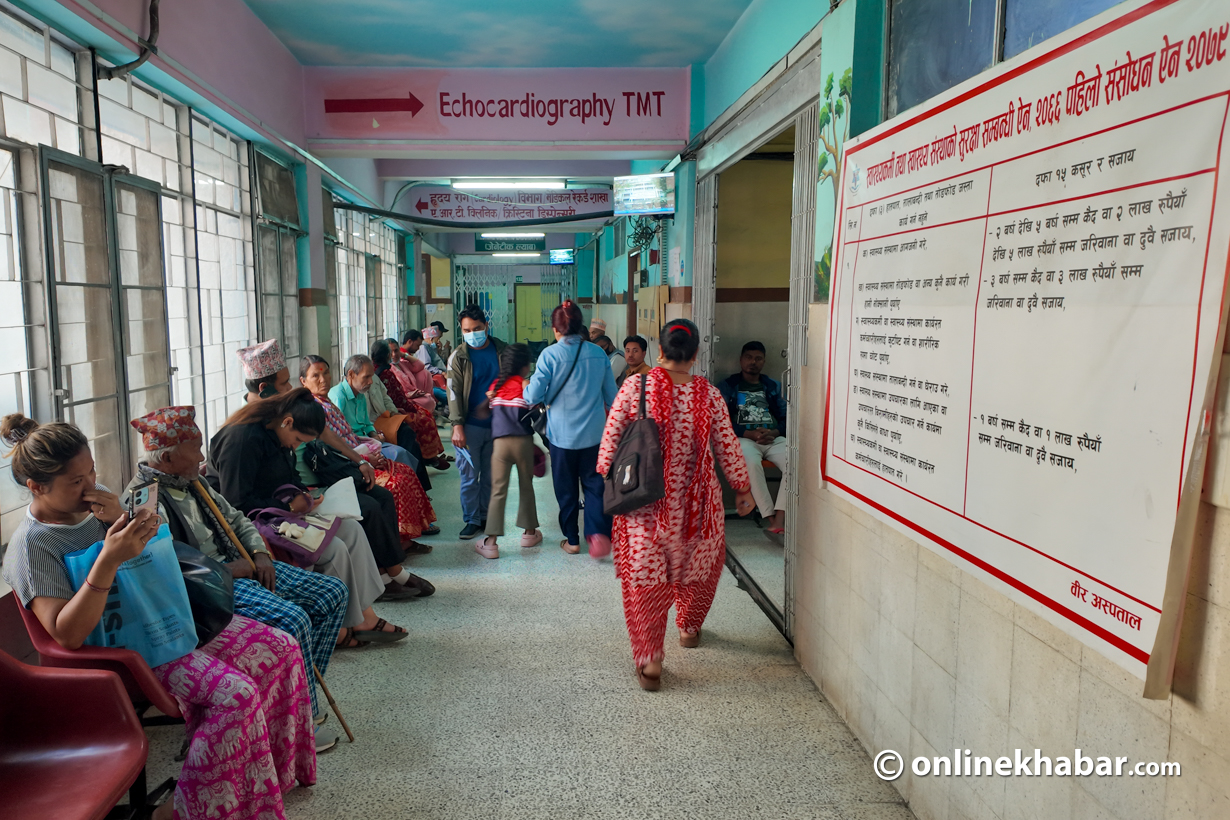
Inside the OPD, confusion reigned. One line was for tickets, another for testing, and yet another for doctor consultations. Some patients sat on the floor, while the elderly and children stood due to a lack of seating; relatives took turns standing in long queues.
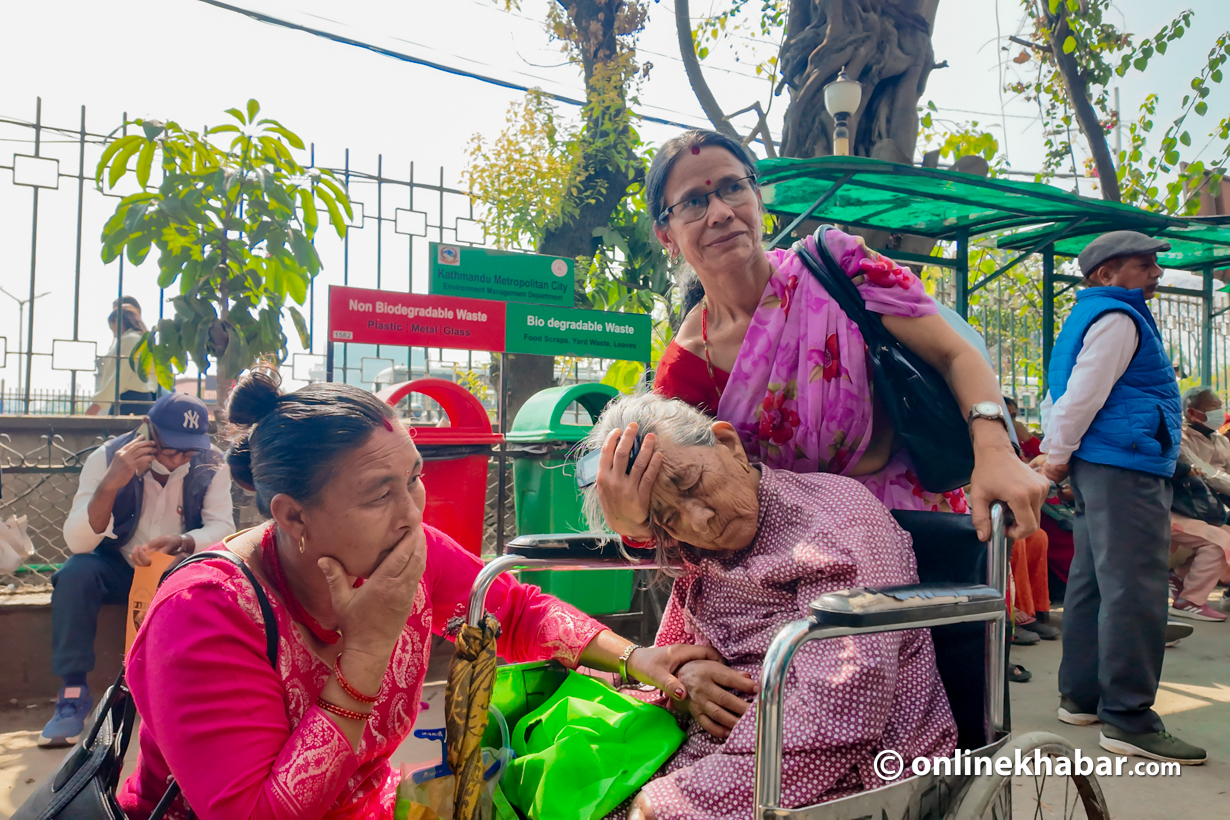
Meanwhile, an elderly woman in a wheelchair was seen being assisted by two women in the hospital courtyard. The 80-year-old suffered from hypertension.
These elderly visitors came again from Sattungal on Sunday but could not see a doctor and returned disappointed. “We came yesterday for a follow-up, but the doctor was unavailable. I am here again because my mother’s condition worsened,” said the caretaker.
Bir Hospital is one of the oldest government hospitals in the country and attracts large numbers of patients from outside the capital. For many poor and marginalized individuals, it serves as a vital hub of affordable, accessible care.
Many patients standing in line expressed a common grievance, “Even when we are ill, we must wait for hours. Will we even get to see a doctor today?”
Krishna Prasad Tiwari from Gorkha said, “We arrived early this morning, but the crowd means we may have to stay in the hospital for two or three days to receive care.”
Tiwari suggested that the hospital operate seven days a week with additional staff to cope with demand.
Patient admissions have also increased alongside the OPD crowd following the two-day closure decision. This has elevated the risk of surgical delays.
Tiwari explained the lengthy wait times throughout hospital departments. “We have to wait hours to see a doctor, and similar congestion exists at laboratories. Hospital management is sluggish, and the two-day closure has worsened the situation.”
Eighteen-year-old Bhesma Khatri, who had appendix surgery last November, came early with old medical files for recurring health issues. “I came yesterday but couldn’t see a doctor and left. The two-day closure has caused me more pain,” she said.
Bir Hospital handles over 3,000 patients daily and represents a beacon of hope for the impoverished. However, patients from remote and hard-to-reach areas often face persistent hardships accessing care.
The hospital has more than 28 departments, with crowds equally dense throughout labs and pharmacies.
Some patients wait in line at ticket counters, others at cash counters, and many stand in queues to see doctors. Basic seating is inadequate for general patients waiting outside the OPD.
The chaotic congestion makes swift service delivery difficult, resulting in widespread dissatisfaction among service users.
Rupn Prasad Patel from Rautahat complained that despite arriving by 7 a.m., he did not get a chance to discuss his problems with a doctor by midday. “You have to queue everywhere. Ordinary people are left confused about where to seek services. Hospital management is weak.”
Patel, who has kidney issues, was accompanied by relative Bires Kumar Chourasiya. Chourasiya said the two-day closure worsened the patient’s condition. “Since Friday, he hasn’t been able to see a doctor and is suffering. The government closure decision has created major difficulties for citizens seeking treatment.”
While the break provided rest for healthcare workers, it posed significant challenges for patients.
Overall, the two-day closure at Bir Hospital has exacerbated the suffering of patients.
Doctors Warn: Healthcare Services Growing More Chaotic
Doctors report a marked increase in patient loads at Bir Hospital following the government’s policy to close services two days per week.
One physician noted that closing the OPD for two consecutive days disrupts treatment for both patients and staff.
“When services are closed on Saturdays and Sundays, the Monday crowd becomes overwhelming, forcing patients from districts to stay in Kathmandu, increasing their hardship,” said the doctor.
Previously scheduled surgeries have also been affected. Patients who booked appointments for Sundays now face uncertainty due to the closure.
Hospital schedules have been disrupted by these closures, causing further complications according to medical staff.
Doctors emphasize that it is impractical to shut down major hospitals like Bir, Teaching, or Civil for two consecutive days and advocate for continuous seven-day operation.
They suggest staggered staff holidays so services can continue uninterrupted six days per week. This approach would maintain OPD, surgery, and other services regularly and reduce long patient lines.
Another physician explained that the two-day closure has increased both outpatient visits and hospital admissions, potentially lengthening surgery waitlists.
“I used to see around 60 patients; now I have to attend to more than 80 daily. Surgery wait times are lengthening across all departments,” the doctor noted.
They also remarked that shorter patient consultation times have become common due to the heavy patient volume. “Previously, doctors spent four to five minutes per patient; now even two minutes is difficult.”
Doctors report that continuous work causes mental stress among healthcare workers, necessitating leaves. However, without effective organizational planning, both patients and staff suffer.
Statistics from Bir Hospital indicate that on regular days, around 2,700 OPD tickets are issued monthly, but on the recent Monday, over 3,400 tickets were sold.
The Ministry of Health’s decision to close public hospitals two days a week lacks a clear plan for managing large hospitals’ service delivery, leading to uncertainty.
“Employees should have equal benefits, but when the hospital closes for two days, distant patients and those scheduled for surgery face difficult problems,” stated another Bir Hospital physician. “If continuous closure is unavoidable, the government should provide incentive bonuses for staff working on off days.”
They explained that with this system, OPD, surgeries, and other services would remain regular, preventing patients from facing long wait times.
The inability to allocate adequate time per patient due to crowding remains a significant issue.
Doctors mentioned that ongoing work pressures contribute to staff mental stress and the need for leaves, but lack of management causes problems for both patients and staff.