What Does the Government’s Administrative Reform Plan Include Regarding Bahuns?
News Summary
Technically prepared and editorially reviewed.
- Prime Minister Walendra Shah has instructed security agencies to remove individuals residing in areas occupied by Bahuns.
- The government plans to complete an integrated digital asset survey within 60 days for landless people, Bahuns, and those living in informal settlements.
- The Rastriya Swatantra Party (RSP) has committed to establishing a high-level National Land Rights Authority to address issues related to Bahuns.
April 23, Kathmandu – The issue concerning Bahuns has resurfaced following Prime Minister Walendra Shah’s directive to security agencies to clear areas occupied by Bahuns. During a meeting with heads of security agencies on Wednesday, Prime Minister Shah ordered the removal of Bahuns from those regions.
Specifically, none of the 100 points in the government’s administrative reform agenda includes a policy to evict landless individuals, Bahuns, or those living in informal settlements. Instead, point 90 of the reform agenda commits to conducting an integrated survey of landless people, Bahuns, and residents of informal settlements. The government aims to complete a nationwide integrated digital survey and verification of these groups within 60 days.
The Shah-led government has set a goal to resolve issues related to landlessness, Bahuns, and unplanned settlements within 1,000 days. During this period, the government plans to collaborate with local bodies to conduct household surveys and apply clear criteria to identify genuine beneficiaries. Additionally, preparations are underway to update records, measure public, government, and trust lands, and develop a GIS-based digital database.
What does the government’s administrative reform plan say about Bahuns?
The government has expressed a commitment to gradually provide land to genuine Bahuns. The reform plan includes developing integrated housing options for landless Bahuns and residents of unplanned settlements in urban areas. This also encompasses resettlement programs, with a pledge to ensure full transparency in land distribution and rehabilitation processes.
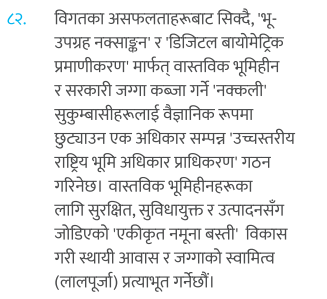
Before the election, the Rastriya Swatantra Party (RSP) committed to establishing a high-level land rights authority to address Bahun-related issues. The RSP promised that this “high-level National Land Rights Authority” would differentiate genuine Bahuns from fraudulent claimants using satellite land mapping and digital biometric authentication. Their manifesto states, “Learning from past failures, the high-level National Land Rights Authority will scientifically distinguish genuine landless individuals from fake Bahuns grabbing government land through satellite mapping and digital biometric verification. Under this initiative, a reliable, convenient, and production-linked integrated model settlement will be developed, guaranteeing permanent housing and land ownership (red book titles) for genuine landless people.”
Rastriya Swatantra Party’s Manifesto on Bahuns