
Why Is There No Dialogue Between Nepal and India?
Summary of the Report
Editorial review completed.
- Since 2015 (2072 BS), Nepal has sent diplomatic notes more than eight times to India and China asserting its sovereignty and territorial integrity over the areas of Lipulekh, Kalapani, and Limpiyadhura.
- India has largely ignored these notes, responding late or rejecting them, while China has maintained public silence.
- Recently, India claimed that the Lipulekh route has been in use since 1954, keeping the door for dialogue open, and Nepal emphasized the need to keep diplomatic talks alive.
Kathmandu, May 5 – In 2015, during Indian Prime Minister Narendra Modi’s visit to China, an agreement was made to open a trade route through the Lipulekh Pass. Nepal considered this an unauthorized agreement over its territory.
The then government led by Prime Minister Sushil Koirala sent diplomatic notes to both India and China, but India did not provide any written response and China remained silent.
Four years later, in 2019, India included the Kalapani area in its new political map; Nepal again sent a diplomatic note. India took over three weeks to respond.
Experts interpreted India’s silence as a lack of seriousness about Nepal’s claims and an unwillingness to engage in border talks. India rejected Nepal’s claims calling them ‘unjustified’ and ‘inconsistent with historical facts.’
In 2020, when India inaugurated a 79 km road in Lipulekh, Nepal strongly protested and not only sent diplomatic notes but also formally included Limpiyadhura, Lipulekh, and Kalapani in its new political map.
Nepal’s move was assertive, yet India dismissed it as ‘artificial’ and ‘unilateral.’ India’s responses have ranged from ignoring, delayed replies, to outright rejection.
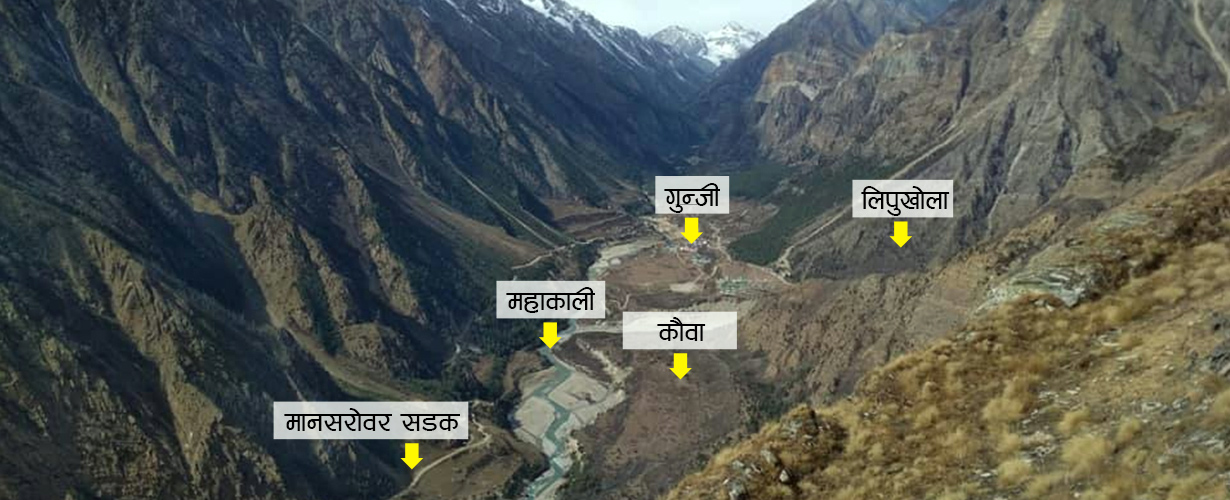
In July 2025, during Chinese Foreign Minister Wang Yi’s visit to India, an agreement was reached to resume border trade via the Lipulekh route without consulting Nepal.
Nepal subsequently sent separate diplomatic notes to India and China. India responded briefly, framing it as trade that had been ongoing for decades, thereby downplaying Nepal’s concerns. Meanwhile, China remained publicly silent.
On April 2, 2026, Nepal added to the series of diplomatic communications by issuing a six-point note to India and China after India announced Kailash Mansarovar pilgrimages via Lipulekh in June-August 2026.
This time, the Nepali government sent the note after wide consultation with opposition parties, signaling national consensus. India responded promptly with a ‘comprehensive’ reply.
Indian Foreign Ministry spokesperson Randhir Jaiswal claimed that the Lipulekh route has been in use since 1954 and rejected Nepal’s territorial claims as ‘unjustified’ and ‘lacking historical evidence.’ However, he indicated willingness to keep bilateral talks open. China again maintained its public silence.
000
These developments show Nepal’s repeated diplomatic efforts to assert sovereignty and territorial integrity, but most notes have been ignored, delayed, or rejected. India repeats its long-standing position, while China uses silence as a strategic tool.
Dinesh Bhattarai, a foreign affairs expert during Sushil Koirala’s premiership, recalls India’s silence on Nepal’s diplomatic notes then and appreciates the current government’s positive steps: ‘We received no reply to letters sent previously; now sending another note and maintaining the stance is positive.’
Former Ambassador Deepkumar Upadhyay emphasizes that neighbors have repeatedly neglected Nepal’s requests for dialogue. ‘The current government’s efforts are commendable; peaceful diplomatic initiatives should be the primary agenda.’
The immediate response from India to the latest note and keeping talks open is viewed positively. It indicates India’s reluctance to let the dispute freeze relations and an attempt to keep diplomatic communication alive.
Following India’s announcement about reopening Kailash Mansarovar pilgrimages via Lipulekh and Nathu La Pass, Nepal strongly asserted its geographical integrity.
On April 30, after India announced sending 20 groups for pilgrimage this year, the Nepalese Ministry of Foreign Affairs issued an official statement on Sunday to express serious concerns to both India and China.
While the previous election government remained silent, the current government has firmly reasserted its stance through diplomatic channels. When news surfaced in the last Chaitra (March-April) about India’s preparations to resume trade with China via Lipulekh, the previous administration did not respond.
After it became public that Indian Foreign Secretary Vikram Misri instructed the Uttarakhand Chief Secretary to prepare for trade, Nepal recalled its long-standing position on pilgrimage and trade issues.
Based on the 1816 Treaty of Sugauli between Nepal and British India, the Mahakali River’s eastern areas of Limpiyadhura, Lipulekh, and Kalapani are integral parts of Nepal. Nepal has already published official maps, but neighbors’ attempts to use the territory favorably have complicated the dispute.
Nepal’s sending of over eight diplomatic notes annually confirms its continuous diplomatic efforts. Although these notes have not brought immediate changes, they have documented Nepal’s position in the international community.
000
Though diplomatic notes have no immediate effect, they carry symbolic importance. Each note conveys a message of national unity and lays groundwork for future talks, though implementation remains uncertain due to weak follow-up.
Despite neighbors’ silence, diplomatic notes serve as a means for Nepal to maintain its stance. Former Ambassador and diplomat Nilamber Acharya notes that diplomatic notes open channels for negotiation, but so far no substantial talks have occurred. He urges continued diplomatic efforts and bilateral talks for resolution in the national interest.
Former Foreign Minister Pradeep Gyawali stresses that diplomatic notes should be seen not as damaging relations but as reflecting continuity and stability in foreign policy.
“National interests cannot be sacrificed in the name of improving relations. Not sending notes might raise suspicions of changing positions. Therefore, these should be viewed as a consistent policy,” he said.
Border expert Buddhi Narayan Shrestha welcomed the current government’s diplomatic note, saying, “This government appears better prepared and proactive.”
An Indian foreign ministry spokesperson asserts that the Lipulekh Pass has been in use since 1954, including for pedestrian travel.
Shrestha emphasized the importance of dialogue and diplomatic effort for resolving remaining border issues. He is optimistic about the government led by Mayor Balen Shah, stating, “This diplomatic note does not appear merely procedural as before.”
He added, “With a stronger government, there is evidence of groundwork and readiness. Diplomatic notes can have impact via public demonstrations and also through ‘silent channels.’ They can also help generate international pressure.”
Diplomat Jayaraj Acharya suggested using India’s response to Nepal’s diplomatic notes as an opportunity to advance diplomatic dialogue. “Since India had not been ready for talks since the release of the new map, its positive response this time is significant.”
He emphasized, “We should take this positively and seek opportunities for solutions through dialogue. Although India has maintained its stance, keeping the possibility of talks alive may be a key step toward resolving this border issue.”
000
The highest-level forum for discussing all issues between Nepal and India is the Nepal-India Joint Commission, established in 1987, co-chaired by the foreign ministers of both countries.
For border disputes, there exist specialized bodies like the Boundary Working Group and the Foreign Secretary-level mechanism for disputes such as Kalapani-Susta, but the Joint Commission provides policy guidance and acts as the main platform for seeking political consensus on contentious issues.
Former Foreign Minister Gyawali said India has somewhat neglected Nepal, urging that beyond correspondence, meetings of the Joint Commission should be convened to raise the border dispute issue.
He also stressed the importance of treating relations with China with equal significance: “China is equally important and should not be sidelined.”