
Labour Ministry Takes Firm Measures Against Outsourced Workers’ Exploitation, Issues Regulatory Correspondence
Summary of the Report
- The government has issued strict directives to Nepal Rastra Bank and labour supply companies to prevent labour exploitation of outsourced workers in accordance with the Labour Act.
- Following complaints of security guards in banks and financial institutions being denied minimum wage and benefits, the Labour Department has written to Nepal Rastra Bank to regulate the matter.
- The Supreme Court has issued directive orders addressing labour supply at lower bids under the Public Procurement Act, which violates the Labour Act.
May 15, Kathmandu – The government has taken a firm stand against the exploitation of workers outsourced through various agencies.
Official letters have been sent to Nepal Rastra Bank, labour supply companies, and related agencies, instructing them to safeguard workers’ rights in line with the Labour Act.
The Labour and Occupational Safety Department under the Ministry of Labour, Employment and Social Security has requested Nepal Rastra Bank to issue directions to banks and financial institutions, ensuring the protection of workers’ rights supplied through labour agencies.
Following findings of labour exploitation against security guards, cleaning staff, frontline workers, and office support staff working in banks and financial institutions, the department has appealed for control measures as per labour laws.
There has been a rise in complaints about labour exploitation against outsourced workers in banks and financial institutions reported recently to the government Help Desk, the Labour Ministry, and the Labour Department.
Department spokesperson Engineer Maninath Gopal reported receiving recurring complaints regarding non-payment of minimum wage and excessive workload. Due to the volume of grievances, a formal correspondence has been sent to Nepal Rastra Bank urging tighter regulation.
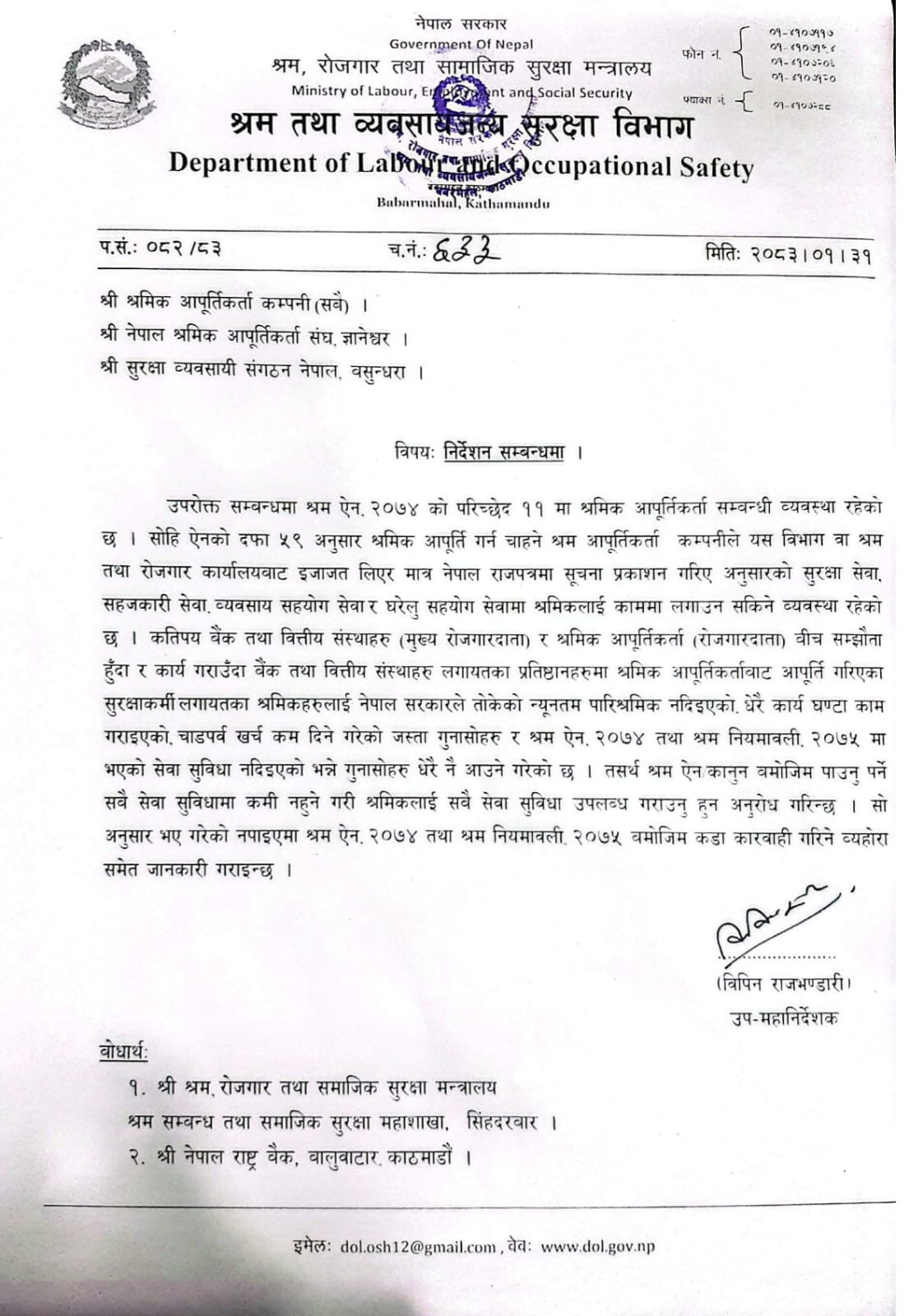
According to Section 59 of the Labour Act 2074, labour supply companies are permitted to employ workers under security services, facilitation services, business assistance services, and domestic help services.
However, numerous complaints have surfaced stating that banks and financial institutions (primary employers) and labour supply companies (employers) fail to pay security personnel and others the government-mandated minimum wage, and do not provide service benefits as required under the Labour Act 2074 and Labour Rules 2075.
The department disclosed it had previously sent a letter dated March 11, 2026, to Nepal Rastra Bank requesting enforcement of the Labour Act, but due to inadequate implementation, the ministry has now reiterated the request with strong directives.
Rule 56 of Labour Rules 2075 mandates establishments to conduct labour audits annually by the end of January. Sub-rule (4) stipulates that banks and financial institutions must submit labour audit reports to Nepal Rastra Bank.
The department has once again written to Nepal Rastra Bank, instructing it to strictly enforce these provisions among banks and financial institutions.
Additionally, all labour supply companies, the Nepal Labour Suppliers Association, and the Security Professionals’ Organizations Nepal have been directed to ensure provision of all rights and service benefits due to workers under the Labour Act and other applicable laws.
The department has issued a stern warning of action against entities failing to provide such services and benefits to workers.
Complaints alleging that security guards working in banks and financial institutions are paid below the minimum wage, forced to work excessive hours, given inadequate festival allowances, and denied labour benefits as per the Labour Act have prompted the department to issue strict instructions to labour suppliers, warning of penalties.
The Ministry of Labour, Employment and Social Security has intensified enforcement of labour rights due to recurring complaints of non-payment of minimum wages and overwork.
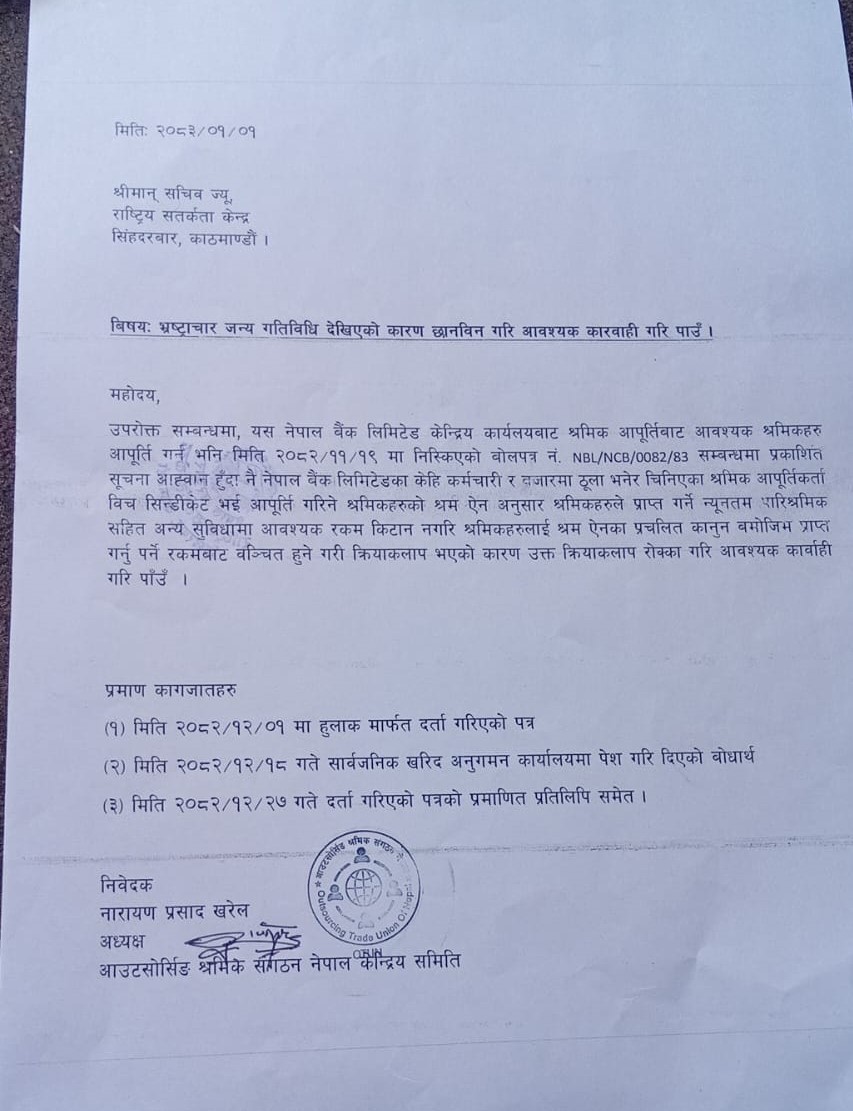
This move follows complaints filed at the Prime Minister’s Office and the government Help Desk. The Outsourcing Workers’ Organisation Nepal had submitted a petition to the Labour Department on December 9, 2025, demanding regulation and legal action against labour supply violations.
After prolonged inaction, Outsourcing Workers’ Organisation Chairperson Narayan Prasad Kharel took the matter to the Prime Minister’s Office, the government Help Desk, and the National Vigilance Centre in order to escalate the issue.
Due to lack of response at the department, pressure from these bodies was directed towards the Labour Ministry.
According to Chairperson Kharel, labour supply companies initially expected to comply with the Labour Act have begun underbidding contracts under the Public Procurement Act, which affects tender approvals adversely.
“Whereas the Labour Act requires certain conditions, supply companies are offering lower bids following the Public Procurement Act. We filed a complaint with the National Vigilance Centre against this tender approval irregularity,” said Kharel. “When our written petitions were not addressed promptly by the department, I, along with administrative officials, filed complaints at the National Vigilance Centre, which eventually led to action.”
The practice of assigning security guards and other outsourced workers according to the Public Procurement Act at lower costs instead of following the Labour Act has led to a writ petition lodged at the Supreme Court. On May 8, a directive order was issued in the government’s name addressing the issue.
Increasingly, labour offices are receiving complaints where a single labour supplier has allegedly exploited between 232 and 300 workers.
The Labour Department has set the minimum monthly wage for security guards at NPR 27,737, yet some employers continue paying only NPR 19,550.