
Development Budget Remains Steady Amid Resource Pressures, Focus on Routine Expenses and Debt Repayment
Summary
Reviewed and edited.
- Finance Minister Dr. Swarnim Wagle presented a budget of NPR 2,124.34 billion (Rs 21.24 trillion) for the fiscal year 2083/84 to the Federal Parliament.
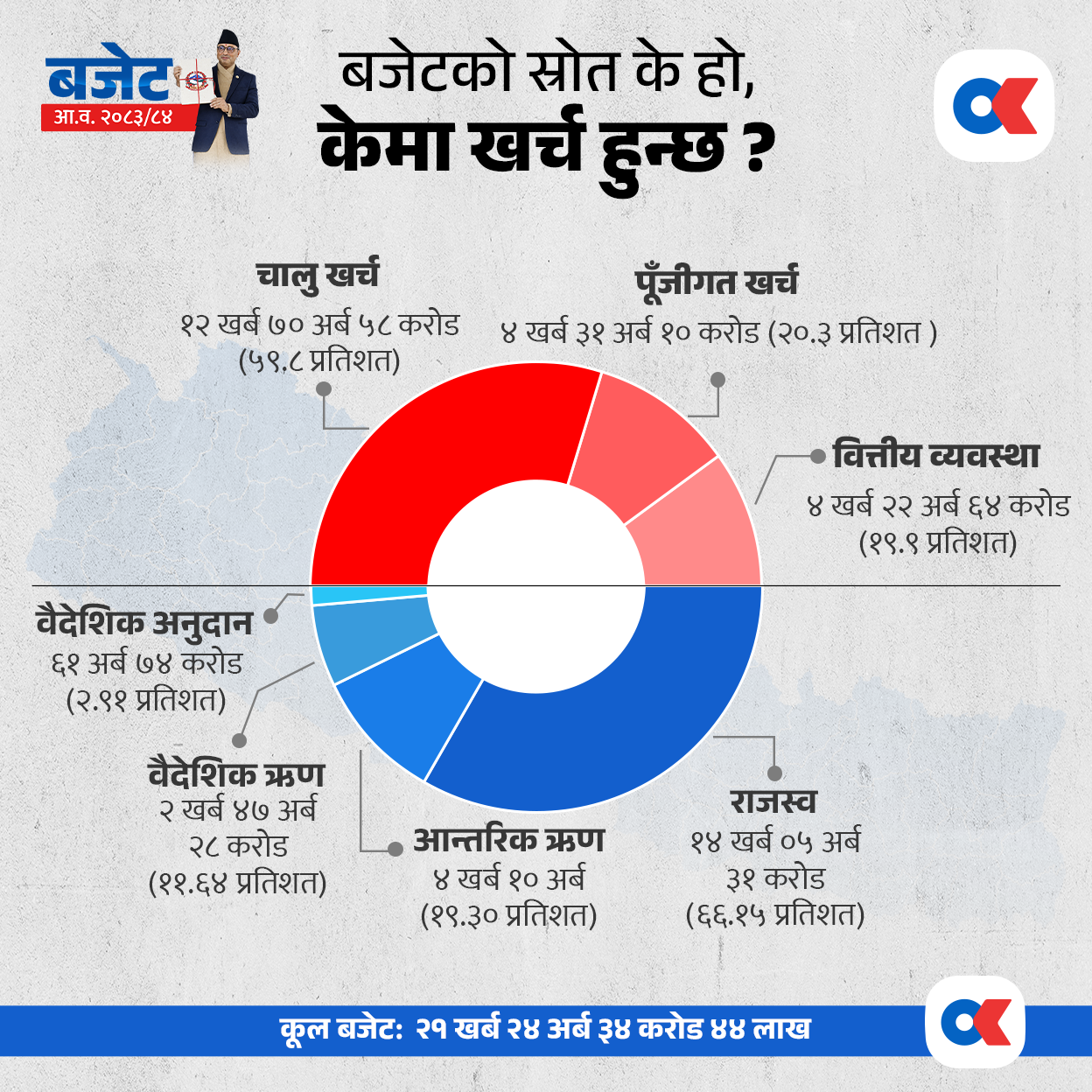
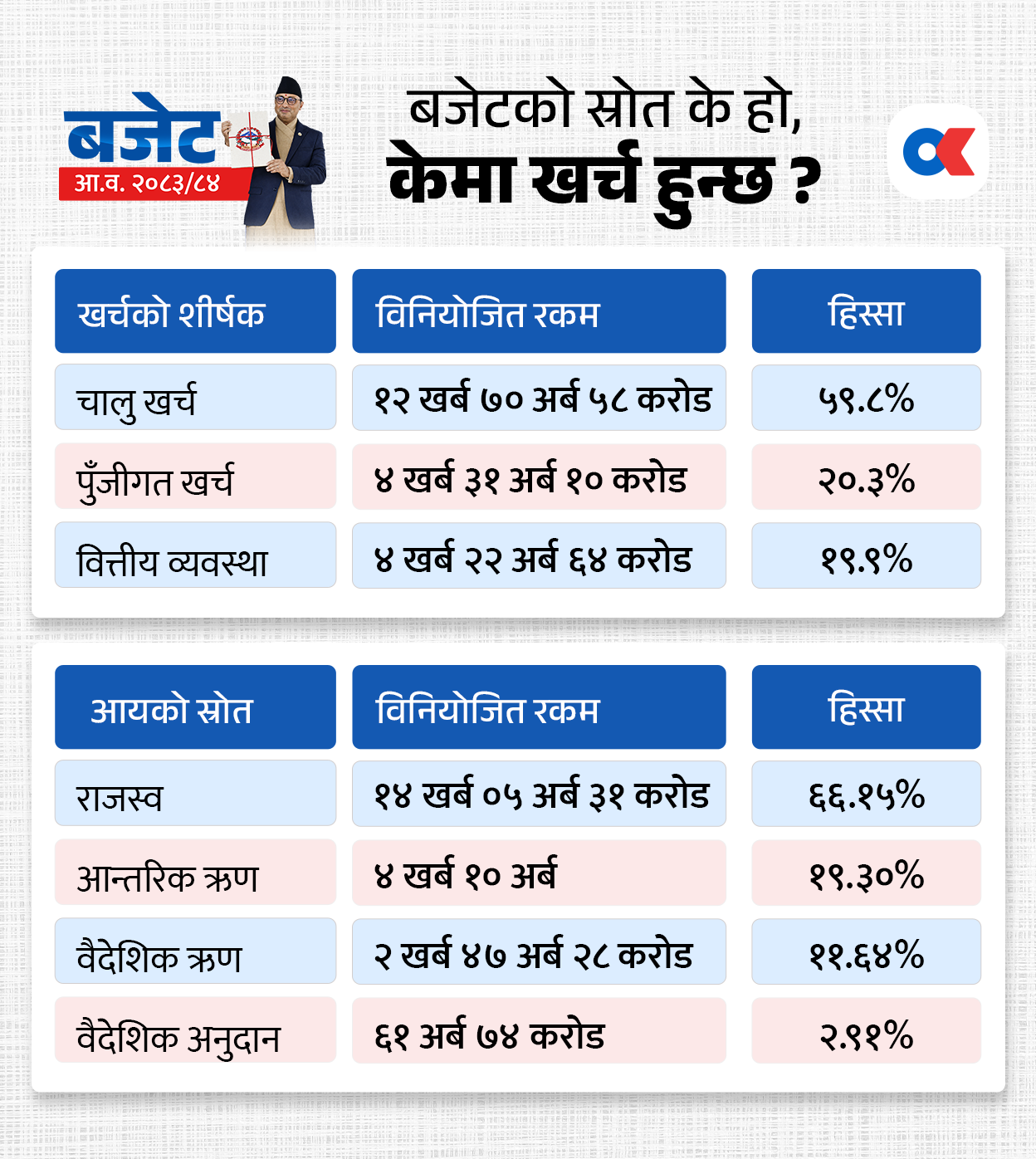
- The government allocated NPR 431.10 billion (Rs 4.31 trillion) for capital expenditure within the total budget for the upcoming fiscal year.
- The budget includes plans to abolish 31 unnecessary government agencies to reduce administrative expenses.
May 29, Kathmandu – The government has unveiled the budget for fiscal year 2083/84, maintaining a stable share of capital expenditure within the total budget amid various resource constraints.
Finance Minister Dr. Swarnim Wagle tabled a budget of NPR 2,124.34 billion before the joint session of the Federal Parliament.
This represents a 25.2% increase in budget size compared to the revised estimate of the current fiscal year 2082/83. However, despite the growth in overall budget size, the share allocated to capital expenditure did not increase.
For the next fiscal year, the government has earmarked NPR 431.10 billion, equivalent to 20.3% of the total budget, for capital expenditure.

In the current fiscal year, capital expenditure accounted for 20.8% of the budget. While the budget includes appealing reform programs, structural challenges remain evident.
This is largely because 79.7% of total resources must be directed toward routine expenses and debt servicing. Consequently, economists express understandable dissatisfaction with the budget brought forth by the Finance Minister.
Economist Prof. Dr. Resham Thapa pointed out that the trend of expanding the budget by borrowing internally is unsustainable in the long term.
According to him, government expenditures are generally non-productive. When the government taps internal loans competing with funds the private sector could employ, it does not benefit the economy.
Finance Minister Dr. Wagle has estimated current expenditures of NPR 1,270 billion (Rs 12.7 trillion) for the upcoming fiscal year, which is NPR 9 billion higher than this year’s allocation. Routine expenses account for 59.8% of the total budget this year.
The government has increased employee salaries and doubled some social allowances, though steps to reduce social security costs have not been significant.
Former Finance Minister Dr. Prakasharan Mahat expressed skepticism about the revenue and foreign loan targets being realistic. He acknowledged salary hikes as positive, but underlined challenges in resource management.
This year, the government has presented a budget with a deficit exceeding NPR 600 billion. Despite attractive programs and slogans overshadowing challenges, the former minister predicts implementation difficulties. He remarked, “It is hard to raise revenue, and although spending capacity needs improvement, it remains limited. Even with a two-thirds government, this might not be feasible.”
The government anticipates collecting only NPR 1,405 billion in revenue for the budget of NPR 2,124 billion. Foreign grants are estimated at NPR 6.17 billion, which surpasses the NPR 5.34 billion received in the current year.
The Finance Minister dismissed these targets as unrealistic amid criticism. The government aims to raise NPR 410 billion through internal borrowings and NPR 247 billion externally next fiscal year.
The National Planning Commission had proposed a ceiling of NPR 1,890 billion for next year. Economist and former Deputy Chairman of the Commission Dr. Prakash Shrestha emphasized the need for a realistic, implementable budget.
He noted that the new government has increased the budget size with a fresh mandate and policy platform. He believes that if this budget is executed effectively, its targets are achievable.
He cautioned, “Repeating the previous pattern of expanding budgets but failing to implement and then making cuts only during mid-term reviews will create problems.”
Optimistic Budget Focused on Reforms
The government has prioritized reforms in this budget. Former Finance Minister Rameshwar Khanal summarized the budget review stating, “Programs for reform are the hallmark of this budget.”
In line with its promise to expand the middle class, the government has removed the lower threshold for income tax, benefiting the majority of taxpayers. Experts view the employee salary increases as a positive step.
The government has reduced customs duties on industrial raw materials by at least one level, leading to reduced rates on 273 items. Additionally, excise duties on 360 items have been eliminated.
Taxes collected at customs points have been consolidated under a green tax system. Capital gains tax has been finalized and the process for automatic VAT refunds has been announced.
Emphasizing that tax compliance should be a partner in development rather than a punishment, the Finance Minister promised to resolve long-standing tax disputes caused by legal ambiguities and taxpayer ignorance.
The government plans to abolish unnecessary government organizational structures and streamline operations. This includes eliminating 31 agencies, six mergers, six transfers, and restructuring 18 entities.
Additionally, the government will pursue institutional reforms for cost reduction and efficiency improvements, encourage investment, and establish policy and legal frameworks for economic reforms and smooth service delivery. The Finance Minister is committed to accelerating and streamlining capital expenditures through these operational reforms.
Entrepreneur Ambika Prasad Paudel urged the Finance Minister to ensure that allocated capital expenditures are fully utilized. He expressed greater enthusiasm than ever before, stating, “My sole wish is that capital expenditures are fully executed, the tax law is clear, and past tax arrears reduction from 70% to 7% is sustained.”
Former Finance State Minister Uday Shamsher Rana expressed dissatisfaction, noting that despite the addition of NPR 657 billion in debt, only NPR 431 billion has been allocated for capital expenditure.
He indicated that public debt increased by 22.41% and that the budget is weak in reducing production, employment, and trade deficits.
While economists find the 22% budget growth ambitious, they raise concerns about implementation capacity.