
Football on the Field, Geopolitics Off It: Challenges Surrounding the 2026 FIFA World Cup
Although FIFA’s core motto is ‘Football connects the world,’ the upcoming 2026 World Cup, set to be hosted jointly by the United States, Canada, and Mexico, is becoming entangled in complex geopolitical tensions.
Summary
Produced by AI, editorial review conducted.
- The stringent U.S. immigration policies pose challenges to fans attending the 2026 FIFA World Cup co-hosted by the United States, Canada, and Mexico.
- Despite escalating U.S.-Iran military tensions, the Iranian national football team will participate, but key administrative officials have been denied visas by the U.S.
- Though $846 million has been allocated for security, the involvement of U.S. Immigration and Customs Enforcement (ICE) has caused concern among stadium staff and foreign teams.
May 25, Kathmandu: FIFA, the international governing body of football, upholds the slogan ‘Football unites the world.’
However, with just a few days to go before the start of the 2026 World Cup, this motto will face a stern test. Rising global tensions since the beginning of the year are expected to manifest even during the tournament.
For the first time in history, the World Cup will be jointly hosted by three nations: the United States, Canada, and Mexico. The U.S. will host approximately 78 of the 104 matches across eleven cities, while Canada and Mexico will host 13 matches each in two and three cities respectively.
This edition will be the largest ever, featuring 48 teams. Along with the increased scale come greater challenges—not just on the field, but also involving diplomacy, sanctions, war, and human rights issues.
Speaking to the Council on Foreign Relations (CFR), international relations expert Ebenezer Obadare said, ‘I don’t believe this World Cup will be easier than its predecessors.’
When the joint hosting decision was made in 2017, relations among the three countries were not as complicated as they are now. Much has changed during Donald Trump’s second term, particularly in trade, immigration, and border policies, which have strained relations with its two neighbors. Experts say the U.S.’s tough immigration stance is negatively impacting players and fans from competing countries.
Earlier this year, the Trump administration imposed full or partial travel bans on citizens from 39 countries entering the U.S., affecting football enthusiasts from participating nations.
The administration has stated that players, coaches, and assistant staff will be exempted from these restrictions for special events including the World Cup and the 2028 Summer Olympics. However, the U.S. State Department clarified that only ‘small groups’ of travelers qualify for such exemptions.
Among World Cup participants, countries like Haiti and Iran face full travel restrictions to the U.S., while Ivory Coast and Senegal are under partial bans. Fans who are neither U.S. permanent residents nor dual citizens of exempt countries will be unable to attend matches in the U.S.
Other countries such as Egypt, Ghana, Jordan, Morocco, Uruguay, and Uzbekistan are primarily affected by visa restrictions related to immigration visas.
Immigration expert Edward Alden noted, ‘These restrictions do not prevent fans from obtaining tourist visas but they are subject to additional scrutiny.’
Further complicating matters, non-immigrant visa holders from five African nations—Algeria, Cape Verde, Ivory Coast, Senegal, and Tunisia—were initially required to provide a $15,000 bond to enter the U.S. to watch matches. This requirement was lifted by the U.S. government in mid-May, just weeks before the tournament, though fans were expected to have purchased tickets by April.
Ticket prices for this World Cup are the highest ever, airfares have risen due to the ongoing conflict involving Iran, and visa processes are stringent—all factors potentially discouraging fans from traveling to the U.S.
The Department of Homeland Security may enforce even stricter screening beyond current bans. One proposal would require online data for applicants from 42 countries, but this measure remains undecided with only one week left before the tournament.
For the first time, ten African nations will participate in the World Cup. However, many African fans who have obtained visas are choosing to attend matches in Canada or Mexico instead of the U.S., largely to avoid long security protocols and mobile device checks at U.S. airports, which experts identify as a key deterrent.
Obadare highlighted the crucial impact of fan presence and enthusiasm by recalling the Nigerian fans at the 1994 Atlanta Olympics, emphasizing that fans are the heart and soul of the game.
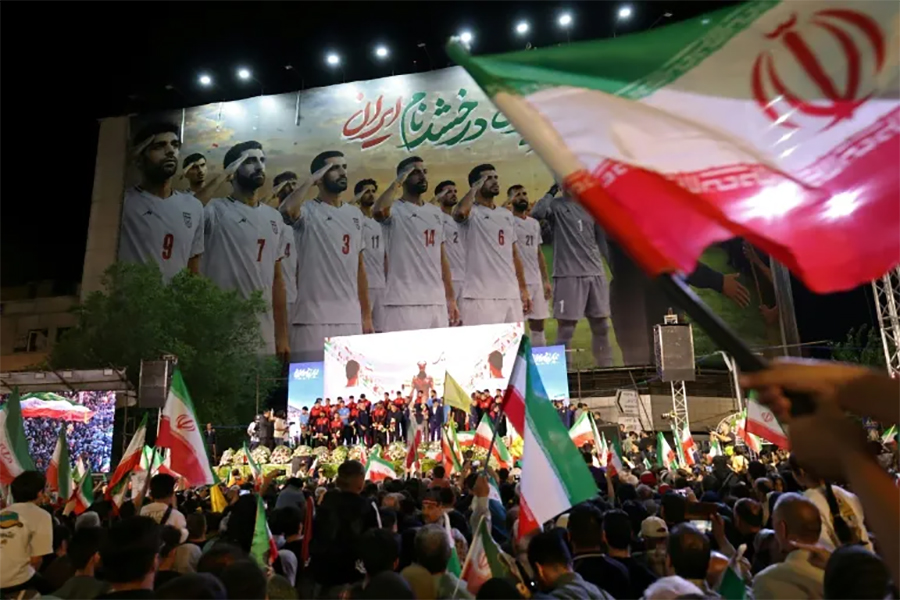
The most complicated issue surrounding this World Cup involves Iran. For the first time, a host country is including a team from a nation currently engaged in military conflict. The U.S. and Israel launched military actions against Iran in February, and the Iranian national football team is preparing for the tournament under this tense backdrop.
The Iranian team’s training camp was originally planned for Arizona, U.S., but visa issues forced the team to relocate their camp to Mexico.
U.S. officials confirmed to Reuters that Iranian players received visas on June 5. Iran will play its opening match against New Zealand on June 15 in Los Angeles, with visas issued only ten days prior to the start.
However, according to Iranian news agency Tasnim, executive director Mehdi Kharati, general secretary Hedayat Mombini, and media director Mohsen Motamedkia have not been granted visas. These officials will travel to Mexico while visa efforts continue.
The Iranian Football Federation condemned the U.S. visa denial for key administrative officials as a non-sporting and fully political decision, stating the matter will be pursued through FIFA channels, urging FIFA’s assistance in securing the visas.
The hardline U.S. immigration policy, travel bans, ICE surveillance, and escalating U.S.-Iran military tensions assure that diplomatic battles off the pitch will be more challenging than the games themselves.
U.S. Secretary of State Marco Rubio informed lawmakers that personnel linked to Iran’s Islamic Revolutionary Guard Corps will not be allowed as part of the Iranian delegation.
Mehdi Taj, president of the Iranian Football Federation and a former Revolutionary Guard commander, was denied U.S. entry last December during the tournament draw in Washington.
According to Iran’s ambassador to Mexico, Abolfazl Pasandideh, visa difficulties and the desire to minimize presence on U.S. soil prompted the team to shift their camp toward Tijuana.
The ambassador asserted, ‘Even on enemy soil, Iran’s participation in the World Cup shows their pursuit of peace.’
Iran is placed in Group G, with matches scheduled against New Zealand and Belgium in Los Angeles, and Egypt in Seattle.
On June 5, the U.S. military destroyed drones launched in the Strait of Hormuz and subsequently attacked an Iranian coastal surveillance center. Amid these retaliatory attacks, the Iranian football team proceeds with World Cup participation. Peace talks have progressed slowly while military actions persist.
Both sides appear poised to use the World Cup for political purposes. Reuters notes, ‘War has turned the World Cup into a stage for geopolitical rivalry, with the tournament now serving as a platform for political posturing.’
The Iranian ambassador reiterated that their participation sends a message of seeking peace with adversary nations.
Security concerns are equally significant.
The U.S. government has allocated $846 million to nine host states, funding cybersecurity, emergency preparedness, security, and drone defenses across eleven cities.
However, a confidential intelligence briefing between U.S. officials and FIFA in March warned that Trump’s tough immigration policy and the Iran conflict could heighten the risk of extremist attacks and civil unrest at games, fan events, and transportation infrastructure.
Concerns also extend to matches in Mexico, where the assassination of drug cartel leader El Mencho via a U.S.-supported operation in February was followed by arson and attacks on public infrastructure by organized crime groups around Guadalajara, impacting tourism. Canadian host cities have reported no similar security risks.
In February, U.S. Immigration and Customs Enforcement (ICE) announced it would play a ‘key role’ in World Cup security, a prospect that has unsettled participating countries.
Germany and the U.K. have advised their citizens to avoid travel to the U.S. due to Homeland Security concerns. Ecuador has protested the presence of ICE agents, while Italian officials resisted ICE involvement during the Milan Indoor Olympics.
In March, Democratic U.S. lawmakers proposed three bills aimed at enhancing visitor safety and limiting ICE enforcement during the World Cup; however, these are unlikely to pass before the tournament amid Republican majorities.
Potential ICE presence is so extensive that even stadium staff have expressed opposition. On May 29, two thousand guest workers at Los Angeles’s SoFi Stadium, which will host eight World Cup matches, failed to reach agreement with unions and stadium managers, subsequently announcing a vote on potential strike action. They demanded improved working conditions and removal of ICE from the stadium.
Yet, Edward Alden maintains a distinct perspective: ‘Most World Cup fans are not undocumented immigrants. The World Cup is a global sporting event, and a heavy ICE presence could disrupt the experience.’
Trump discussed the diplomatic potential of the World Cup in sports diplomacy.
According to Politico, the U.S. State Department’s ‘Sports Diplomacy Playbook’ guides Washington on leveraging the World Cup to promote foreign investment and soft power strategies.
Trump also attempted to lift sanctions on Russia to allow participation in the 2022 World Cup after the invasion of Ukraine, but the restrictions remained in place.
Meanwhile, calls to sanction Israel amid the ongoing Gaza conflict have been ignored, with the State Department guaranteeing efforts to block such measures.
New teams such as Cape Verde, Curaçao, Jordan, and Uzbekistan will make their World Cup debuts. The expanded 48-team format will result in many matchups between teams that have never previously faced each other, creating fresh opportunities for friendly competition and displays of soft power.