
Jiri Paves a New Path for Literature Focused on Nature and Sustainability
We have read and written extensively about nature in literature, but literary discourse that places nature itself at the center and prioritizes environmental crises has often remained marginal. This time, an effort has been made to bring the achievements and challenges observed in nature to the forefront of literary discussion.
The inaugural Bagmati Environmental Literature Festival 2082, held under the theme ‘Nature, Literature, and a Sustainable Future,’ signals a broadening of the traditional framework of Nepali literature. This festival was organized collaboratively by the Ministry of Forests and Environment of Bagmati Province, Jiri Municipality, various literary organizations, and institutions active in forestry and environmental fields.
Taking place from Chaitra 27 to 29, the festival gathered literary creators focused on environmental themes from all 13 districts of Bagmati Province. On the morning of Chaitra 30, which was the final day of the Nepali year 2082, guests were bid farewell from Jiri.
Located approximately 190 kilometers from the federal capital in the Himalayan valley of Jiri, attending the festival did not feel like merely participating in a single event. Rather, it felt like standing at the birthplace of a new dialogue. Jiri’s natural surroundings moved from background to the forefront of literature, demonstrating that literature must not only express beauty but also serve as a means to address the pressing issues of our time.
The festival highlighted not only environmental crises but also openly celebrated the various efforts and achievements made towards environmental balance. Attempts were made to incorporate successes in community forestry and watershed management within literary works.
A Celebratory Festival
On Chaitra 28 before the official opening, creators from all 13 districts gathered near Jiri’s Gorans Park. Amidst blooming white rhododendron gardens surrounding a pond and meadow, participants enjoyed their time; some sang songs, others danced, while some engaged in dialogue. They then proceeded to Hatdanda, where the local community’s enthusiastic participation was evident, and guests were welcomed with tableaux reflecting ethnic and local cultural life.
With the procession including the tableau and local community, a rally was held on foot from Hatdanda to Linking Bazaar, culminating in an inauguration ceremony held on a stage prepared at the bus park. The tableau dance captivated all attendees.
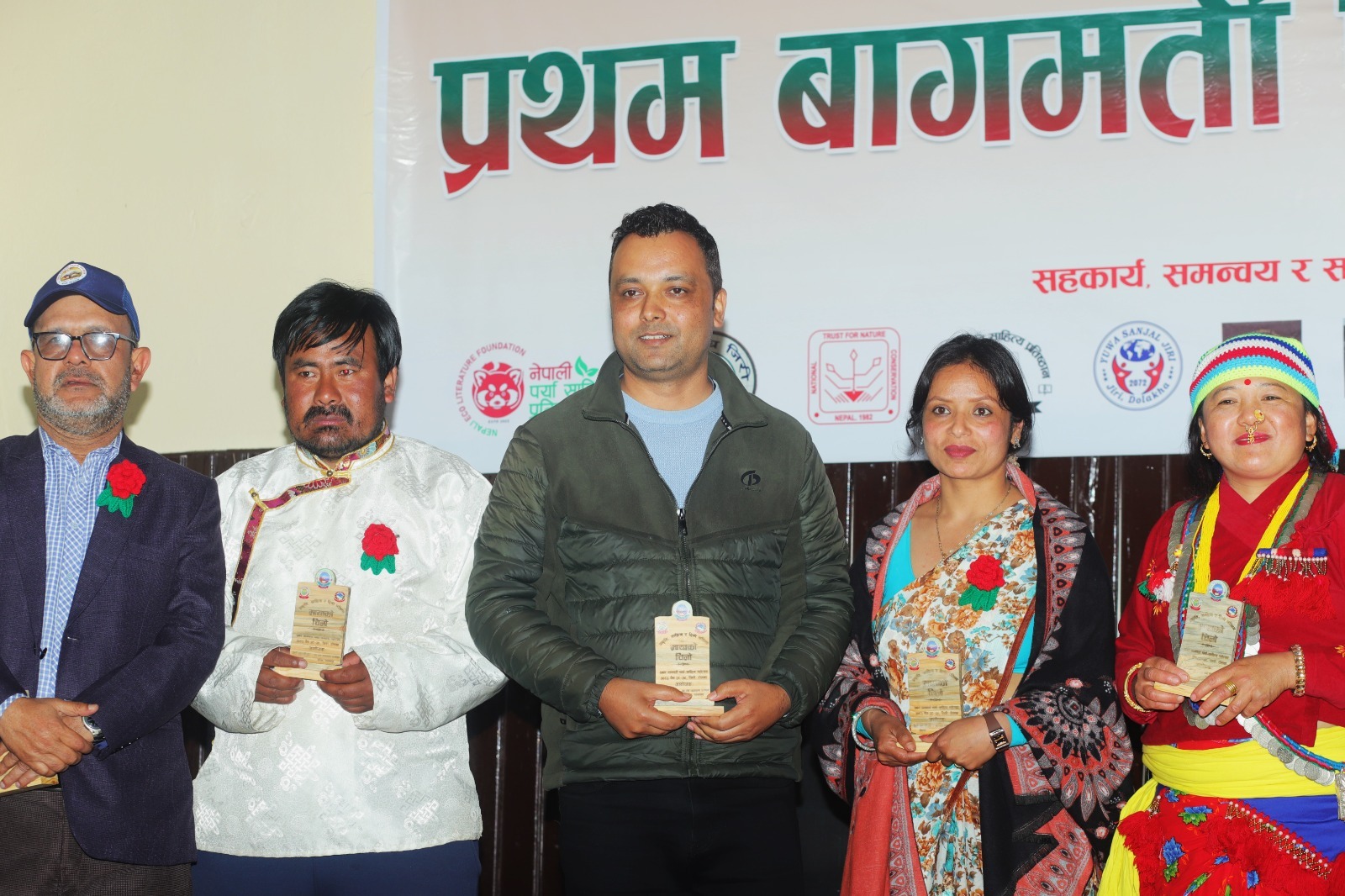
The event was chaired by Jiri Municipality Chief, Mitra Jirel, and inaugurated by Bagmati Province Minister for Forests and Environment, Bharat KC. The program also saw notable participation from provincial legislator Urmila Sunuwar, Ministry Secretary Dr. Kedar Baral, representatives from various political parties, local government representatives, journalists, civic leaders, and members of the general public.
This helped establish the festival not only as a literary event but also as a shared platform for social and policy dialogue.
Keynote: A Profound Intellectual Foundation
One of the most impactful elements of the festival was the keynote presentation. Prof. Dr. Sanjiv Upreti explained that environmental literature should not be seen as just a trendy term, but as an intellectual intervention demanded by the era., He clarified that literature in the time of climate crisis cannot remain neutral; it must raise questions, spread awareness, and hold society accountable.
Similarly, author and environmentalist Ramesh Bhusal from Chhalpatha presented under the title ‘Red Earth, Hot Earth.’ He likened humans to ‘greedy demons’ and offered a strong critique of the destructive acts committed against the environment. His message emphasized that literature’s impact remains limited if it fails to connect deeply with life, thus steering environmental literature toward a practical foundation.
Festival events took place in a newly constructed recreation building, which by fortunate coincidence was handed over by the provincial government to the Jiri Municipality on the festival’s final day. The program included nearly four dozen poetry readings, an evening dedicated to eight ghazals, and a cultural night featuring local traditions, all of which were engaging. Renowned poet Kumar Nagarkoti’s poetry reading was a particular highlight for the audience.
There were presentations from ghazal writers, poets, dialogue facilitators, authors, journalists, and activists. The ghazals by Jit Karki from Dolakha were notably rhythmic. Participation from Pratik Dhakal, Bhawani Khatiwada, Bhupin Khadka, Dadhi Sapkota, Archana Thapa, Archana Rai, Dr. Ashok Thapa, Dr. Naveenbandhu Pahadi, and Deepak Sapkota was also significant.
Six panel discussions were held over two days. Among them, the dialogues titled ‘Voices of Earth People‘ and ‘Yesterday, Today, and Tomorrow of Jiri‘ were especially impactful. These dialogues sought to connect local experiences, struggles, and possibilities with literature.
Additionally, poetry readings and discussions held against the backdrop of a pond inscribed with ‘I Love Jiri’ in an open field near the town added vibrancy and memorability to the program. This combination of natural beauty and literary expression deepened the festival’s emotional resonance.
Jiri itself proved highly relevant in this context. A dialogue-centric literary debate in this naturally beautiful region seemed not just coincidental but necessary. This festival signals that Jiri can be established not only as a tourist destination but also as a center for ideas, debate, dialogue, and creativity.
A New Journey Marked by Questions
Nonetheless, some questions have emerged and continue to arise — why hasn’t such an important dialogue expanded nationwide? Why could greater participation from creators not be ensured? One notable aspect is that this was an initiative at the Bagmati Province level and a first-time effort. It might have had many shortcomings, but there is room for rapid improvement and advancement.
Bagmati Province Chief Minister Indra Banija conveyed a written message of good wishes, pledging to make environmental literature festivals a regular occurrence. Participants were not only delighted to hear about the continuity but also urged governments at all levels to include environmental literary activities. He announced intentions to establish regular coordination with institutions and individuals interested in environmental literature. Suggestions were also made to incorporate environmental literature topics into school curricula.
To expand a subject like environmental literature, greater coordination between the state, academic institutions, and the literary community is essential. In the future, making such programs more inclusive and multidimensional and extending them to international levels could deepen their impact substantially.
Amid these questions, one thing is clear—the effort initiated in Jiri is no small feat. It is a sign, a possibility, and perhaps the beginning of a new literary movement. This opens the door for literature to be viewed from a new perspective.
Ultimately, the voice raised in Jiri should not remain limited there. It needs to expand, deepen dialogue, and advance as a campaign reconnecting literature with nature. If achieved, environmental literature may evolve from merely a term into a new direction for Nepali literature. This journey began in Jiri.
Wishing everyone a Happy New Year!