
Dozers Continue Demolitions Despite Supreme Court Order
May 16, Kathmandu – Kohalpur Municipality in Banke had issued a 10-day notice on April 29 to clear land around the cricket ground in Ward No. 11.
A day before this deadline expired, the Supreme Court ordered that evictions of homeless and unorganized settlements should not be carried out forcefully without following a phased process and appropriate management.
This order was issued on May 8 by a two-judge bench of Kumar Regmi and Nityananda Pandey, in response to petitions filed after rapid removals of riverside settlements began in Kathmandu during the second week of April.
The very next day after the court’s order, Kohalpur Municipality issued another notice stating it considered the Supreme Court’s interim order regarding homeless settlements inapplicable to encroached land owned by the Municipality Development Committee, as signed by Chief Administrative Officer Man Bahadur Giri.
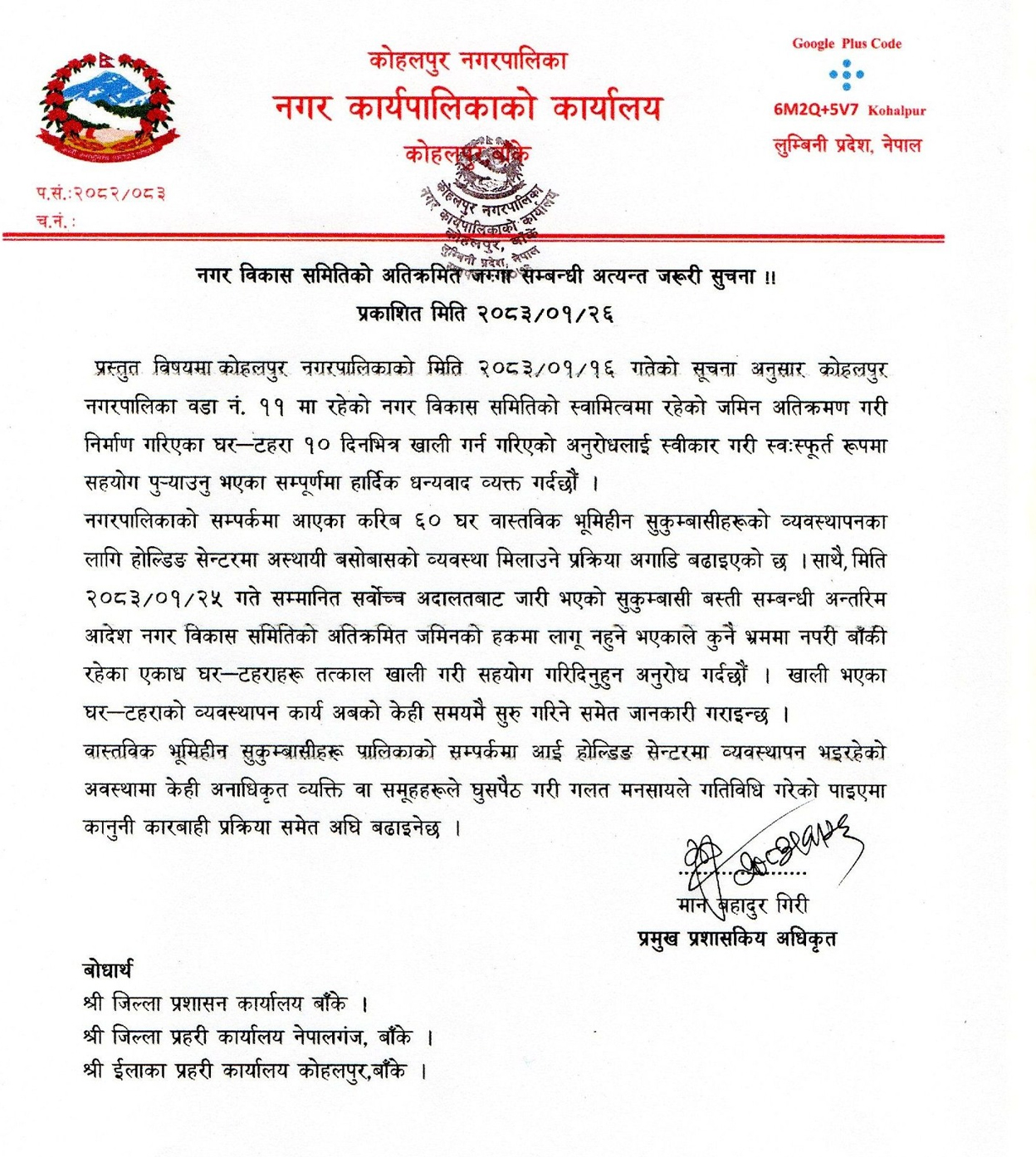
In accordance with its original notice, the municipality evicted 370 families from the land, of which 110 were accommodated in holding centers, according to Kohalpur Deputy Mayor Sangita Subedi.
Subedi explained that the Supreme Court order only prohibited clearing homeless settlements on government-declared land (Ailani Land), but does not apply to settlements on municipal development land. “The court said not to clear settlements on public land; it did not prohibit removal of settlements on development land,” she said.
Similar evictions have been ongoing across municipalities in Bardiya District as well, adjoining Banke. Bardiya Madhuwan Municipality Mayor Tej Bahadur Bhat said that, contrary to the Supreme Court order, the Division Forest Office has been using dozers to clear settlements.
The Road Division Office under the Ministry of Forests and Environment in Lumbini Province had announced on April 27 a plan to clear encroached forest areas. In response, all local municipalities and rural municipalities in the district jointly protested. They also opposed instances where the army and police collected fees.
Despite the Supreme Court order, demolition using dozers did not stop. Mayor Bhat stated, “We have protested since the army began collecting fees. We demand the Supreme Court’s order be implemented, yet demolitions continue against the order.”
In another district of Lumbini Province, East Rukum, clearance operations are underway. Sisne Rural Municipality has removed structures along the Mid-Hill (Pushpalal) Highway. The municipality chair Krishna Regmi said they demolished garages, hotels, and other facilities built near drainage lines along the road, providing alternatives to the affected owners.
Chairman Regmi added, “According to legal provisions, no structures are allowed within 17 meters of the road. We demolished those structures after offering alternatives. The government must act as guardian and, if necessary, enforce punishments.”
The clearance of roadside structures has not stopped in the Terai region either. On Friday, dozers operated near the Bara 3 bridge on the Pathalaiya-Dhalkebar road section.
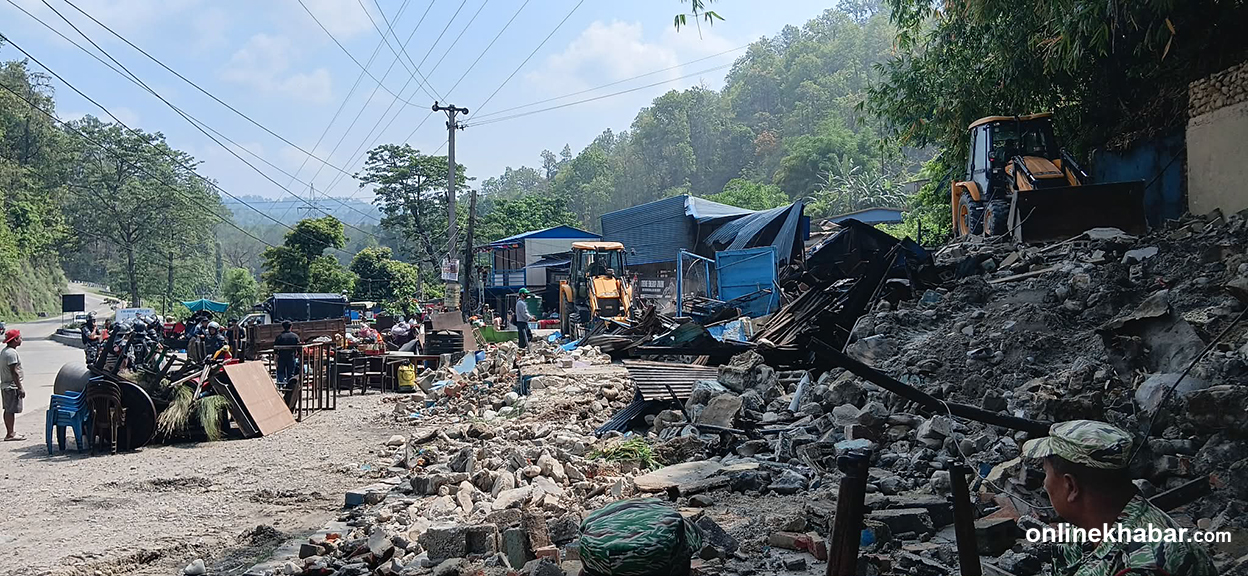
The Division Forest Office Bara reported having demolished 70 houses and huts belonging to 35 families near the road. This operation was a joint effort between the forest office, Bara, Parsa National Park, and local government.
Sujit Kumar Zha, head of the Division Forest Office Bara, said that the court has not halted clearing of encroachments in forest and conservation areas. According to him, the eviction was done under the Forest Act and Wildlife Conservation Act.
He claimed that about 17,000 households reside in encroached areas in Bara alone, adding, “The court has not stopped us from working according to law. Remaining encroachments will also be cleared.”
However, businessmen displaced from the No. 3 bridge area have protested, alleging the government evicted them forcibly contrary to the court’s directives. They accused the government of mocking the judiciary and human rights.
Mohan Sharma, president of the Industry and Commerce Association in Jitpur Simara, said the government did not even provide minimum time for business owners to relocate their goods. Sharma, who was present at the site on the day dozers operated, said owners were given less than half an hour to clear belongings. “Those who had land without ownership must receive compensation. No one has spoken in favor of the people amid rapid eviction,” he added.
Stakeholders point out that despite the court ruling in favor of the people, enforcement remains lacking. Senior advocates Dinesh Tripathi, Gopal Ranpaheli, Majid Ansari and others had filed separate petitions in the Supreme Court demanding that settlements not be removed unlawfully.
In its hearing, the court stated: “Considering the irreparable damages and humanitarian crisis that would arise by forcibly evicting homeless and unorganized settlers without following legal process, and with regard to their rights to housing, education, and health, the Government of Nepal is ordered not to carry out forced removal or displacement without adhering to the defined procedures outlined in the government’s reform agenda point 91 from the cabinet meeting of Chaitra 13, 2082 BS, the Ministry of Federal Affairs and General Administration’s circular of Baishakh 17, and directives from the Home Ministry to all municipalities and rural municipalities.”
Point 91 of the government reform agenda mandates that within 60 days, fees should be collected and verified and that land should be allocated to genuine landless people within 1000 days. The Ministry of Federal Affairs and General Administration directed all local units on Baishakh 17 to immediately identify homeless persons, plan their resettlement, and seek cooperation from school administrations if necessary for evictions.
On the same day, the Home Ministry issued a circular to district administration offices stating that plans to remove encroached structures must be submitted and that clearance should proceed only with ministry approval and adequate security arrangements.
Senior advocate and petitioner Dinesh Tripathi said that the court instructed that no structures should be demolished without providing suitable alternative settlements.
Not only the court, but the secretariat meeting of the ruling National Independent Party also recommended the government refrain from using dozers until an authority is formed to assess the homeless settlements in areas like Thapathali, Manohara, Balaju, and Swayambhu, where landless homeless have been evicted and are living in insecure conditions.
Urban Development Minister Sunil Lamsal has likewise stated that clearance of settlements will not proceed until identification and proper management plans for homeless people are developed.
Stakeholders stress that these actions not only violate the government’s commitments but also contravene Supreme Court directives.