
Government Deploys Foreign Rescue Teams Five Days After Disaster Strikes
News Summary
- After the Rasuwa flood, foreign rescue teams from India and China began tunnel rescue operations only five days later due to delayed government approval.
- It is estimated that around 600 people are trapped inside hydropower project tunnels, but Nepal has yet to conduct a successful rescue.
- Rescue efforts have started at Chilime, Upper Trishuli-1, and Langtang projects; at Chilime, the bodies of two out of six trapped individuals have been recovered.
September 14, Kathmandu – Due to exceptionally delayed government approval, rescue teams from India and China commenced search-and-rescue operations inside flood-affected tunnels only five days after the disaster struck.
The Rasuwa flood is estimated to have trapped approximately 600 individuals in various hydropower project tunnels, yet Nepal has been unable to conduct successful rescues thus far.
Despite repeated requests, hydropower projects state that the government has not yet managed to rescue employees and workers trapped inside the tunnels.
Since Sunday, rescue operations have begun in the Chilime, Upper Trishuli-1, and Langtang hydropower projects. Although the tunnel of the Upper Trishuli-3 A project was located on Sunday, rescue has not yet started there despite five days since the flood.
Experts warn that the government’s unusual delay has put those trapped inside the tunnels at significant risk.
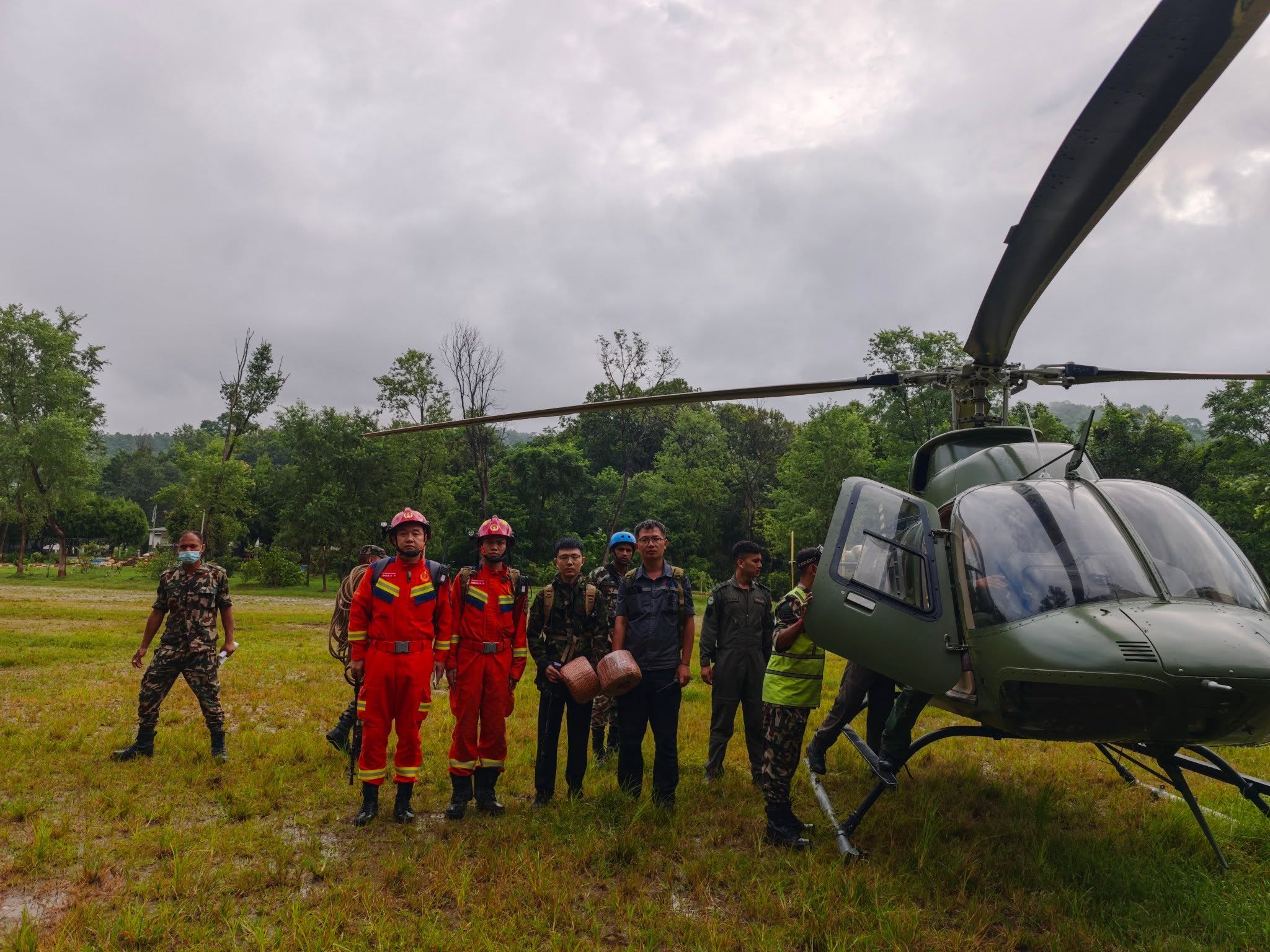
According to sources from the Ministry of Foreign Affairs, a Chinese rescue team dispatched for the Rasuwa flood is engaged in rescue operations at the 216 MW capacity Upper Trishuli-1 (UT-1) project.
This rescue operation was coordinated with the Chinese contractor China Railway, with a 9-member team deployed in the affected area, the ministry added.
UT-1 is the largest hydropower project under construction in the Trishuli corridor, where rescue efforts began only on Sunday.
Approximately 600 people remain out of contact at this site; project CEO Giriraj Adhikari of Nepal Water and Energy estimates that about 400 of them are trapped inside the tunnels.
Around 260 individuals, including 10 Koreans, have been rescued from the affected areas, but rescuing those still stuck inside the tunnels remains unfeasible, Adhikari stated.
It is estimated that 300 workers are trapped in the tunnel along with 100 more working at the headworks.
The Chinese embassy in Nepal confirmed that a second Chinese rescue team arrived in Nepal on Sunday morning; however, the Ministry of Foreign Affairs has not disclosed where this team has been deployed.
Similarly, the government announced the deployment of an 11-member Indian team for rescue operations at the Chilime Hydropower Project.
Of six individuals trapped inside the Chilime tunnel, two bodies have already been recovered by a joint Indian and Nepali army rescue team.
The Indian team includes doctors, paramedics, and tunnel engineers, and an additional 22-member Indian Army unit has also been dispatched for rescue work.
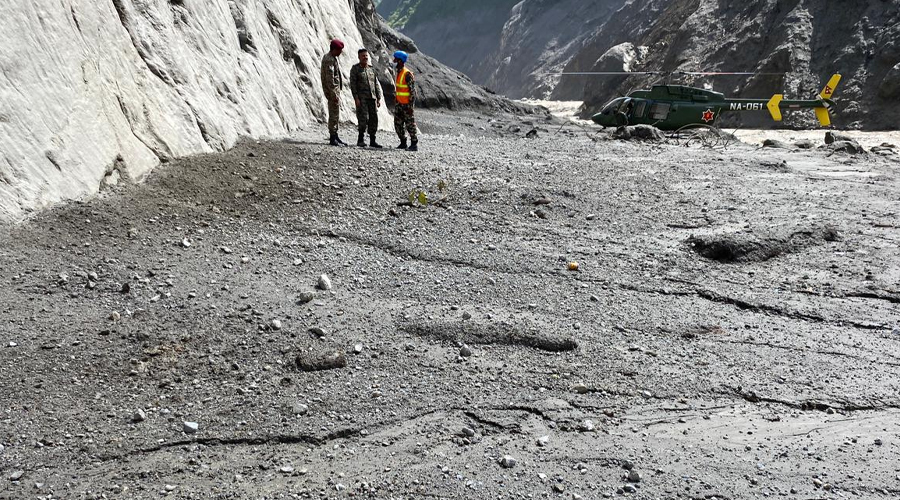
The initial team conducted aerial surveys over Chilime and Langtang areas via helicopter on Saturday.
The Prime Minister’s Office stated that the Indian expert team, along with an 82-member joint security team of the Nepali Army, Nepal Police, and Armed Police Force, has started work using advanced equipment to clear the tunnels and rescue those trapped inside.
Along with the rescue teams, the Indian government has provided Nepal with relief materials including portable generators, food, water purification tablets, and medicines.
On Saturday, mountaineering rescue specialists were sent via Summit Air helicopter, though they have yet to become effective in rescuing those trapped.
Upon reaching approximately 100 meters inside the tunnel, they found it completely filled with ice, noting that special equipment and expert teams are needed for excavation. This prompted the deployment of the Indian expert team.
Meanwhile, the South Korean rescue team has also arrived in Nepal as confirmed by Foreign Secretary Amrit Rai, but the team has yet to be deployed to the field.
The UK government has announced the dispatch of its Rapid Deployment Team (RDT) to Nepal. British Foreign Secretary Ed Miliband said this team will work in coordination with Nepali officials and the British Embassy, focusing particularly on rescuing British citizens.
Sources report that the British team has arrived in Nepal and is ready to assist British citizens if necessary.
Although the UK communicated plans to send rescuers earlier, they only arrived after the government indicated a need, according to sources.
Similarly, Australia had offered to send rescue teams but could not deploy them due to Nepal government delays in granting permission.
Foreign governments have cited difficulty obtaining permission from Nepal as the main barrier, which is why foreign rescue teams only reached limited areas on the fifth day after the devastating flood.
However, the Ministry of Foreign Affairs denies any delay in granting permission to foreign teams.
Nepali rescuers and experts have acknowledged Nepal’s limited capacity for tunnel rescues.
An official from Nepal Electricity Authority remarked, “No rescue inside the tunnels for five days shows the lack of required skills, capabilities, and equipment in Nepal. Foreign experts and equipment should have been brought promptly but were not.”
Nepal Engineers’ Association President Suvaschandra Baral emphasized that the government’s delay in the rescue effort has led to severe consequences and urgent intervention is necessary.
Baral said, “It only takes 2–3 hours by flight to bring rescuers and necessary equipment from India and China, but the government made a grave mistake by not doing so immediately. The delay in rescue could cost many lives.”
He further criticized the government for significant delays in deploying Nepali manpower and equipment.
“Nepal Engineers Association repeatedly warned about government negligence in the rescue effort, but no effective action was taken,” Baral added.
Foreign Minister Shisir Khanal stated that foreign rescue teams from India and China were brought in because Nepali rescuers were unable to operate effectively. Offers of assistance also came from other countries, and Nepal is prepared to accept help as needed.
The National Disaster Risk Reduction and Management Authority reported that 599 foreign nationals remain missing due to the Rasuwa flood, with 261 people rescued alive, including 167 Indians and 40 Chinese.