
Trump’s Portrait on the New US Dollar Coin Sparks Legal and Ethical Debate Amid Promotion Efforts
Summary
- The US Mint, under the Treasury Department, has released a new one-dollar coin featuring President Donald Trump’s portrait, putting it into circulation and sale.
- Issued to mark the 250th anniversary of the United States’ founding, the coin’s design includes inscriptions such as ‘Liberty,’ ‘In God We Trust,’ and ‘1776–2026.’
- The inclusion of a living person’s image on currency has sparked legal and ethical controversy, with critics pointing to loopholes exploited from a 2020 law.
September 7, Kathmandu – On Wednesday, the US Mint, part of the American Treasury Department, unveiled a new one-dollar coin bearing the image of President Donald Trump, beginning its sale and circulation. This coin was issued to commemorate the 250th anniversary, known as the Semiquincentennial, of the United States’ establishment.
This marks a rare event in modern American history where the portrait of a living individual is stamped on a metal coin; such practice had not occurred since 1866.
Historically, the closest precedent was in 1926 during the 150th anniversary of American independence when a half-dollar coin featured then-President Calvin Coolidge’s image. Trump’s coin thus represents only the second instance of a sitting president’s portrait appearing on currency.
Design and Features of the Coin
The one-dollar coin, jointly issued by the US Treasury and the US Mint, displays a solemn portrait of President Trump in formal attire on the obverse side. The upper rim bears the word ‘Liberty,’ while the bottom features the dates ‘1776–2026.’
At the center is the national motto ‘In God We Trust.’ The reverse side depicts the presidential seal alongside the traditional national bird, the bald eagle. The eagle’s chest shield is inscribed with ‘250’ to mark the anniversary, and its claws and beak carry the Latin motto ‘E Pluribus Unum,’ meaning ‘Out of many, one.’ Additional inscriptions include ‘United States of America’ and ‘One Dollar.’
Originally, a more aggressive portrait was proposed, showing President Trump leaning forward with fists clenched on a table, but the final design was altered before approval.
The approved design was sanctioned by the American Fine Arts Commission, whose members were appointed by Trump. However, the Treasury Department has not clarified why the initial design was changed.
Though the coin appears golden in color, it contains no actual gold. According to the US Mint’s technical details, the coin is composed of 88.5% copper, 6% zinc, 3.5% manganese, and 2% nickel. The coin primarily targets collectors.
Nevertheless, it is considered legal tender under US law, allowing citizens to use it for debts or taxes. Private businesses retain the discretion to accept or reject it.
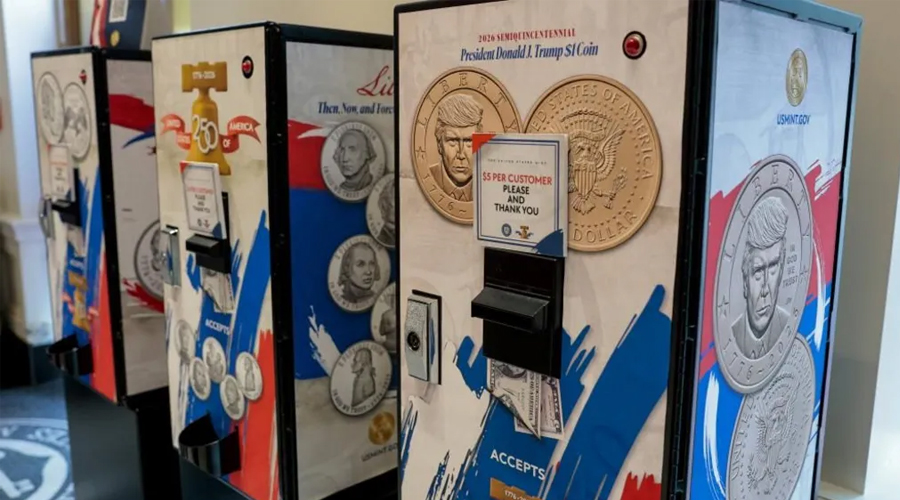
The coins are available through the Mint’s official website, sold in rolls of 25 coins priced at $61 and bags of 100 coins priced at $154.50. This means individual coins cost between $1.55 and $2.44, exceeding the face value of one dollar. Vending machines at sales centers in Washington, D.C. have also dispensed coins for $5 each.
High demand shortly after launch led to the Mint’s website displaying ‘sold out’ notices and virtual queues lasting hours.
Special editions include 250,000 coins minted to commemorate July Fourth, featuring a distinct ‘July Fourth’ mark.
Exploiting Legal Loopholes
US law explicitly prohibits the depiction of living persons on currency, making the decision to feature Trump’s portrait on this coin a matter of legal and ethical controversy.
In 1866, Congress passed legislation banning images of living persons on currency, bills, or securities. This followed a controversy when a Treasury official placed his own portrait on a five-cent note.
The 2005 Presidential $1 Coin Act further restricted the image of deceased presidents from appearing on coins less than two years after their death.
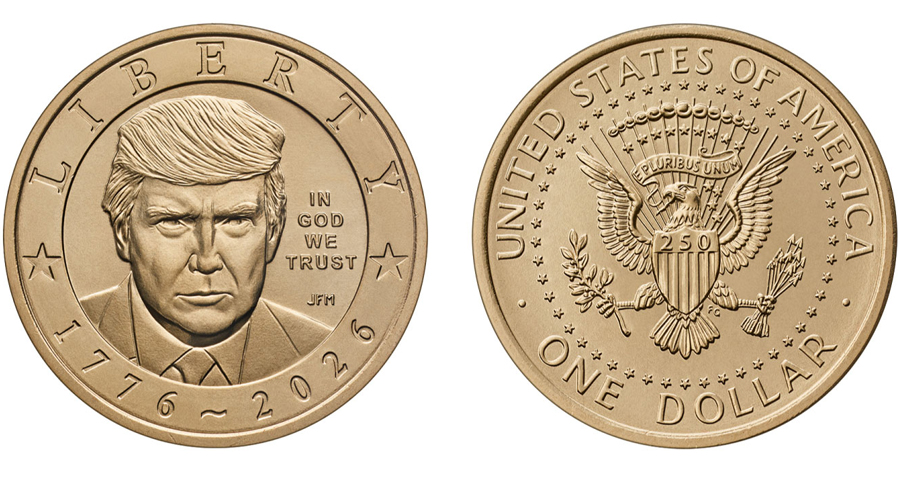
However, the Trump administration utilized a loophole in the 2020 Circulating Collectible Coin Redesign Act, which authorized the Treasury to release a commemorative one-dollar coin in 2026 for the 250th anniversary.
While the act bans images of living persons on the reverse side of coins, it does not explicitly prohibit portraiture on the obverse side. The Trump administration relied on this ambiguity to justify the inclusion of his likeness on the coin face.
The department also argued that the Treasury Secretary holds discretionary power to approve the coin’s design and issuance under special circumstances.
Strong Opposition Criticism
The coin’s release triggered intense debate between the Trump administration and its critics. Treasury Secretary Scott Besant expressed support on social media, stating, ‘This coin, including President Trump, celebrates the strength of American values and the nation’s commitment to safeguarding liberty for all.’
President Trump told Fox Business Network in his distinctive manner, ‘It’s quite unusual, but I feel honored by it. They gave me a coin, which is very nice.’
Democratic leaders and political analysts have heavily criticized the move. With midterm elections approaching and rising inflation and economic challenges, they accused the president of leveraging the coin to proliferate his image widely.
Democratic Senator Elizabeth Warren sharply remarked on social media, ‘While Americans struggle to afford essentials like food, housing, and healthcare, what is Donald Trump doing? He’s trying to stick his face on every surface he can find.’
The coin was also presented as a diplomatic gift by US Treasury officials to foreign counterparts during the recent G-20 summit in North Carolina. One foreign finance minister reportedly expressed surprise to learn it would enter daily circulation within the United States.
Members of the Citizens Coinage Advisory Committee (CCAC) expressed discontent, lamenting deviations from established approval procedures.
Donald Skarinsky, a member appointed by Senate Minority Leader Chuck Schumer, warned that by bypassing the committee’s review, the Mint’s actions might be unlawful. The Mint, however, claimed independent decision-making authority due to the committee’s refusal to deliberate.
Ongoing Personal Branding Strategy
Featuring living individuals on coins is not an isolated effort. President Donald Trump has continued to implement a series of moves during his second term to embed his personal brand and name into American institutional symbols, historic sites, and public assets.
Last year, he succeeded in affixing his name to the Kennedy Center for the Performing Arts, the United States Institute of Peace, and a class of new warships.
Moreover, public issuance of a $1 million gold Visa card, national park admission passes, passport pages, and large flags and banners on government buildings have all displayed Trump’s name and image.
In March, the Treasury announced an unprecedented plan to include the current president’s signature on paper notes, where traditionally only the Treasury Secretary and Treasurer signatures appear.
Secretary Scott Besant has also proposed issuing a new $250 note bearing Trump’s portrait, openly challenging century-old legal norms forbidding images of living persons on currency.
Various international media outlets have analyzed Trump’s approach as a strategy to merge his personal branding with national identity. From AI-generated images portraying him with superhuman powers on social media to inscribing his name on historic monuments, critics argue these actions encroach upon American democratic values and traditions.
(Content contributed by agencies)