
Controversy Over Serving Only Vegetarian Food at BRICS Summit Explained
News Summary
Well-reviewed analysis.
- Following the 18th BRICS Summit held in New Delhi, opposition parties in India have criticized Prime Minister Narendra Modi’s China policy, diplomatic transparency, and the menu served at the summit.
- The 11-member BRICS group adopted the New Delhi Declaration 2026, urging restraint, dialogue, and diplomacy to address tensions in the Middle East.
- A bilateral dialogue between Iran and the United Arab Emirates during the summit is considered a significant diplomatic achievement for India.
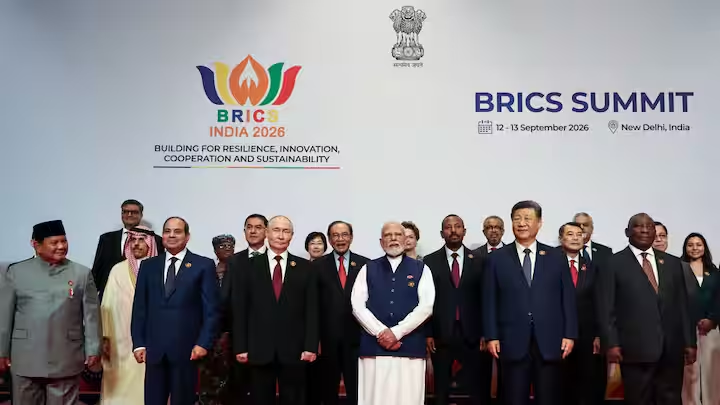
September 14, Kathmandu – The 18th BRICS Summit held in New Delhi has sparked internal political controversy in India. The high-level meeting at India Mandapam saw spirited debate between the ruling and opposition parties regarding diplomatic successes and the food served during the event.
Leaders from various countries, including Russian President Vladimir Putin and Chinese President Xi Jinping, participated in the summit. After its conclusion, opposition parties have criticized Prime Minister Narendra Modi and his government over their China policy, diplomatic transparency, and the dinner menu.
The Indian National Congress and the Samajwadi Party have raised fundamental questions about the achievements of the BRICS summit and the diplomatic style of the Indian government. Samajwadi Party MP Ram Gopal Yadav claimed that no concrete or significant outcomes emerged from the event.
‘There have been no significant achievements. If these BRICS nations collectively had been able to stop the Russia-Ukraine war or mediate the conflict involving Iran, it would have been a major accomplishment,’ Yadav said.
He added, ‘These wars are having global repercussions; negatively impacting economies, and no region in the world can remain unaffected by them.’
Despite such criticism, the 11-member BRICS group adopted the New Delhi Declaration 2026. The declaration expressed grave concern over rising tensions in the Middle East and called for restraint, dialogue, and diplomacy. It also emphasized safeguarding civilian infrastructure and maintaining global trade, supply chains, and energy flows.
The bilateral agreement between Iran and the UAE to resolve the West Asian conflict is viewed as a significant diplomatic success for India.
During the summit, bilateral talks were held in New Delhi between Iranian President Masoud Pezeshkian and Abu Dhabi’s Crown Prince Sheikh Khalid bin Mohammed bin Zayed Al Nahyan, marking notable progress in diplomatic relations between Tehran and Abu Dhabi.
Alongside diplomatic achievements, the food served at the summit also sparked political controversy. Opposition parties, including Congress, criticized the gala dinner at India Mandapam for offering only vegetarian dishes. They alleged that imposing vegetarian food on international guests suppressed India’s multicultural culinary heritage by excluding non-vegetarian items.
Congress leader Pawan Khera questioned the Modi government on social media platform X, asking, ‘Why is the government ashamed of India’s diversity?’
‘The BJP’s long-standing practice of imposing dietary preferences on Indian citizens is problematic. Now they are imposing their dietary choices on distinguished global guests. India is a rich, diverse country with a wide range of non-vegetarian dishes loved worldwide. So why is the Modi government trying to conceal this cultural aspect? Are they embarrassed to honor India’s diversity?’ Khera questioned.
Opposition leader Rahul Gandhi also posted a photo of chole bhature on X without mentioning the summit or menu directly, mocking the situation. He wrote, ‘For your information: 80 percent of Indians are non-vegetarians. Indian non-vegetarian food is extremely delicious, just like the chole bhature my sister makes.’
Other opposition leaders also condemned the government’s decision. Trinamool Congress MP Mahua Moitra tweeted, ‘If I advised the visiting BRICS leaders to skip this menu and instead get some bad kebabs delivered to them via security personnel from nearby Karim’s, would I be considered a bad MP?’
Meanwhile, Shiv Sena (UBT) MP Priyanka Chaturvedi, though vegetarian herself, shared her own experience of having to request vegetarian options separately at international events.
‘Keeping with the spirit of “Atithi Devo Bhava,” it would be best to offer guests alternative options. However, all guests understand the limitations of the event,’ Chaturvedi wrote.
Following the opposition’s criticisms, the Bharatiya Janata Party (BJP) defended the vegetarian menu and accused the opposition of ‘playing politics over food.’
Parliamentary Affairs Minister Kiren Rijiju wrote on X, ‘It is unbelievable that the Congress Party is politicizing the menu served to BRICS leaders. Our guests greatly appreciated the diverse regional traditions, flavors, and nutritious presentation of Indian vegetarian cuisine.’
The BJP accused the opposition of focusing on the menu after failing to question India’s diplomatic achievements, the discussions on global challenges, or consensus reached among BRICS members.
The dinner hosted by Prime Minister Modi on Saturday featured exclusively vegetarian dishes. The menu started with Khandvi Mille-feuille and Khumb Galouti.
The main course included paneer lababdar, guchhi maharash, carrot bean poriyal, thakkali belle saru, millet pulao, beetroot raita, and a variety of Indian breads.
Desserts included Old Delhi style fruit cream, jalebi, and sahatoot firni. The menu featured culinary traditions from the Himalayan region, South India, and Old Delhi. International dishes such as penne al pomodoro e panna, pearl millet with haricot beans, and baked vegetable au gratin were also included.
However, the vegetarian meal at India Mandapam was not the sole option for visiting delegations. Hotels accommodating the leaders and their teams arranged menus catering to individual preferences.
According to executive chef Kaushik Mishra of the Taj Mahal Hotel, the culinary preferences of each delegation were researched for months.
‘This menu serves as a language of friendship, acquainting visitors with Indian spices, herbs, flowers, regional traditions, and home-made flavors, while also recognizing their own culinary cultures,’ Mishra explained.
He added that an India Friendship menu with meat dishes like nalli nihari and almond paper fries was created for in-room dining.
Rumors circulated on social media claiming Chinese President Xi Jinping skipped the vegetarian dinner, with some alleging he went to Taj Palace to eat mutton curry and chapli kebab by car. However, official sources stated that President Xi was absent due to exhaustion from a long flight and his busy schedule with the summit and bilateral talks with Modi.
This is not the first time India has served an entirely vegetarian meal at an international conference. In May 2026, a similar meal was served during the reception for Vietnamese President Vo Lam, and the 2023 G20 summit heavily featured millet-based vegetarian food.
However, during the informal Modi-Xi summit at Mamallapuram in Tamil Nadu in 2019, meat dishes like chicken and goat were included. Similar practices occur in other countries as well. In 2023, US President Joe Biden hosted a plant-based meal honoring Modi at the White House, and the UAE served vegetarian food welcoming Modi.
(In collaboration with Indian media sources)