
Why Is the Court Faltering on the Issue of Ordinance Promulgation?
April 28, Kathmandu – The government holds a clear two-thirds majority. There is little possibility of opposition when undertaking people-centric initiatives. This government has the opportunity to enact laws without succumbing to any group’s pressure or influence.
Amid this opportunity, the government has postponed the parliamentary session dates to issue ordinances. Drafts of ordinances, passed through Cabinet decisions not made public, have reportedly reached the President’s office.
Instead of submitting new bills to the House of Representatives, the government has recommended two ordinances concerning cooperatives and the Constitutional Council to the President.
Senior Advocate Dr. Surendra Bhandari has commented that unlike past governments, the current administration is not compelled to issue ordinances. He states that avoiding debate and pushing forward through ordinances signals the onset of an authoritarian style.
“Earlier governments faced certain compulsions forcing them to violate the constitution, but this government faces no blockage from Parliament to pass laws,” Bhandari states. “Bringing ordinances when laws should be passed by Parliament undermines the legislative authority.”

In parliamentary democracies, the executive is authorized to issue ordinances only when there is an urgent necessity or when Parliament is not in session.
Nepal’s interim constitutions of 1990 and 2007 and the current 2015 Constitution contain provisions for such ordinances. However, many administrations have misused this provision.
In 2017, the Communist Party of Nepal (CPN) with a two-thirds majority, issued multiple ordinances related to the Constitutional Council. Prime Minister KP Sharma Oli led the council and appointed 52 constitutional officials through these ordinances.
After the Supreme Court’s order removed Oli from his post, the government under Sher Bahadur Deuba introduced political party-related ordinances, which facilitated the split of UML and formation of the CPN (Unified Socialist).
Some ordinances amended existing laws contrary to established acts. Provisions of criminal law were altered without debate, granting unusual privileges to some and imposing harsher detention on others.
Advocate Om Prakash Aryal challenged such ordinance-based amendments as unconstitutional in the Supreme Court, but his petition was dismissed in mid-July.
Aryal argued, “Laws cannot be amended by ordinance; it disrespects Parliament and interferes with the legislature’s authority.”
He noted that even the interim government had submitted ordinances related to the Constitutional Council to the President’s office, but the then President Ram Chandra Paudel left them pending without approval.
What Does the Constitution Say?
Article 114 of Nepal’s Constitution authorizes the President, upon the Council of Ministers’ recommendation, to issue ordinances when Parliament is not in session and in urgent circumstances. Such ordinances must be ratified by Parliament within 60 days of its next session or else they automatically lapse.
Yet in recent years, ruling parties have routinely misused ordinances for their own advantage. The previous governments led by Oli, Deuba, and Prachanda used ordinances arbitrarily, and now there are indications the current Balendra government may follow suit.
Governments have habitually relied on ordinances for self-serving purposes. For instance, in 2022, the Deuba administration issued an ordinance on Nepal Police that placed police structures of three districts of Kathmandu Valley under federal control, attempting to resolve federalism and power-sharing issues via ordinance.
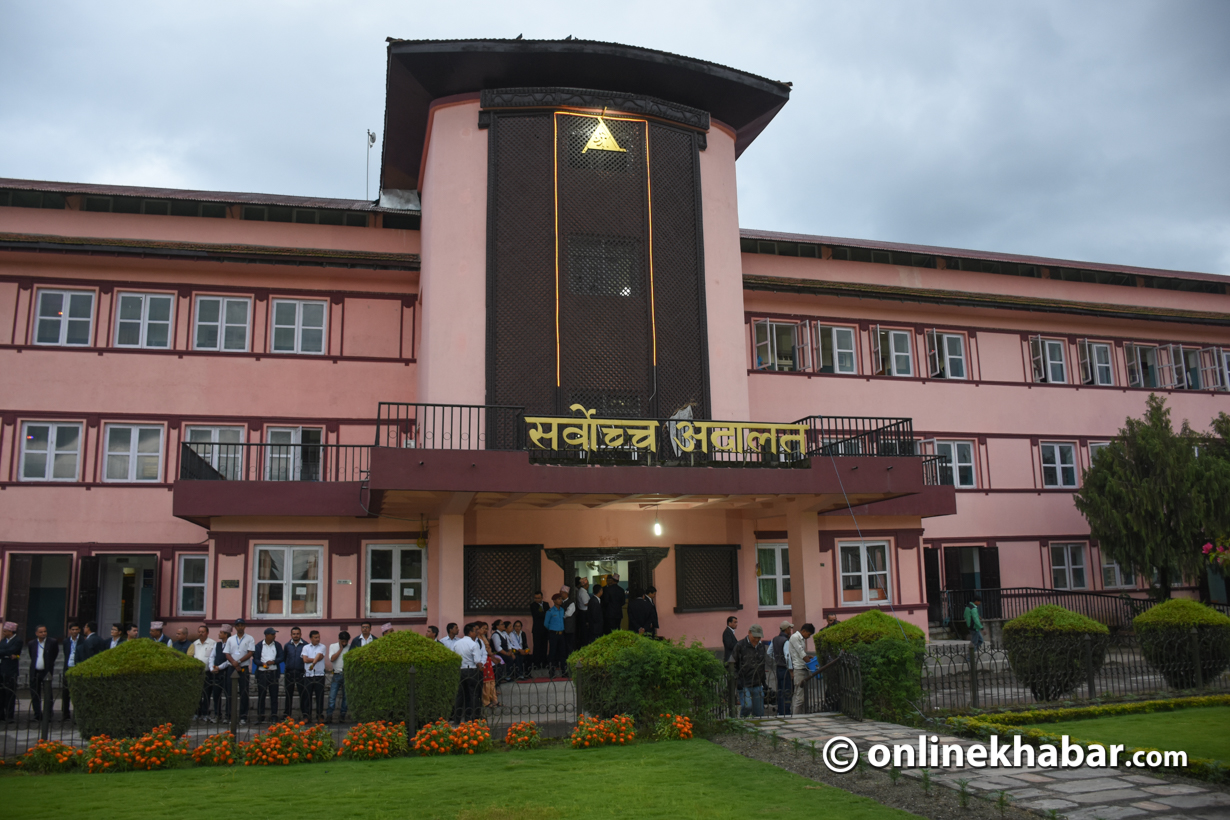
Despite continuous litigation on cases like the 52 constitutional officials’ appointments and the political party ordinance amid UML’s division, the Supreme Court has generally refrained from delivering clear, conclusive interpretations regarding ordinances.
Since ordinances have a set limited duration, the courts rarely hear disputes once an ordinance becomes invalidated and the Supreme Court often states there is no need to interpret an ordinance that no longer exists. This practice grants ongoing opportunities for the rulers to exploit ordinances.
The Supreme Court’s Silence
While the Supreme Court initially questioned the legitimacy of ordinances, its final interpretation appears to have shifted. When the Oli government introduced an ordinance amending citizenship law, the Supreme Court issued a temporary order.
At that time, the Court referred to such practices as “colorful legislation” and ruled that ordinances lack constitutional validity.
It stated, “If this practice becomes accepted as normal, it would interfere with legislative authority and could adversely affect the constitutional principle of separation of powers.”
Constitutional and governmental practice require that ordinances meet basic criteria, such as being issued only when Parliament is not in session. Nonetheless, governments have repeatedly delayed parliamentary sessions while issuing ordinances.
Senior Advocate Bhandari views this authoritarian tendency of the government as disrespectful to the rule of law and the legislature.
Another critical condition for issuing ordinances is the ‘urgency’ of the matter. Article 114 of the Constitution indicates ordinances are justified only when a task cannot be accomplished otherwise.
Although the Supreme Court initially gave clear directions regarding the citizenship ordinance, it remained silent in its final ruling where a bench tacitly accepted that the ordinance’s urgent necessity had ended.
The case concerning the 52 constitutional officials follows a similar pattern. Repeated issuance of the same ordinance has prevented the Supreme Court from providing an interpretation on the ordinance’s broader impact on the country’s governance.
In late July, the Supreme Court had an opportunity to assess the ordinance’s justification, but judges in the Constitutional Bench appeared reluctant.
Judges Dr. Manojkumar Sharma and Dr. Kumar Chudal explained at length the scope of the President’s power to issue ordinances but refrained from discussing conditions or limits.
They relied on precedents that the constitutionality of invalidated laws could not be tested, concluding that since ordinances issued by the Oli government had lapsed, they could not be adjudicated.
It is unclear from the ruling whether Chief Justice Prakash Man Singh Raut and Judge Dr. Nahakul Subedi agreed with this position. Senior Judge Sapana Pradhan Malla dissented by remaining silent. The full text of that nearly ten-month-old decision has yet to be published.
Senior Advocate Bhandari remarks that the country’s judiciary is overly traditional and inactive in constitutional dispute interpretation.
“In precedent cases related to ordinances and significant issues like interim government formation, the Supreme Court has not shown prompt, necessary initiative,” Bhandari says. “The Court is missing opportunities to interpret constitutional conflicts and thereby enliven the Constitution.”