
Madhesi-Centric Parties Out of Power After Eight Years
Summary
- After eight years in power, Madhesi-centric parties have become opposition for the first time.
- Unable to form a government in Madhesh Province, JSP, Janamat, and LOSPA were replaced by a Congress-led coalition.
- Political analysts say Madhesi-centric parties lost public support due to their focus on power interests.
May 24, Janakpurdhama – Madhesi-centric parties that have been in power in Madhesh for eight years are now in opposition for the first time. After the Congress-led government ousted the Janata Samajwadi Party (JSP), Madhesh is witnessing its first government without any Madhesi-centric party representation.
On Thursday, Madhesh Chief Minister Krishnaprasad Yadav dismissed ministers Rajkumar Gupta (Physical Infrastructure), Manish Suman (Labor and Transport), and Ranikumari Tiwari (Education and Culture), all from JSP Nepal. He later gave them time to resign voluntarily before removing them and invited UML to join the government.
Earlier, on May 4, Janamat Party withdrew its support from the Madhesh government. Although Maheshprasad Yadav, Finance Minister from Janamat, and Sports and Social Welfare Minister Basant Kushwaha resigned by the Chief Minister’s directive, this marked the first time Madhesi-centric parties lost power in the region.
Following the promulgation of the constitution on September 20, 2015 (Ashwin 3, 2072 BS), the first provincial elections in 2017 established a government in Madhesh Province led by Lalbabu Raut of the Federal Socialist Forum. Initially, the Forum and Rastriya Janata Party Nepal collectively won 55 of 54 required seats. Despite subsequent unity and splits, and participation from Congress and the then Maoist Centre, Raut’s government remained in power.
However, the Loktantrik Samajwadi Party (LOSPA), led by Mahanta Thakur, left the government after two years. The Madhesh-focused parties influenced the renaming of Province No. 2 to ‘Madhesh Province.’
In the second provincial election held in December 2022 (Mangsir 2079), Madhesi-centric parties were again unable to secure a majority. In the 107-seat Madhesh Provincial Assembly, JSP Nepal won 19 seats, Janamat 13, and LOSPA 9. The three parties failed to form a government together. Although JSP and Janamat crossed the electoral threshold, LOSPA did not become a national party. Despite this, JSP led the initial government of their second term.
On January 7, 2023 (Poush 23, 2079 BS), Saroj Kumar Yadav, leader of the JSP parliamentary party, became Chief Minister supported by UML, Janamat, Maoist Centre, LOSPA, and the Unified Socialist party. National-level political alignments affected Madhesh politics. Maoist Centre withdrew its support on May 14 (Baisakh 30), and on May 6, 2024 (Jestha 23, 2081 BS), Yadav lost a vote of confidence in the assembly with 50 votes in favor and 53 against, ending his 17-month government tenure.
Afterward, on May 8, Madhesi-centric parties regained leadership with Satish Kumar Singh from Janamat appointed Chief Minister, backed by UML, Maoist Centre, Unified Socialist, Nagrik Unmukti Party, and Federal Socialist Party. Although LOSPA was in government, JSP remained in opposition initially; later, Congress joined the coalition.
During the ‘Janajati Jatiya’ (‘Jenji’) movement on September 9, 2023 (Bhadra 24), under the direction of Dr. CK Raut, Chief Minister Singh announced his resignation on social media but later refused to resign as the situation calmed. Subsequently, Janamat withdrew its support and on October 14 (Ashoj 28) announced resignation in the assembly due to the impending loss of a vote of confidence. Singh’s tenure lasted about 16 months.
On October 15 (Ashoj 29), Jitendra Sonal of LOSPA became Chief Minister with support from six parties including JSP. The coalition included JSP, Janamat, Maoist Centre, LOSPA, and UML Unified Socialist.
However, Sonal’s appointment led to a split within Janamat as provincial assembly members and former ministers Satish Singh and Tribhuvan Sah left to form the Janaswaraj Party, which was later invalidated. On November 8 (Kartik 22), both Singh and Sah were absent during Sonal’s vote of confidence, causing Sonal to lose support after a rebellion by Maoist Centre assembly member Rahbar Ansari. Following this, Sonal announced his resignation, ending the continuous leadership of Madhesi-centric parties in Madhesh government.
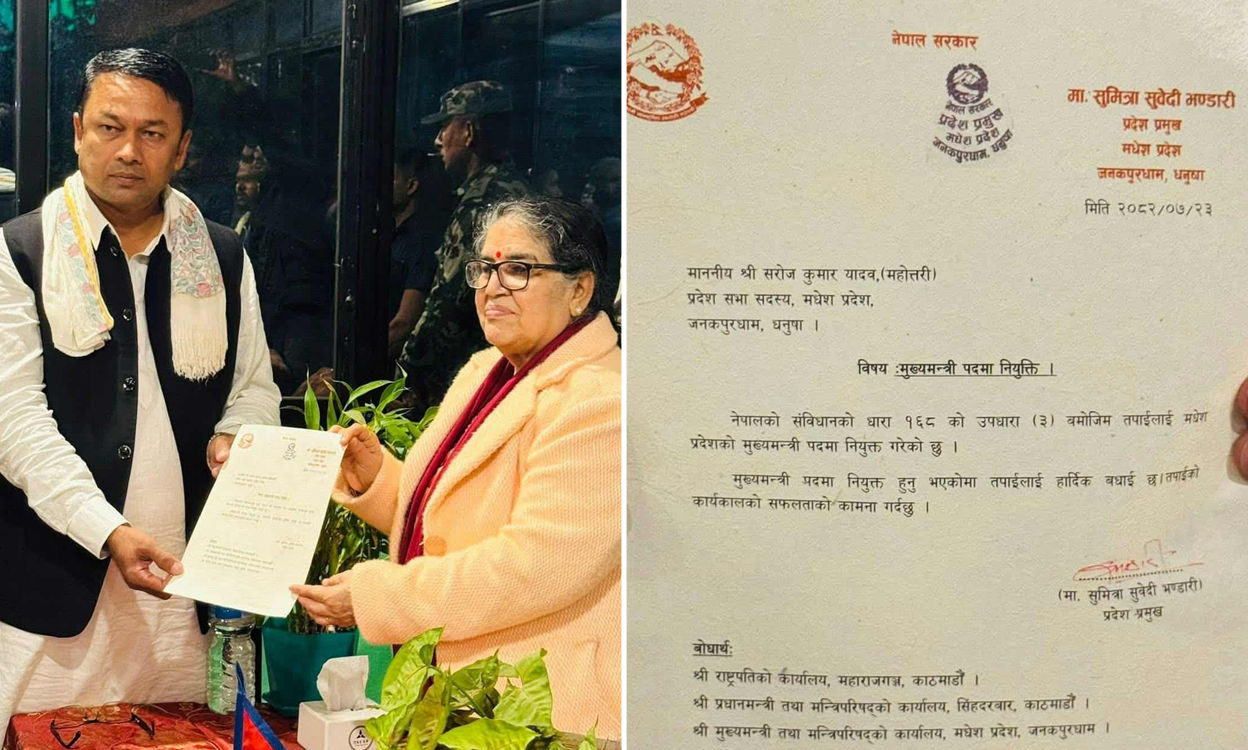
According to Section 168(3) of the Constitution, UML parliamentary party leader Saroj Kumar Yadav was appointed Chief Minister on November 9 (Kartik 23) at night. Despite controversy about the oath-taking reportedly held at a hotel, this government included one seat each for Rastriya Prajatantra Party Nepal and Federal Socialist Party. However, this government fell within 21 days.
Later, on December 4 (Mangsir 19), Congress’s Krishnaprasad Yadav was appointed Chief Minister with support from Madhesi-centric parties. Nevertheless, currently all Madhesi-centric parties are in opposition — a situation unprecedented in Madhesh.
JSP leader Manish Suman commented, “This is an unnatural coalition. We are now in opposition and will support or oppose the government based on merits and faults.”
Despite this, Madhesi-centric parties have held roles at the federal level. Until September 8, 2023, during the ‘Jenji’ rebellion, Mahanta Thakur’s LOSPA was part of then Prime Minister KP Sharma Oli’s government.
However, after failing to cross the electoral threshold in the January 4, 2024, House of Representatives election, JSP and Janamat lost national party status. Although their presence in the House became marginal, Madhesi parties remained influential in provincial power dynamics. With the formation of a Congress, UML, and Maoist Centre coalition, Madhesi-centric parties have been sidelined.
Political analyst Dr. Bhogendra Jha states, “Janamat Party is the main cause of instability in Madhesh Provincial Assembly’s second term. The public had high expectations from Janamat, but the government was never strong. It has become clear that Dr. CK Raut lacks a clear vision.”
Madhesi-Centric Parties Marginalized Due to Power Politics
Analysts argue that prioritizing personal power interests over agendas led to the marginalization of Madhesi-centric parties. Despite governing Madhesh for years, they failed to act according to popular sentiment.
Issues such as patronage budgets, operating through consumer committees, distributing project letters, and manipulating personnel transfers have tainted the Madhesh government’s reputation. There are widespread allegations that Madhesi-centric parties created a culture conducive to corruption and weak governance.
A political analyst commented that Madhesi-centric parties’ failure to carve a distinct identity separate from Congress and UML is a key factor in their current predicament.
“While in power, these parties acted to benefit their inner circle and themselves but failed to deliver for the general public. Consequently, popular support has declined. They do not present themselves differently from Congress or UML,” he noted.
Dr. Bhogendra Jha contends that the situation arose from the thirst for power and selfish behavior of Madhesi-centric parties. “The Madhesi issue is not resolved, but the power ambitions of these parties have caused this state of affairs. They also lacked federalism and discipline,” he said.
While Madhesi-centric parties could regain opportunities by acting responsibly as opposition, their willingness to do anything to regain power limits expectations.