
Ask the Border Residents: Who Is Encroaching on the Border?
News Summary
Editorially Reviewed.
- After Prime Minister Balen Shah stated that Nepal has also encroached on Indian territory, protests and debates erupted from parliament to the streets.
- Regarding the dam under construction in Shusta, West Nawalparasi, the Indian Border Security Force (BSF) has instructed district officials that work should proceed only after discussions.
- While the Armed Police have repaired 2,690 border pillars in the last three fiscal years, the Indian side’s participation has been very limited.
May 31, Kathmandu – “I only realized after becoming the prime minister that it’s not only India that has encroached, but Nepal has also encroached on Indian land. This issue must be looked at by both sides,” Prime Minister Balen Shah said during his first response to the parliamentarians’ questions on Sunday.
The question raised about India’s encroachment on Nepalese territories of Lipulekh, Limpiyadhura, and Kalapani prompted the prime minister to reveal that the matter has even been conveyed to the United Kingdom, with Nepal also raising accusations of encroachment. His statement has intensified debates both within parliament and on the streets. Opposition parties have demanded that this statement be removed from the parliamentary record.
On the same day, the opposition’s affiliated organizations held protests on the streets. The prime minister’s controversial remarks have reignited the Nepal-India border dispute.
Linked to the prime minister’s remarks, the Indian Border Security Force has allegedly obstructed the construction of a dam by the Nepalese side, sparking criticism. However, prior to the prime minister’s statement, the BSF had requested district officials to hold discussions before proceeding with the dam construction in Shusta, West Nawalparasi, which Nepalese security personnel confirmed.
The border dispute sparked by the prime minister’s comments is only one aspect. There are various other problems faced by local border residents. According to a former AIG who retired from the Armed Police’s border department, numerous issues especially affect the southern border areas. Both sides engage in farming and housing within a ten-yard belt, causing frequent conflicts.
The former official explained that boundary problems intensified during the COVID-19 pandemic when border crossings were closed. “Disputes increased as the Indian side escalated tensions. We saw a direct impact on the livelihoods of the border residents as disputes peaked,” he stated.
Since border residents are the first line of defense, they bear the brunt of all problems in the border regions, former AIG Narayan Babu Thapa said. There have been incidents where border residents lost their lives or were injured due to these disputes.
For example, a clash occurred on August 30, 2016, at the Khandha River along the Nepal-India border in Saptari district when the Indian side attempted to build a dam by encroaching on Nepalese land, resulting in 12 Nepalese injured.
At that time, Devanarayan Yadav of Tilathi VDC-4 led the resistance, sustaining injuries including a head wound from the Indian side’s attack.
The conflict arose during efforts to rebuild the dam in Tilathi after the Indian-made dam was damaged by flooding about a decade ago, when the Indian side attempted reconstruction encroaching on Nepalese land.
Later, Devanarayan was arrested and an abduction case was filed against him. He was detained by Indian authorities on October 2, 2017. His son Ajay was also arrested due to complaints filed after marrying an Indian woman. When visiting Devanarayan, Indian police publicly handcuffed him.
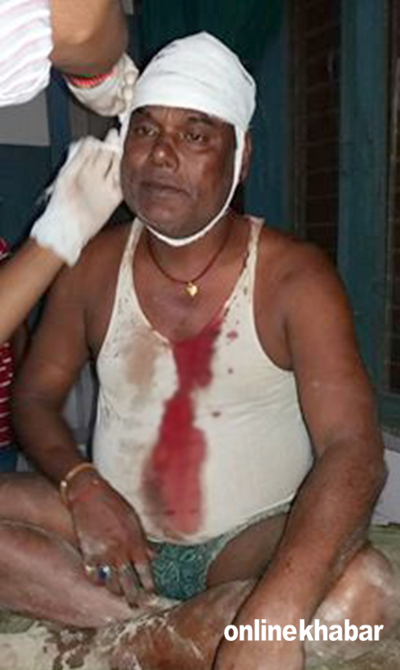
Security officials have linked the arrest and handcuffing of the innocent Devanarayan on Nepalese soil to the long-standing border dispute. He was later released on bail as ordered by the court.
Devanarayan’s head injuries are not an isolated case; there have also been fatal incidents due to the border dispute.
In February 2017, Govinda Gautam of Kanchanpur Rehabilitation died after being shot by the BSF during a calvert construction dispute along the Nepal-India border. Though the government declared him a martyr, the issue later faded into obscurity.
On August 1, 2021, 33-year-old Jay Singh Dhami from Byas Rural Municipality-2, Darchula, went missing due to negligence by Indian security personnel. While crossing the Mahakali River via a traditional rope bridge (“twin”), Indian forces reportedly cut the rope, causing his disappearance. Nepal sent a diplomatic note to India at that time, but no response has been received so far.
The government provided 1 million rupees relief to Jay Singh’s family, recognizing him as deceased. Incidents such as disappearances, killings, and assaults reveal the hardships suffered by border residents.
What Is Happening in Shusta?
A dam is currently under construction in Shusta, West Nawalparasi. The Ministry of Energy, Water Resources, and Irrigation is overseeing the embankment work with a contract worth approximately 140 million rupees.
Just on Saturday, a team including Armed Police SP Govinda Khati and Chief District Officer Deepak Nepali visited the border area for inspection. Nepalese and Indian Border Security Forces conduct joint patrols there.
According to SP Khati, joint patrols were scheduled on Sunday. The team visited the dam site in the afternoon. The Nepalese side is working on an extension of approximately 132 meters on the old dam. The BSF has requested that new dam construction proceed only after discussions at the district magistrate level, security personnel confirmed.
Chief District Officer Deepak Raj Nepal of West Nawalparasi said the BSF requested coordination during the new dam construction. He stated, “The BSF asked us not to work without discussions and coordination, but the work has not been stopped.”
Border Security by Armed Police
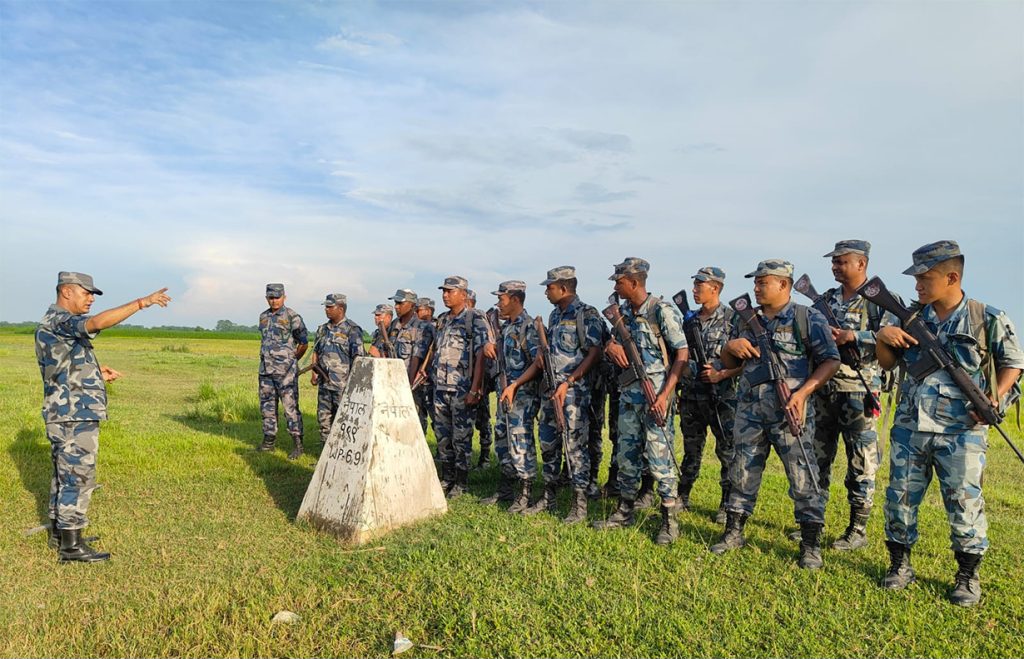
Initially, border posts were established by the Nepal Police, but after the formation of the Armed Police Force, border security has been managed by them. According to APF Deputy Spokesperson DSP Shailendra Thapa, there are 249 Border Out Posts (BOPs) along the Indian border and 11 BOPs along the Chinese border.
Through these BOPs, the Armed Police secure the borders and conduct joint patrols with the Indian Border Security Force. Coordination occurs even at the Inspector General of Police (IGP) level. During fiscal years 2022/23 and 2023/24, intense discussions have taken place between Nepal and India. The Armed Police have repaired 2,690 boundary pillars, whereas the Indian side has shown less activity.
The Armed Police prioritize repairing the ‘ten-yard’ border pillars, while the Indian side has not carried out any repairs in fiscal year 2024/25 yet.
Challenges Faced by Shusta Residents
On February 24, 2025, Ranjan Loniya of Shusta Rural Municipality-5 was working in his own field when BSF personnel stopped him, claiming “This is Indian land,” and assaulted him. When BSF tried to detain him and take him to their camp, local villagers, Nepal Police, and Armed Police intervened and freed him.
The Indian side filed cases against activist Adam Khan, Ranjan Loniya, and 14 others at Balmiki Nagar police station. Some were arrested by Indian authorities following the case.
Adam Khan said, “Despite such atrocities by the Indian side against Nepalese, political parties and security agencies do not openly protest. Anyone who does risks facing lawsuits and arrest.”
Harijan, a local clerk from Shusta-5, complained that BSF has prohibited motorcycle movement and threatened with weapons during smuggling control.
Ward Chair Harilal Dusadh of Shusta-3 stated that the BSF obstructed farming, calvert construction, and caused harassment when residents entered settlements.
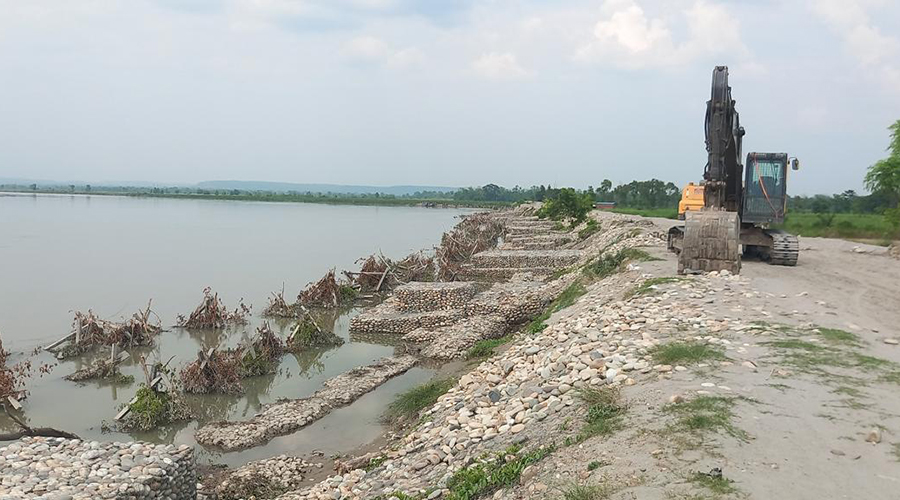
Due to changes in the Narayani (Gandak) River’s course, India is alleged to have encroached on approximately 14,500 hectares of Nepalese land in Shusta over the past decade. Raviendra Jaiswal, spokesperson for the Shusta Protection Campaign, said a significant portion of land is under Indian control, limiting locals’ access to their own land.
Jaiswal added, “Nepal’s weak presence and lack of support for Shusta residents leave locals afraid to speak openly about abuses. BSF personnel armed with weapons enter Nepalese territory, restrict farmers from accessing their fields, and create psychological pressure.”
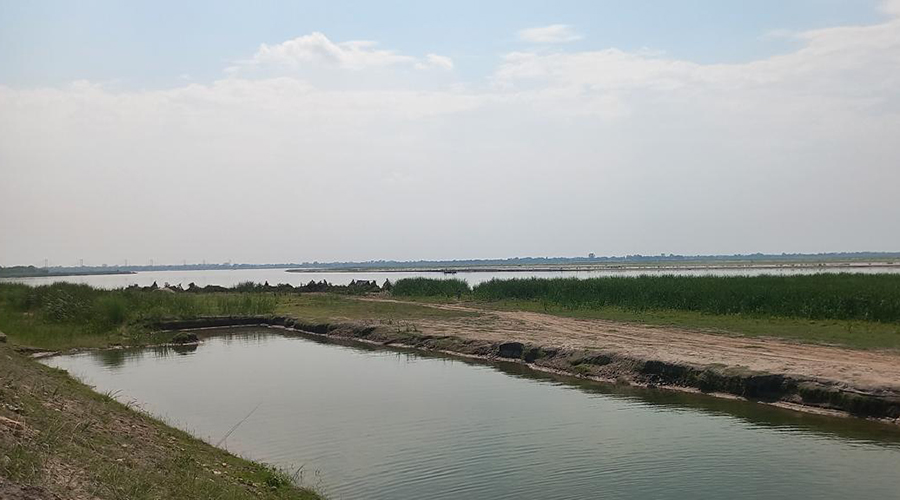
Shusta Rural Municipality Chair Teknarayan Upadhyay said the encroachment figures are based on data provided to the federal government. He noted, “Before 1993, the abuse by BSF and Indians was more severe, but issues have decreased with the presence of Nepalese security forces.”
Historically, the border dispute and river erosion have affected this area, with the Narayani River and Indian Bihar state forming the boundary. The absence of fixed border pillars and frequent river course shifts lead to land encroachment.
In 1965, the government resettled about 400 families, including veterans, in Shusta. Various obstructions since then have contributed to the current dispute.