What Is China’s Activity in the Eastern Maritime Region of Taiwan?
June 12, Kathmandu – The United Kingdom, France, and Germany have expressed serious concern over China’s coast guard patrol activities near Taiwan’s eastern shore. These three countries issued a joint statement last Wednesday through their respective offices in Taipei, which function as de facto embassies despite the absence of formal diplomatic ties with Taiwan.
None of these countries has formal diplomatic relations with Taiwan, reflecting the stance of most Western nations. Nonetheless, they frequently express concerns about China’s growing pressure on Taiwan.
The joint statement read, “We are watching China’s new activities in Taiwan’s eastern maritime zones with serious concern.” It elaborated on the reasons for this anxiety.
China’s actions are claimed to threaten regional stability and jeopardize the freedom of navigation. The security of international shipping routes has also been affected. These three countries oppose any unilateral attempts to alter the status quo through force or intimidation and called for the safety of vessels and sailors to be ensured. When asked for comment, China’s Foreign Ministry did not immediately respond.
The UK, France, and Germany do not have formal relations with Taiwan because they adhere to the One-China policy, which recognizes Beijing as the sole legitimate government of China. Consequently, they cannot establish official embassies in Taipei.
This is the case for many other countries worldwide as well. Nonetheless, they maintain representative offices in Taipei to facilitate trade, cultural, and other relations. These offices issued the joint statement on Wednesday.
The dispute began earlier this year in June when China deployed coast guard vessels near Taiwan’s eastern coast in a maritime area. China termed this maneuver the “Special Maritime Traffic Law Enforcement Campaign.” Taipei promptly protested against the incursion.
This campaign is linked directly to another recent development: the Philippine President’s recent visit to Japan. During the visit, Japan and the Philippines issued a joint statement announcing the start of formal talks to demarcate maritime boundaries within their exclusive economic zones (EEZs).
This maritime area lies east-west in proximity to Taiwan. Beijing claims it as part of China’s maritime jurisdiction. According to China, Japan and the Philippines have moved unilaterally in these talks, prompting China to launch its campaign last Saturday as a countermeasure.
Coastal nations have rights over economic resources within a determined distance from their shores, known as the Exclusive Economic Zone. When EEZs of neighboring countries overlap, negotiations are necessary between involved parties to establish clear boundaries.
Japan and the Philippines’ effort to begin talks falls under this context. However, China asserts that, based on its claims over Taiwan, this region falls within its maritime interests, necessitating its inclusion in any boundary discussions.
000
The sequence of events clarifies the situation further. China began its campaign last Saturday. On Tuesday, Mao Ning, spokesperson for China’s Foreign Ministry, held a press conference, followed by another from Zhang Han, spokesperson of the Taiwan Affairs Office in Beijing on Wednesday.
On the same day, Zhu Fenglian, spokesperson for the State Council’s Taiwan Affairs Office, publicly reaffirmed China’s stance while the UK, France, and Germany issued their joint statement. The release of three separate diplomatic messages in one day underlines the seriousness of this dispute.
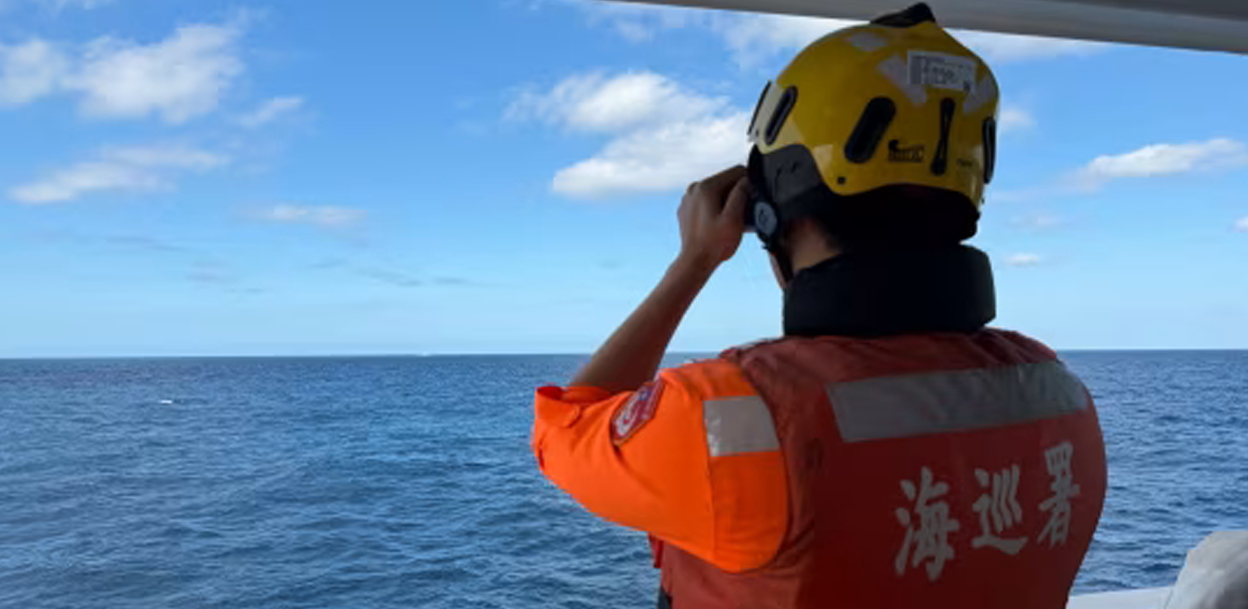
According to China’s official news agency Xinhua, the campaign is conducted by China’s Ministry of Transport and involves maritime security administrations from Fujian and Guangdong provinces. The East China Sea Navigation Support Center coordinates operations alongside the East China Sea Rescue Bureau.
Xinhua outlined several campaign objectives: First, to fully enforce China’s maritime administrative laws within the main waters. Second, to enhance patrol capabilities and traffic control in deep seas. Third, to ensure maritime traffic safety. Fourth, to safeguard national interests.
China released statistics claiming its coast guard inspected 198 vessels transiting the area, noting violations detected on three ships, which were rectified. It also conducted hydrographic surveys in the region.
China also reported patrols in areas where underwater cables are laid, deploying maritime survey vessels in the same waters. During the Tuesday press briefing, Foreign Ministry spokesperson Mao Ning sharply criticized Japan and the Philippines’ actions, labeling them violations of the United Nations Convention on the Law of the Sea (UNCLOS).
She described this move as a violation of fundamental principles of international law and relations, stating, “This action causes serious harm to China’s maritime rights and interests.” Mao emphasized that China would never accept these developments.
She affirmed that both Chinese domestic laws and UNCLOS confirm China’s exclusive economic zone and continental shelf in the area. Mao noted that boundary determinations between neighboring or adjacent coastal states should be concluded through bilateral agreements based on equal grounds, asserting that China must be an indispensable party in the talks east of Taiwan.
At another press briefing, Zhu Fenglian of the Taiwan Affairs Office declared the Japan-Philippines proposed boundary talks entirely illegal, null, and void.
She characterized the talks as a severe assault on China’s maritime rights and a breach of international law. Zhu referred to residents on both sides of the Taiwan Strait as Chinese nationals and urged steadfast adherence to national positions.
Zhu warned that if Taiwan’s ruling Democratic Progressive Party collaborates with foreign powers against national interests, the people on both sides of the Strait would reject such moves, and history would punish them accordingly.
In a separate Wednesday press conference in Beijing, Zhang Han reaffirmed China’s claim that the maritime area Japan and the Philippines are attempting to delimit lies within China’s exclusive economic zone. He described Chinese coast guard patrols as lawful, legitimate, and necessary.
000
This situation raises major strategic questions. China appears to be employing its coast guard as a tool to extend its influence without crossing military boundaries, blurring the distinction between civilian pressure and military action.
Known as a “gray zone” strategy, coast guard activities, naval shadowing, and airspace incursions exemplify tactics that intensify tension without outright warfare, testing governmental resolve within limited boundaries. Consequently, Western governments face significant challenges in formulating appropriate responses.
Lisa Curtis, senior fellow at the Center for a New American Security and director of its Asia-Pacific Security Program, stated that China’s strategy aims to gradually weaken Taiwan’s defense structures without declaring war.
“Beijing uses coast guard and paramilitary vessels to create situations. If Taiwan or its allies were to respond with military force, they would be accused of provocations, while doing nothing would enable China’s incremental control,” she explains.
Ivan Lakshman, Southeast Asian political analyst at the International Institute for Strategic Studies, views the coast guard as an “aggressive weapon” for asserting sovereignty and applying strategic pressure.
“China employs its coast guard as an offensive tool. These white-painted vessels perform strategic roles similar to the gray-colored naval ships, effectively erasing the distinction between civilian administration and military operations,” he wrote in The Straits Times.
Andrew Small, senior fellow at the German Marshall Fund’s Indo-Pacific program, emphasized that Taiwan’s issue is a global one. The concern of European countries stems from its impact on global supply chains.
“This is not solely Taiwan’s issue; it concerns the security of global supply chains. The gray zone strategy is difficult to counter alone, so Western governments must collectively reject it and pressure for adherence to international legal norms,” he asserted.
Raymond Powell, director of the Sealevel project at Stanford University, compared China’s strategy to a shark that gradually encircles its prey without attacking suddenly. Speaking to the Wall Street Journal, he said, “Its goal is to isolate Taiwan gradually from the world without firing a shot. Each aggressive move is so minor that the chance of immediate war remains low, which is precisely China’s strategy.”