Drafts of Two Bills Prepared to Split Nepal Aviation Authority; Could EU Blacklist Be Lifted?
June 9, Kathmandu – Drafts of two bills have been prepared to divide Nepal’s aviation regulatory body, the Civil Aviation Authority of Nepal (CAAN), into service provider and regulatory authorities. The bills are titled the Nepal Air Services Authority Establishment and Management Bill and the Civil Aviation Authority of Nepal (Amendment) Bill.
The Ministry of Culture, Tourism, and Civil Aviation has made both drafts public for stakeholder feedback. These bills were initially registered in the previous parliament but were not passed before its dissolution, prompting the ministry to prepare and publicize the drafts again.
Currently, under the Civil Aviation Authority Act 1996 (2053 BS), a single authority regulates the airline sector and manages airport operations.
Through these new bills, the government aims to replace the Civil Aviation Authority Act 1996. Nepal has been on the European Union’s (EU) aviation blacklist since 2013.
International regulatory bodies have raised concerns over the combined regulatory and service provider model in Nepal. Approval of the bills would strengthen Nepal’s position in negotiations with the EU.
Separate Authority to Manage All Airports Nationwide
According to the new drafts, the Nepal Air Services Authority (referred to in English as the Air Services Authority of Nepal) will handle airport, air navigation services, and related operations.
This authority will undertake airport construction, upgrades, operations, and management. It will oversee Nepal’s airspace, airports, air navigation, and related services within airport areas.
The authority will also manage air traffic control and aviation information services, firefighting and rescue services at airports, ground handling, fueling, flight catering, and cargo services.
Further responsibilities include preparing and implementing aeronautical charts, coordinating search and rescue operations, exchanging meteorological information for flights, and developing standards for airports, heliports, and helipads, which will then be submitted to the regulatory authority for approval.
The chairperson of this authority will be the Secretary of the Ministry of Tourism. The board will include additional members such as the joint secretaries from the Ministries of Home, Finance, and Tourism, as well as two expert members.
The Managing Director, who will act as the member-secretary, must be at least 35 but no older than 60. The legislation stipulates that airport construction cannot proceed without government approval.
Importantly, the bill opens the door for private sector involvement in airport operations and management.
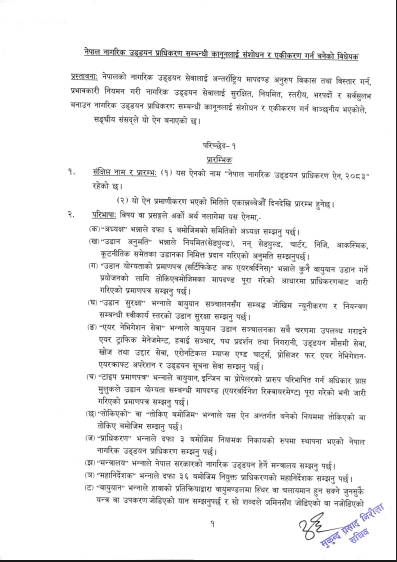
The authority can approve contracts with government or non-government entities, or competitively with the private sector, for the operation and management of airports under its control.
The bill prohibits establishing slaughterhouses or dumping waste within three kilometers of any airport.
The new authority will also be responsible for levying and setting various service charges related to airports, issuing takeoff and landing permits, and overseeing air navigation and airway management.
Leadership will come from a Managing Director appointed via open competition from senior officials currently serving in the authority or those with at least a postgraduate degree from reputable universities and minimum 15 years of experience including five years in civil aviation management.
The Managing Director’s term is four years, with provisions allowing the government to remove the director at any time in case of underperformance.
Civil Aviation Authority to Serve as Regulatory Body
Under the new arrangement, CAAN will operate as the regulatory organization. It will issue, renew, suspend, or revoke certificates to licensed entities and service providers.
These functions cover airline operations; aircraft airworthiness; recreational aviation activities like gliding, ultralight, microlight, ballooning, paragliding, hang gliding, and skydiving; as well as air navigation services, airport, heliport, and helipad operation; civil aviation training; aircraft and parts manufacturing or maintenance; as well as heavy maintenance (overhaul).
CAAN will also register aircraft and provide registration marks and national insignia, approve airport registration and security standards, and issue type certificates to aircraft.
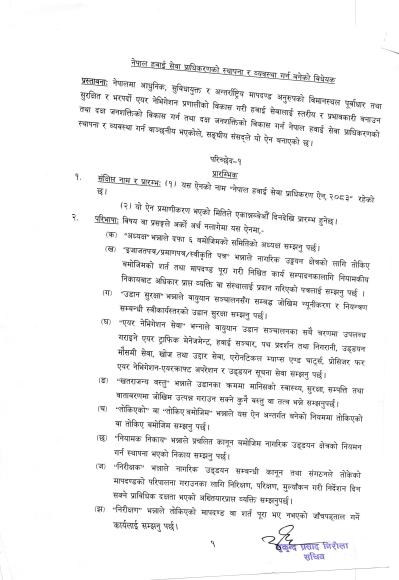
The authority will regulate issuance of necessary licenses, certificates, and permits for specialized qualifications, competence, and experience required in civil aviation.
Additionally, it will monitor compliance with approved procedures and standards regarding aircraft arrival and departure points, air routes, and flight protocols.
CAAN will implement international conventions, standards, and recommendations related to civil aviation to which Nepal is a party, issuing necessary directives or circulars and addressing any divergent reservations or provisions with international bodies.
Setting fare rates will also fall under the regulatory authority’s purview. The chairperson of CAAN will be the Minister of Tourism, with joint secretary-level members from the Ministries of Tourism and Finance and one expert member included.
The Director General, who acts as the member-secretary, will serve a four-year term. The government may appoint a first-class gazetted officer or senior official from the authority to the Director General post, and can remove the Director General at any time if performance is unsatisfactory, as per the new bill.