
What Are the Backgrounds of the Chairpersons Managing the Mini-Parliament?
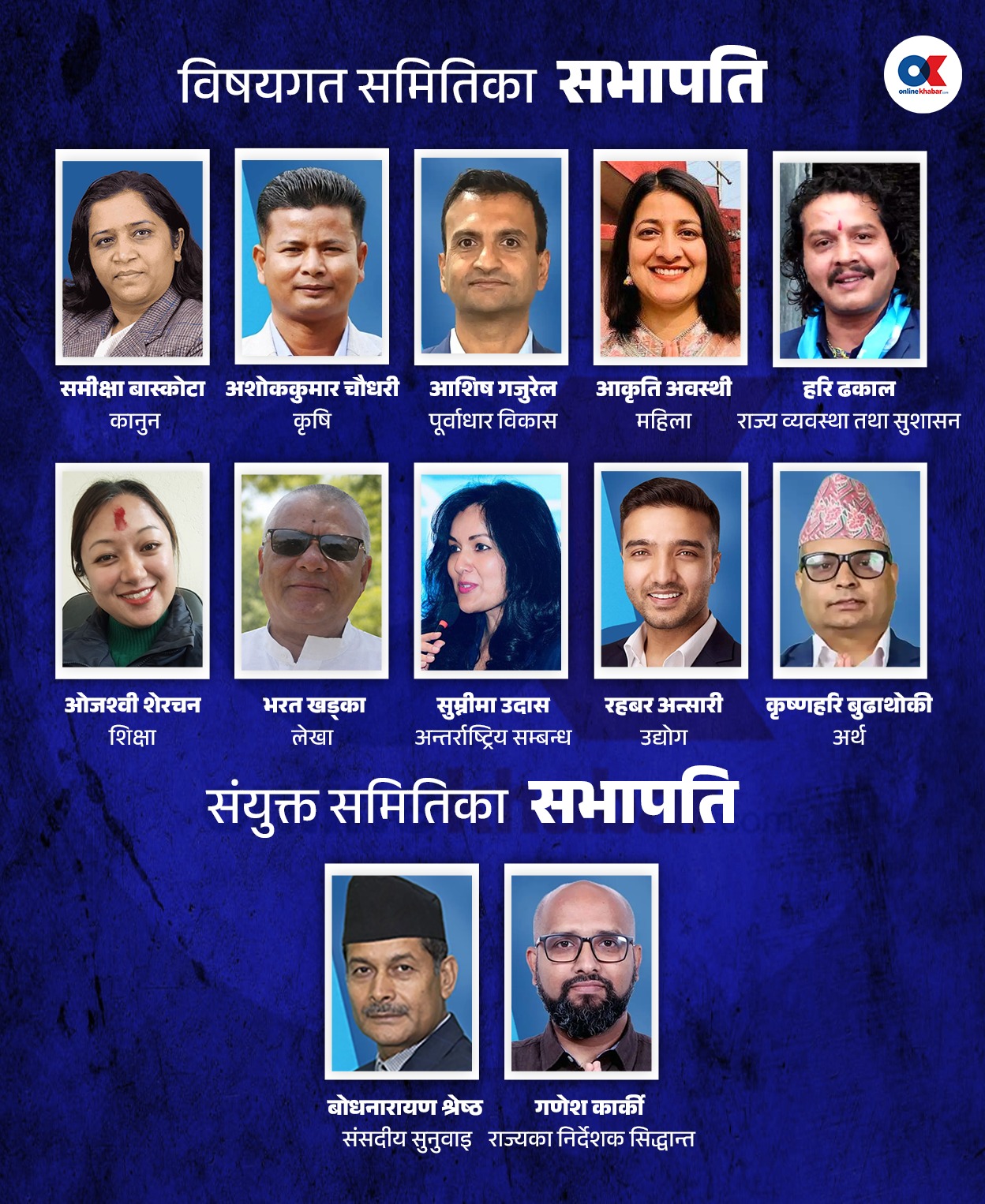
April 17, Kathmandu – On Friday, twelve parliamentary committees appointed their chairpersons. Among the new chairpersons of the parliamentary committees, often referred to as the mini-parliament, nine are first-time members of parliament while three have prior parliamentary experience.
Hari Dhakal of the State Affairs and Good Governance Committee, Ashokkumar Chaudhary of the Agriculture, Cooperatives and Natural Resources Committee, and Bharat Bahadur Khadka of the Public Accounts Committee have all previously served on various committees in the earlier parliament.
The other nine chairpersons are entering the federal parliament for the first time. These include Samiksha Baskota, chairperson of the Law, Justice and Human Rights Committee; Ashish Gajurel, chairperson of the Infrastructure Development Committee; and Aakriti Awasthi, chairperson of the Women and Social Affairs Committee. Bodhnarayan Shrestha is the chairperson of the Parliamentary Hearing Committee, while Sumnima Udas leads the International Relations and Tourism Committee and Krishnahari Budhathoki chairs the Finance Committee.
Ganesh Karki chairs the State Directive Principles, Policy and Duties Implementation Monitoring and Evaluation Committee; Ojaswi Sherchan leads the Education, Health and Information Technology Committee; and Rahbar Ansari is chairperson of the Industry, Commerce, Labor and Consumer Interests Committee.
Ansari, the chairperson of the Industry, Commerce, Labor and Consumer Interests Committee, was previously a member of the Madhesh Province Assembly and has now been directly elected to the House of Representatives.
Leadership of the Public Accounts Committee with Over Four Decades of Political Experience
The Public Accounts Committee is one of the most vital subject committees of the parliament. It audits whether government spending is necessary, economical, and effective. It plays a critical role in providing checks and balances on the government.
Traditionally, the chairpersonship of the Public Accounts Committee is given to the main opposition party. This time, Bharat Bahadur Khadka of the Nepali Congress was unanimously appointed chairperson.
Born in 2016 BS (1959/60 AD) in Khirsain Village Development Committee of Doti, Khadka has been active in politics since 2032 BS (1975/76 AD). He initiated his political journey in 2039 BS (1982/83) as the chief of Khirsain Village Panchayat.
He served as deputy chairperson of Doti District Panchayat in 2043 BS, chairperson of the same Panchayat in 2044 BS, and deputy chairperson of the District Development Committee after the 2049 BS local elections. In 2054 BS, he was re-elected as chairperson of the District Development Committee.
After the establishment of the republican system in 2062/2063 BS (2005/2006), Khadka remained politically strong. He became a member of parliament through the 2070 BS (2013/14) Constituent Assembly election and then secured membership in the Sudurpaschim Province Assembly in the 2074 BS (2017) provincial elections.
In 2082 BS (2025/26), Khadka was directly elected as a member of the House of Representatives from Doti, and the Nepali Congress entrusted him with the role of chairperson of the Public Accounts Committee.
Experienced Young Leaders Entrusted with Key Roles
The State Affairs and Good Governance Committee includes top party leaders and works to hold the government accountable to parliament.
This committee is chaired by Hari Dhakal of the Rastriya Swatantra Party (RSP). He gained prominence in the 2079 BS (2022) election by defeating prominent leaders such as Dr. Bishwapaudel of the Nepali Congress and Surendra Pandey of the UML from Chitwan-1.
Dhakal now faces the challenge of leading this committee which includes senior leaders such as RSP Chairperson Ravi Lamichhane, CPN-UML coordinator and former Prime Minister Pushpa Kamal Dahal ‘Prachanda’, Labor Culture Party Chairman Harkraj Rai, and National Democratic Party parliamentary leader Gyanbahadur Shahi.
The committee also counts experienced young parliamentarians like Amaresh Kumar Singh, Arjun Narasingh KC, Padmakumari Aryal, Bhishma Raj Angdembe, Mohammad Ishtiyak Rai, and Yuvraj Dulal.
Additional members include Kavindra Burlakoti, Kamal Subedi, Karishma Kathariya, Gajala Shamim Mikrani, Nishkal Rai, Purushottam Suprabhat Yadav, Afsana Banu, Bishwaraj Pokharel, Ramesh Prasain, Rabindra Patel, Ram Lama, Rubina Acharya, Rekha Kumari Yadav, Vishnumaya Bik, and Shraddha Kuwar Kshetri.
At 42 years old, Dhakal is a youth leader with a background in the UML. During his school and college years, he was a member and secretary of the All Nepal National Free Students Union (ANNFSU), the student wing of UML.
After some ups and downs in business, he turned towards a spiritual path and became active in yoga, meditation, and ascetic activities.
Active in the RSP since 2079 BS, Dhakal has earned the trust of senior leaders and now has the responsibility to make the government accountable to parliament.
Besides lawmaking at the highest level, this committee advises and guides the government on good governance, peace and security, and legal affairs.
Its jurisdiction includes the Office of the Prime Minister and Council of Ministers, Ministry of Home Affairs, Ministry of Defence, Ministry of Federal Affairs and General Administration, Commission for the Investigation of Abuse of Authority, Public Service Commission, Election Commission, among others.
Another experienced young parliamentarian, Ashokkumar Chaudhary, chairs the Agriculture, Cooperatives and Natural Resources Committee.
Chaudhary, who became a proportional representation member in 2079 BS and was directly elected from Sunsari-3 this term, triumphed over major competitors including Vijay Kumar Gachhadar of the Congress and Bhagwati Chaudhary of UML to win the committee leadership.
This committee was also previously led by the Nepali Congress. It oversees the Ministry of Agriculture, Livestock, Land Management, Cooperatives, Poverty Alleviation, Forestry, Environment, and associated agencies.
Due to its direct impact on people’s lives, experienced leaders contest for its leadership. This time, the 42-year-old Chaudhary was chosen.
Prior to politics, Chaudhary was active in sports and is an international player in the ancient sport of tug-of-war. He represented Nepal in the 14th Asian Tug of War Championship in 2019.
He also serves as an advisor to the Nepal Tug of War Association and has continuously advocated for players’ rights, infrastructure, and expanded opportunities. In the previous parliament, he prioritized fertilizer, seeds, and irrigation as agricultural improvements.
Chaudhary pledged to ensure minimum support prices and market guarantees for agricultural products, gaining popularity among farmers.
Challenging Questioners of the Parliament
Ganesh Karki, chairperson of the State Directive Principles, Policy and Duties Implementation Monitoring Committee, is known as a strong questioner. He has even questioned his own party coordinator, Ravi Lamichhane, earning a reputation as a rebellious leader. He will continue to hold the government accountable regarding parliament’s responsibilities.
Part 4 of Nepal’s Constitution specifies state directive principles, policies, and duties as guidelines for state operations. Karki’s committee is responsible for evaluating the government’s implementation of these.
Karki, 40, elected from Morang-3, is also a film writer.
Krishnahari Budhathoki, chairperson of the Finance Committee, is an economic expert active in research for over two decades.
He has offered policy recommendations suitable for Nepal’s economy in public forums and now has parliamentary responsibilities. Budhathoki will review the effectiveness of government economic reforms and recommend improvements where necessary.
Ashish Gajurel chairs the Infrastructure Development Committee. He served as a government investment board advisor for over 11 years.
With a background in traffic engineering and transport management, Gajurel is an advocate for sustainable transport, road safety, infrastructure integrity, and policy implementation.
Holding a master’s degree in transport systems from Germany, he is expected to contribute significantly to modern, scientific infrastructure development.
Bodhnarayan Shrestha, chairperson of the Parliamentary Hearing Committee, is known for supporting development policy reform and result-oriented politics.
He advises the government to ensure efficiency, capacity, and integrity in appointments to constitutional bodies and will sound necessary alarms when required.
His committee oversees recommendations and decisions on appointments of the Chief Justice, Supreme Court justices, Judicial Council members, heads of constitutional bodies, and ambassadors.
Shrestha, 56, holds a bachelor’s in political science and a master’s in rural development. He will play a crucial role in ensuring the right people are appointed to the right positions.
Activists of Street Movements Now Leading Parliamentary Committees
Samiksha Baskota, chairperson of the Law, Justice and Human Rights Committee, is a leader of the Bibeksheel Sajha Party. She earned a master’s degree in law from the USA and entered parliament after the merger of Bibeksheel Sajha and RSP in the last Mangsir (Nepali calendar) election.
Previously, she raised demands for fundamental rights on the streets and will now pursue these through parliamentary channels.
Active in legal, human rights, and judicial reforms, Baskota will provide recommendations for positive governmental changes. Her committee also leads on international treaties, peace processes, and supervises the Ministry of Law, Justice and Parliamentary Affairs, Judicial Council, Judicial Service Commission, and the Attorney General’s Office.
Sumnima Udas chairs the International Relations and Tourism Committee. A former CNN journalist with decades of experience reporting from conflict zones, she now has the opportunity to lead debates on Nepal’s foreign policy.
Ojaswi Sherchan, chairperson of the Education, Health, and Information Technology Committee, is a parliamentarian with a medical background, having specialized in biochemistry at BP Koirala Institute of Health Sciences, Dharan.
Her committee will lead policy formation on medical education, research, health system improvements, and epidemic management.
Women Leaders Championing the New Generation Take Charge of Social Affairs Committee
Aakriti Awasthi, chairperson of the Women and Social Affairs Committee, is the sister of Mukesh Awasthi, a victim of the Janajati (Ethnic) movement. A proportional representation member, she plays a strong role.
Her committee focuses on inclusion and rights, monitoring the ministries and commissions related to women, children, senior citizens, national women’s commission, Dalit commission, inclusive commission, and other ethnic and community commissions.
It is expected that the new leadership will channel the voices raised by the Janajati movement on the streets into meaningful parliamentary responses by the government.