
Question for the Prime Minister: Will ‘Sudhan Gurung-2’ Be Appointed as Home Minister Next?
April 22, Kathmandu. As the government was being formed, there was widespread attention on who would be assigned the key ministries of Home, Finance, and Foreign Affairs, considered the most powerful posts after the Prime Minister.
On the basis of expertise, Swarnim Wagley was appointed Finance Minister, and Shishir Khanal was named Foreign Minister. Within the Rashtriya Sangh (Raj Sangh), no major claims were made for these ministries.
However, the question of who would take the most powerful position of Home Minister saw differing priorities among the top leaders of the Rashtriya Sangh: Ravi Lamichhane and senior leader and Prime Minister Balendra Shah. Lamichhane gave first priority to DP Aryal, who has now become the Speaker of the House.
In Prime Minister Shah’s list, trusted names ranged from Sunil Lamsal to Sudhan Gurung. Shah allocated Lamsal the Ministry of Physical Planning, while Sudhan Gurung was appointed Home Minister.
The announcement of Gurung as Home Minister surprised many, especially as he was placed third in ministerial seniority after Finance Minister Wagley. Former ministers and MPs, Foreign Minister Shishir Khanal and Virajbhakta Shrestha, were ranked lower than Sudhan.
This indicated he held a powerful position within the cabinet. However, within a few days, questions about his ranking led the Prime Minister to demote him to fifth.
Sudhan Gurung, entering the cabinet as a key minister in a one-party two-thirds government, resigned on Wednesday, just 26 days after taking office.
His resignation came after issues concerning the opacity of his personal assets and controversial financial partnerships with certain individuals surfaced.
He claims that following repeated discussions with party chairman Ravi Lamichhane and Prime Minister Balendra Shah, he resigned to assist in the investigation of these matters raised against him.

The Rastriya Swatantra Party (RSP) has positioned itself as a force advocating good governance, transparency, and a new political culture. The party committed to reforms and adopting a style distinct from old party practices.
From this perspective, Gurung’s resignation supports the commitments of both the Prime Minister and the RSP. Madan Sharma, chairperson of Transparency International Nepal, stated, “Removing an individual once questions arise aids progress toward good governance.”
However, another question remains: how do such controversial figures become ministers in the first place?
Former Home Secretary Khemraj Regmi commented, “It is essential to review the suitability of individuals embroiled in controversy during the movement holding the sensitive post of Home Minister. Questions about asset transparency must be satisfactorily resolved.”
He explained that ministers becoming entangled in controversies, especially while holding such sensitive positions, undermines public trust in good governance.
Reviewing Sudhan Gurung’s tenure from his ministerial service through the Janajati Jatiya Gandaki (JNG) movement, it appears he attempted to accelerate work. However, initial missteps occurred. Trying to portray boldness, he lost balance, claiming “It is sinful to be poor and die,” aiming to look hardworking. Yet, after undisclosed asset facts emerged, he was compelled to resign.
Sudhan Gurung’s rise was unusual. During the JNG movement days, he was present at Maiti Ghar distributing water on behalf of the “Our Nepal” organization.
However, his role shifted there, and he is linked to the destructive incident on Bhadra 24 (September 9), although the Gaurav Bahadur Karki commission did not conduct the investigation. Calls for reform remain unanswered.
Initially joining the movement for humanitarian purposes, Gurung eventually emerged as one of its leaders, involved in negotiations with the military and even threatening the President.
The government led by Sushila Karki saw Gurung and his supporters visiting offices in Singha Durbar and threatening then Home Minister Om Prakash Aryal.
At first, he opposed elections under the current system, while all other political parties prepared for polls. Later, he joined the Rashtriya Sangh (RSP) and contested from Gorkha-1.
With a background spanning the movement to elections, once Home Minister, Gurung initiated swift crackdowns, launched sudden arrests, and took strict measures against individuals with high criminal records.
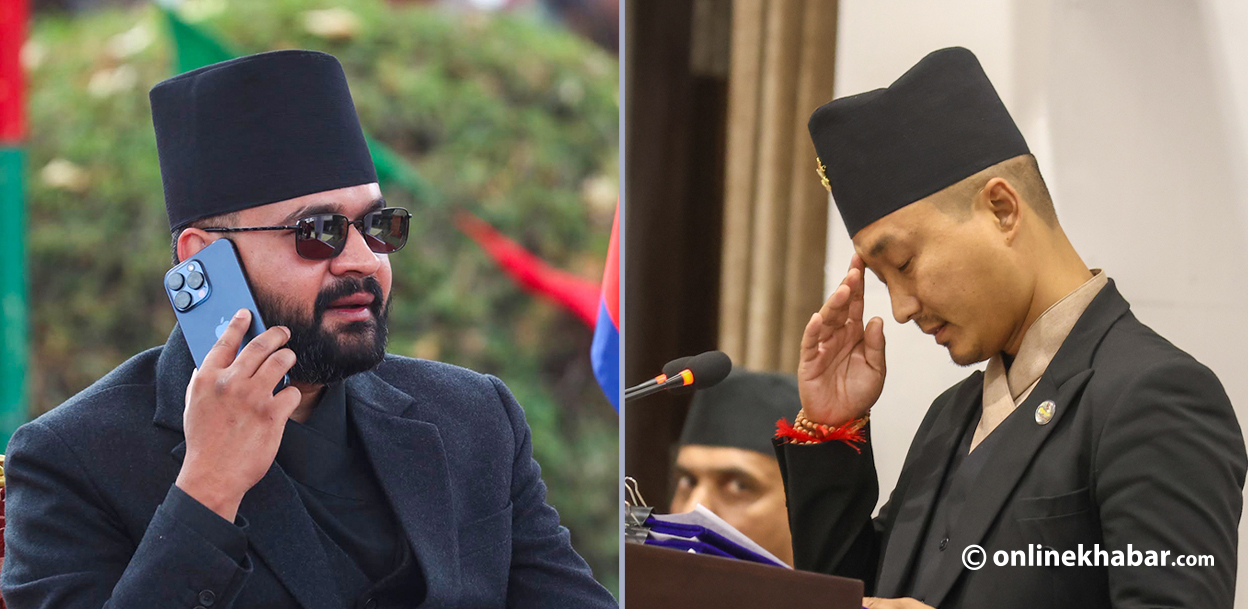
He allegedly had then Prime Minister KP Sharma Oli and Home Minister Ramesh Lekhak arrested within 24 hours. Initially, his style earned praise.
However, courts raised legal and procedural issues regarding these actions, leading to the release of many detainees. He failed to act based on evidence and procedures rather than political zeal.
Positive aspects include his attempts to activate the Home Ministry. His concern for disaster management and direct communication style with security personnel demonstrated his enthusiasm to work.
However, his departure was due to controversies surrounding his assets and conflicts of interest. It emerged that he held shares in a company connected to a controversial businessman, which he failed to disclose in his asset statements.
As facts of his opaque dealings surfaced in media, questions about the cleanliness of his financial status came to the forefront.

Although he stepped down, the main question is why individuals with such backgrounds are appointed Home Minister in the first place.
A government promoting the slogan of good governance faltering at the basic transparency test for its own ministers sends a concerning message. Now Prime Minister Shah faces the challenge of answering this question.
Sharma of Transparency Nepal remarked, “After his removal amid questions, investigations into the related issues and involved individuals will indicate the direction of the government’s good governance.”
In Nepal’s past governments, Home Ministers too have been embroiled in controversy, with questions arising both during and after their tenure.
Examples from Ramesh Lekhak to Bal Krishna Khand show the Home Ministry used as a means to display power and expand influence. Lekhak faced controversy over the visit visa case, and currently the JNG movement suppression case is under investigation.
When Ravi Lamichhane was Home Minister, citizenship controversies led to his dismissal and loss of parliamentary seat, while Bal Krishna Khand is implicated and facing legal proceedings in a fake Bhutanese refugee case.

Therefore, further investigation into Minister Gurung is necessary. Even amid controversy, his resignation reflects a break from the old pattern of refusing to relinquish the post, which is positive. Yet, resignation alone does not resolve all questions.
Gurung has pledged to assist government investigations, but how the government will conduct inquiries into him and his associated partners remains to be seen.
Now, the most important responsibility lies with the Prime Minister. Will the new Home Minister be an honest, transparent, and institutionally mature individual, or will a ‘Sudhan Gurung-2’ be appointed? That is the pressing question.
The Home Ministry is the gateway for citizens seeking justice. The police, administration, and peace and security structures are all guided by it. Hence, the conduct and decisions of the person heading this ministry directly affect public trust.
If the Home Minister himself is controversial, how can citizens trust the system the ministry aims to operate? The RSP and the Prime Minister certainly must have learned lessons from Sudhan Gurung’s 26-day tenure.