
Bank Directors and CEOs Should Not Resign Amid Ongoing Legal Cases, Says Nepal Rastra Bank
News Summary
Prepared by AI. Editorial review completed.
- According to the Bank and Financial Institutions Act, bank directors and CEOs are not required to resign solely on the basis of ongoing criminal charges, says Nepal Rastra Bank.
- The government has filed a case in Kathmandu District Court against directors and senior officials of Nepal Investment Mega Bank over the recovery of NPR 460 crore from the sale of Smart Telecom’s collateral.
- Officials from Nepal Rastra Bank clarify that until guilt is proven and punishment delivered, directors and CEOs are not disqualified.
September 18, Kathmandu – Following the government’s legal action against the chairperson, most directors, the CEO, and some employees of Nepal Investment Mega Bank (NIMB), there has been growing discussion about the status of their positions.
However, as per the Bank and Financial Institutions Act 2073 (Bafiya) and directives from Nepal Rastra Bank, there appears to be no provision for suspending or dismissing directors or CEOs solely based on the filing of criminal cases.
The government has filed a case in Kathmandu District Court against the directors and senior officials of Nepal Investment Mega Bank over the recovery of NPR 4.6 billion (460 crore) through the sale of Smart Telecom’s pledged assets.
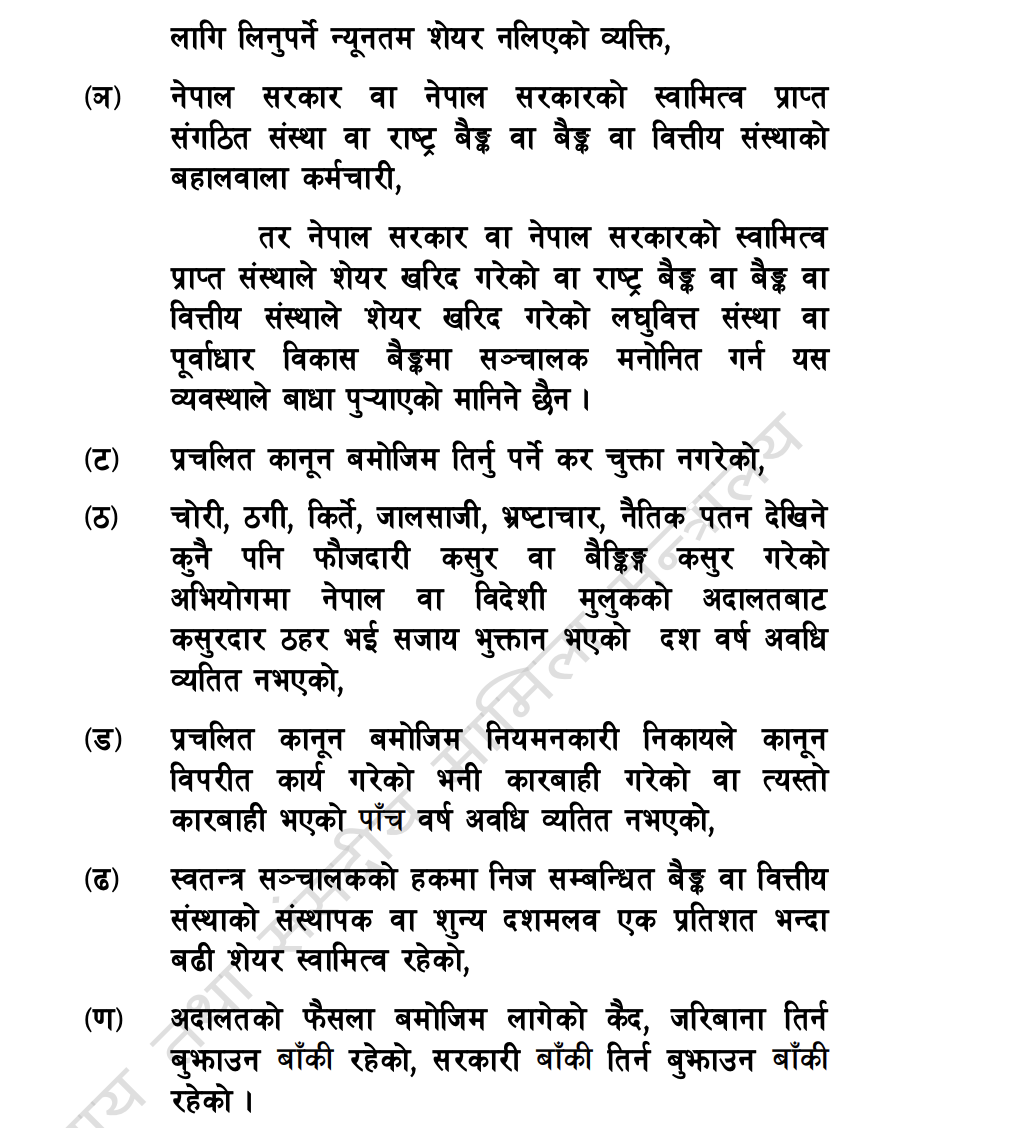
Sections 16, 17, 18, and 19 of the Bank and Financial Institutions Act provide regulations regarding the qualifications, disqualifications, and conditions under which directors of banks and financial institutions cannot continue in their roles.
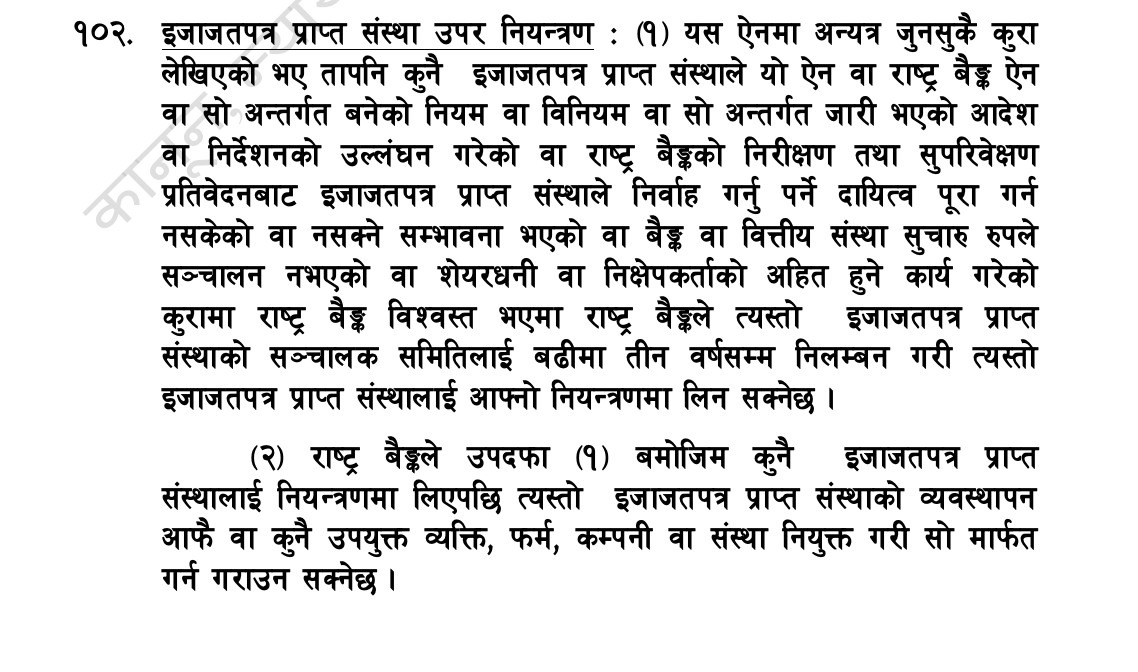
Article 102 of the same act details conditions under which a bank’s board of directors may be suspended. However, there is no provision in any section for suspending or removing a director or the committee based solely on pending criminal cases.
Specifically, sub-clause 1(ख) of Section 18 notes that individuals involved in crimes such as theft, fraud, forgery, or corruption who have been convicted and have not completed their sentence within the last 10 years are disqualified from being directors. Thus, a mere filing of a case does not disqualify a person from holding the director’s position unless proven guilty and sentenced.
Section 29 of Bafiya outlines the appointment and service conditions of the chief executive officer (CEO). Since the CEO must also meet the disqualification criteria in Section 18 (sub-section 1), the Nepal Rastra Bank official stated that a CEO cannot be dismissed or suspended solely on the basis of a pending case.
Authority to suspend a bank’s board of directors lies only with Nepal Rastra Bank under Article 102. Yet, even this does not permit suspension based solely on ongoing legal proceedings.
‘If a licensed institution violates rules, fails to meet obligations, ceases operations, or causes proven harm to shareholders or depositors, Nepal Rastra Bank may suspend it for up to three years and take control,’ the article states. However, suspension based purely on pending court cases is not allowed.
Consequently, a senior official at Nepal Rastra Bank clarified that there is no legal basis for removing or suspending bank directors or CEOs simply because criminal charges have been filed. ‘Only upon proof of criminal guilt and sentencing can they be disqualified from their positions,’ he stated.
An official also mentioned that after obtaining necessary legal advice, the bank concluded that the directors and CEO should not step down from their responsibilities. ‘The board of directors and CEO are performing their duties regularly without any ambiguity,’ the official added.