
Ministerial Change Alone Won’t Resolve Gas Supply Shortage, Say Experts and Lawmakers
- Amid a nationwide shortage of LPG gas, Minister for Industry, Commerce and Supplies Gauri Kumari Yadav has resigned, with Deepak Kumar Sah appointed as her successor.
- In the House of Representatives, MPs sharply criticized the government for its failure to address the gas shortage, demanding ‘Gas, not ministers.’
- Former secretaries and experts attribute the gas shortage primarily to disorganized distribution systems, weak monitoring, and lack of storage facilities.
September 11, Kathmandu – A severe shortage of cooking LPG gas persists across Kathmandu Valley and various districts of Nepal. Citizens are seen roaming streets carrying empty cylinders; some have cooked rice on the roadside, while others have staged protests demanding the government provide gas.
Faced with widespread criticism and mounting pressure as consumers’ stoves remain unlit, Industry, Commerce and Supplies Minister Gauri Kumari Yadav tendered her resignation.
More than two and a half months have passed since Balendra Shah (Balen Shah) formed his government, yet for the ordinary people enduring the acute gas shortage, the ministerial resignation and new appointment remain a major talking point. Still, a prevailing question lingers: ‘Will the empty cylinders at home finally be refilled with the change in ministers?’
Citizens had hoped the new government would ensure smooth supply, good governance, and end black market activities, but they are now left disappointed.
The situation is so dire that consumers are forced to pay up to NPR 3,000 per gas cylinder, despite the official price being set at NPR 2,060. Authorities have thus far failed to curb black marketeering and price gouging effectively.
Instead, accusations are being directed at activists of traditional political parties for deliberately hoarding gas, shifting blame onto consumers and the public.
Acknowledging the lack of support from his own ministry’s staff, poor cooperation from Nepal Oil Corporation, and failure to break the cartel of gas traders, Gauri Kumari Yadav stepped down from her ministerial role.
On Thursday, Prime Minister Balen Shah appointed Deepak Kumar Sah, elected from Sunsari-4, as the new minister. Sah took office immediately and started working on resolving the gas problem.
However, the new minister faces formidable challenges in quickly making gas supply easier, as Nepal’s gas crisis stems not from individual leadership alone, but from structural flaws, policy weaknesses, cartel practices among traders, and insufficient infrastructure.
The shortage began as early as December 2025 (Poush 2082 in Nepali calendar). The war in West Asia disrupted supply chains, with the problem remaining unresolved. Although the government has taken various measures, they have not yielded success.
Public Outcry in Parliament: ‘Not Ministers, We Want Gas’
The gas shortage issue has escalated from the streets to the parliament. In today’s House session, MPs strongly criticized the government.
Ashika Tamang, a lawmaker from the ruling Rastriya Swatantra Party (Raswapa), expressed dissatisfaction that the government has failed to ensure even minimum gas supplies.
‘I receive daily calls reporting that stores have gas but shopkeepers refuse to sell it. It’s like gold is available but I have broken ears. Is there a mafia bigger than the government in this country?’ she said.

MP Tamang warned the two-thirds government that the public cannot be left hungry due to lack of gas in shops.
‘If there really is no gas, then declare it immediately and tell people to find alternate cooking methods. Changing ministers every month without addressing the issue will only make things worse,’ she added.
Similarly, Nepali Congress lawmaker Geeta Gurung reminded the parliament that the public needs gas, not a new minister. ‘Though the industry minister has changed, let the empty cylinders at homes be refilled,’ she stated.
Lack of Storage Capacity and Dependence on Imports
Obstructions such as landslides on the Prithvi Highway or maintenance at Indian refineries continue to disrupt Nepal’s gas supply, largely due to the absence of a national storage infrastructure.
Nepal lacks any official government-operated LPG storage facilities. There are only 58 private industrial gas bullets providing approximately 10,000 tonnes of national storage capacity. Nepal Oil Corporation does not have the capability to operate gas bullets, bottling plants, or storage units.
The entire gas supply chain is controlled by the private sector. During crises, industrialists, dealers, and middlemen create artificial shortages that drive up prices. Until the government asserts its control, these problems will persist.
Building gas storage facilities is not a new concept. Whenever gas shortages arise, such projects have been proposed but remain unimplemented.
After the devastating 2015 earthquake and the Indian blockade, Nepal experienced a severe gas crisis. At that time, Nepal Oil Corporation planned to build a storage with a capacity of 35,000 tonnes, but the plan never materialized.
In 2019, the cabinet considered proposals for storage facilities in Jhapa and Chitwan, but these were scrapped citing government policy to reduce gas consumption and promote electricity use.
During the COVID-19 pandemic, storage and bottling plants were initiated in Jhapa, Janakpur, and Chitwan, but these have yet to have a significant impact.
Due to storage and pipeline issues, Nepal is compelled to use Indian gas bullets for transport, costing approximately NPR 600 million annually in transit fees to India.
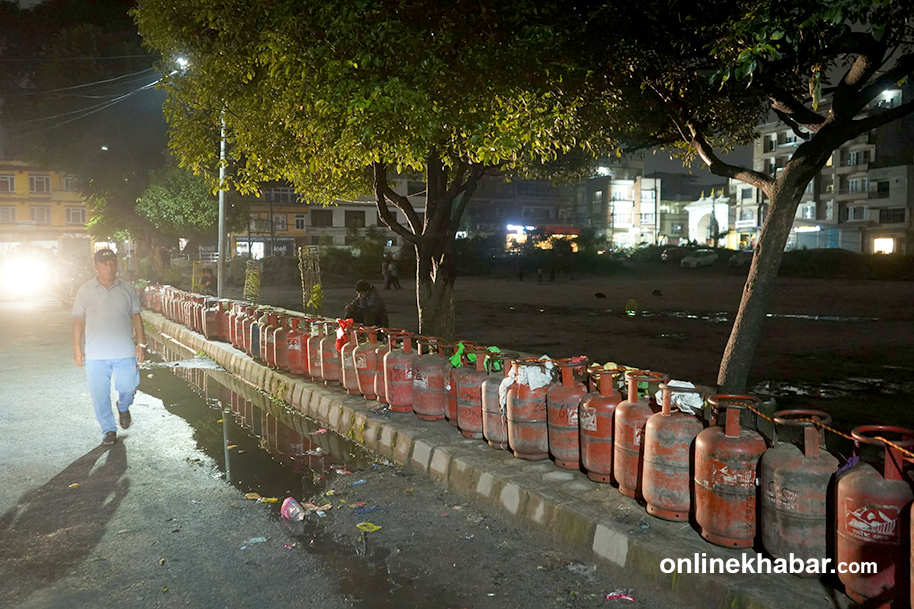
There is a plan to build a storage facility and pipeline with a capacity of approximately 45,000 to 50,000 tonnes in Netra Ganj, Sarlahi. Government officials claim completion within three years is expected, though financing arrangements remain undecided, raising concerns the plan may remain just on paper.
Need for Policy-Level Improvements
Consumer rights activist Madhav Timalsina stated that changing ministers will not bring immediate improvements in gas supply. According to him, the root causes lie in a long-standing weak distribution system and policy failures.
‘Our distribution system, rules, procedures, and mindset are outdated, so ministerial changes alone won’t quickly solve the problem,’ Timalsina explained.
He added that poor leadership and lack of strategic vision hamper gas supply efforts. Ministers should have focused on diplomatic coordination between gas stations and policy formulation but instead got entangled in distribution issues themselves.
Distrust of government staff and unnecessary interference have rendered Nepal Oil Corporation inactive, he said.
He suggested that the new minister should be prepared to bring gas even by helicopter during natural disasters and work to build public trust.
Calls to Increase Imports and Strengthen Monitoring
Former Commerce Secretary Purushottam Ojha emphasized the need to increase LPG imports and implement effective monitoring to resolve the gas crisis.
He advised the new minister to prioritize removing road blockades and tracking all 58 industrialists immediately.
Ojha identified two primary causes of the gas shortage: inadequate imports and issues within the distribution network.
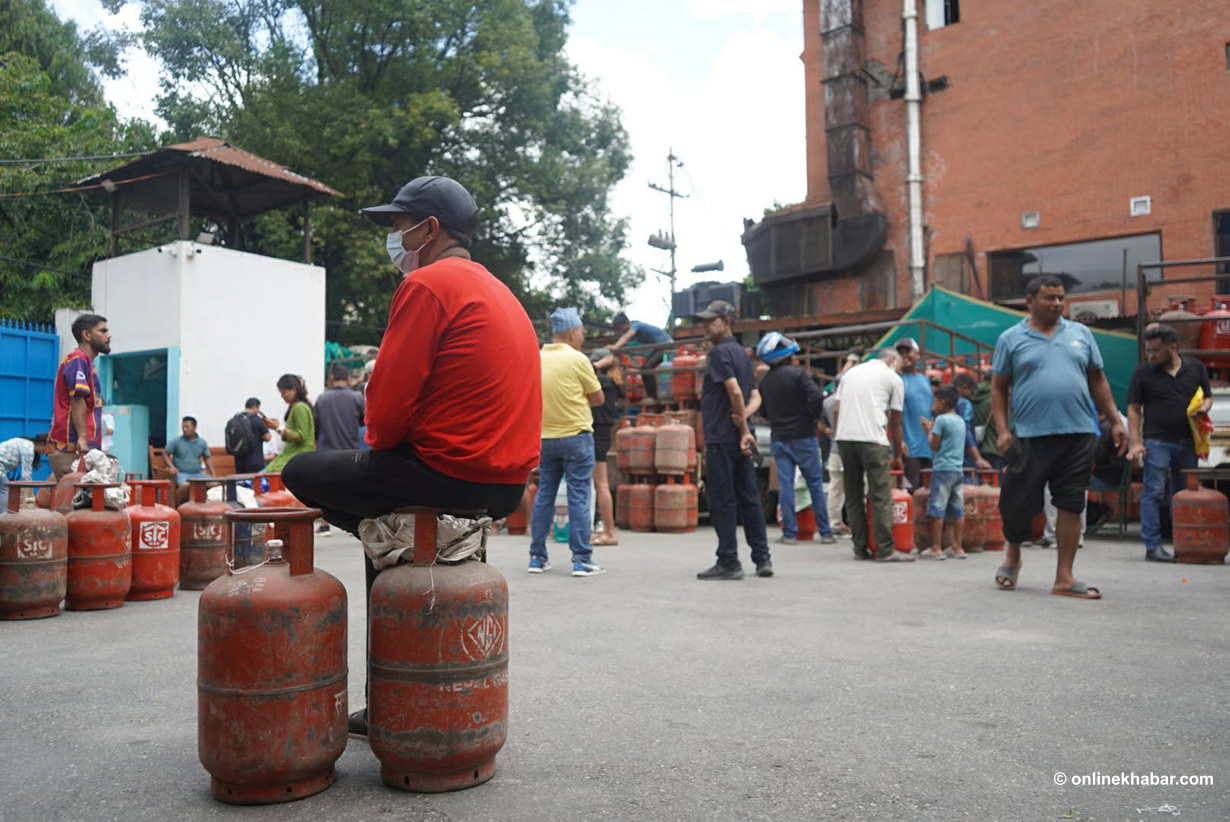
‘First, the amount of gas imported must be increased. Second, transportation issues must be resolved swiftly. Road closures have increased costs for trucks transporting gas from the Terai,’ Ojha said.
He recommended strict monitoring using data on the 58 industrialists to prevent gas leakage and black marketing.
While the former minister blamed staff, Ojha cautioned against blaming employees and stressed the importance of leadership gaining their trust to work effectively.
Industry Perspective: Market Has Enough Gas; ‘Panic Buying’ Drives Shortage
Shiv Prasad Ghimire, former president of Nepal LPG Industry Association, claimed that gas supply in the market exceeds normal levels and that ‘panic buying’ due to highway blockades has created an illusion of shortage.
Presenting statistics, he noted that Kathmandu Valley’s daily gas consumption ranges from 35,000 to 40,000 cylinders, and recently even more gas has been sent to meet demand.
‘On September 4, 34,134 cylinders were supplied; on the 5th, 29,239; on the 6th, 42,142; on the 7th, 48,109; on the 8th, 46,218; on the 9th, 53,469; and on the 10th, 45,324 cylinders,’ Ghimire said.
He acknowledged that when highways are blocked, smaller vehicles handle transport, leading to uncontrolled price hikes.
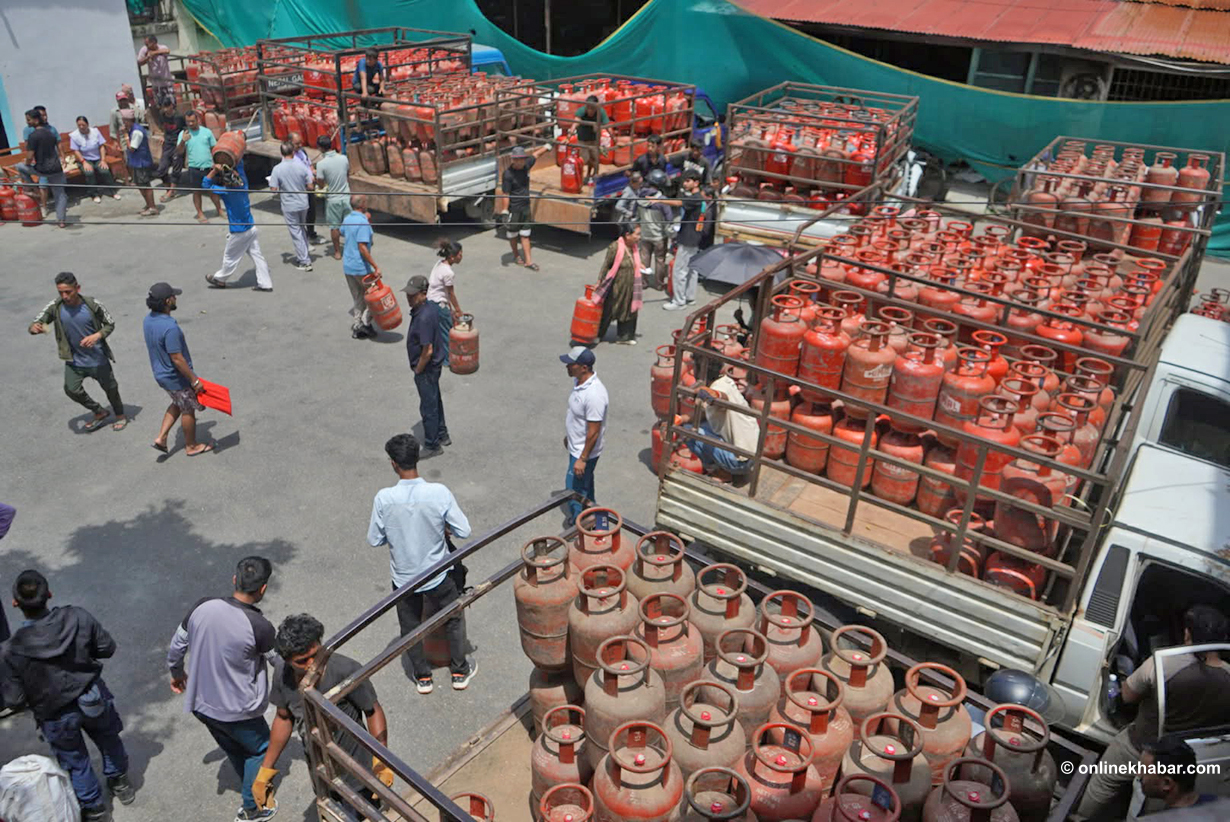
He explained that large vehicles now handle long-haul transport, while smaller vehicles distribute gas within Kathmandu, and also mentioned that imports from India have increased.
‘While normally 40,000 to 45,000 tons are imported monthly, over 60,200 tons have been brought in so far in September,’ he added.
Ghimire considered government accusations against industrialists for the shortage as unfair and unfortunate amidst current circumstances.
Sufficient Supply but Weak Distribution
Sushil Bhattarai, former acting executive director of Nepal Oil Corporation and petroleum expert, stated that Nepal has enough gas in the market, but distribution weaknesses and poor monitoring cause the problems.
‘We require 45,000 to 46,000 tons monthly, but India supplies up to 60,000 tons. However, lack of distribution coordination worsens the problem,’ he noted.
He pointed out that psychological fear leads to simultaneous demand spikes, escalating the shortage.
‘Previously, large gas bullets carrying 1,250 cylinders were sent directly to Kathmandu Valley, but now, distribution is handled by four smaller vehicles,’ Bhattarai explained.
Due to weak monitoring, he said there is practically a ‘vacuum’ in the market, and highlighted that Nepal Oil Corporation lacks legal authority to penalize gas sellers for malpractice.
The data and expert analyses clearly show that the gas shortage cannot be resolved solely by political decisions.
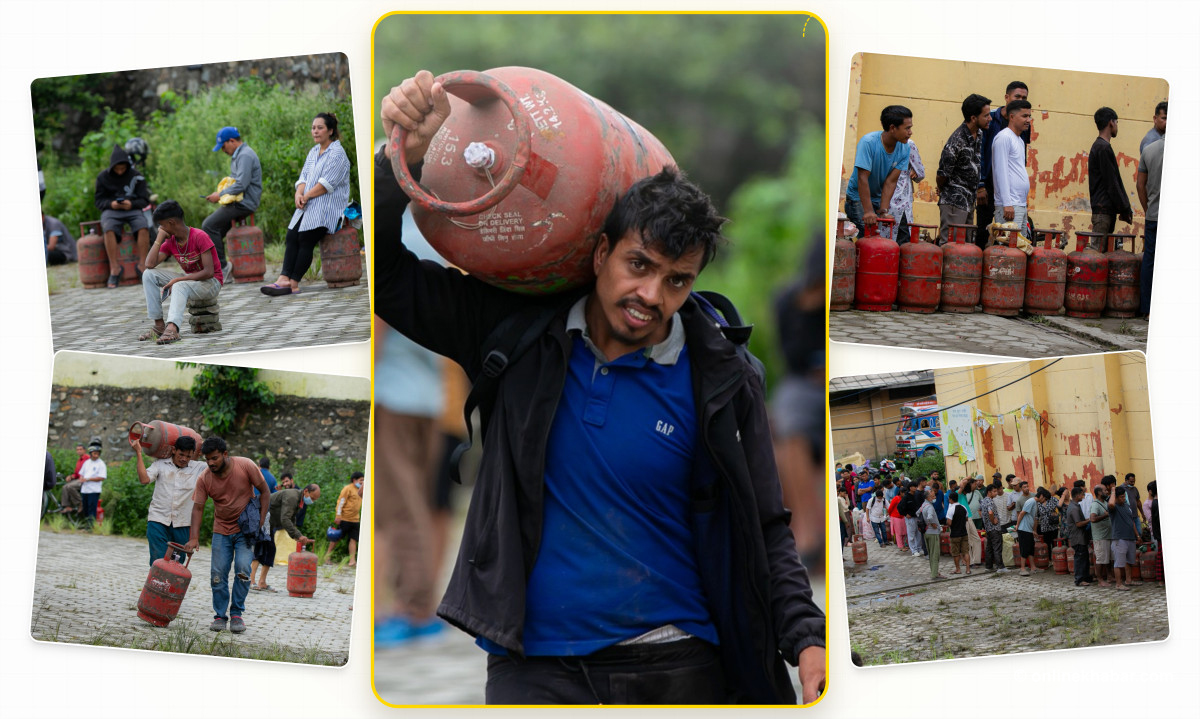
The new minister faces significant challenges in streamlining gas supply since the government lacks accurate data on total consumption and how much gas individual industrialists import.
Dealer certification and a fair distribution process have not been effectively implemented in the public sector.
The new leadership must engage in diplomatic coordination with the Indian government and Indian Oil Corporation to facilitate gas imports from nearby stations.
Ministerial resignations will not solve the supply problem immediately, nor will roads be rebuilt overnight.
Until the private sector cartel is dismantled, state control reinforced, and a national gas storage facility built, there will be no tangible change for consumers.
Thus, ministerial changes are a political event, but the public will only gain accessible gas supply after a sustained, long-term state effort.