
‘Right to Recall’ Does Not Work This Way!
News Summary
Editorial Reviewed.
- Prime Minister Balendra Shah dismissed Labour Minister Deepak Kumar Sah upon the recommendation of National Independent Party chairman Ravi Lamichhane.
- Although the Rashtriya Swatantra Party’s (Raswap) statute includes a ‘Right to Recall’ provision, constitutional expert Dr. Bipin Adhikar stated that dismissing a minister does not equate to this right.
- In Nepal, the ‘Right to Recall’ refers to the voters’ authority to withdraw their elected representatives.
March 27, Kathmandu — According to Greek historian Herodotus, democracy is a system of governance where all power rests with the people. Abraham Lincoln, the 16th President of the United States, defined democracy as a “government of the people, by the people, for the people.”
People transfer their sovereign power to representatives through ballots for a fixed term, and these elected representatives govern on behalf of the people.
But what happens if these elected representatives are unaccountable to the people? This question relates to a remark by former British Prime Minister and author Winston Churchill.
“A little man enters a small room, takes a small pencil, and makes a small mark on a small piece of paper. These small marks determine the country’s fate for five years,” Churchill said, “but after the election, that little man is forgotten, neglected, and ignored — until the next vote.”
When the people are neglected, the mechanism that allows them to remove elected representatives before their term ends is known as the Right to Recall. This ensures elected officials remain accountable to their constituents.
This right enables constituents to remove members of parliament or local representatives if they fail their responsibilities or break public trust. The Right to Recall is believed to strengthen democracy, although it is also associated with costs and political instability.
In Nepal, if the Prime Minister loses a vote of confidence, parliament can dismiss the government, and impeachment processes can remove the president or vice president. The Prime Minister has the exclusive authority to dismiss ministers.
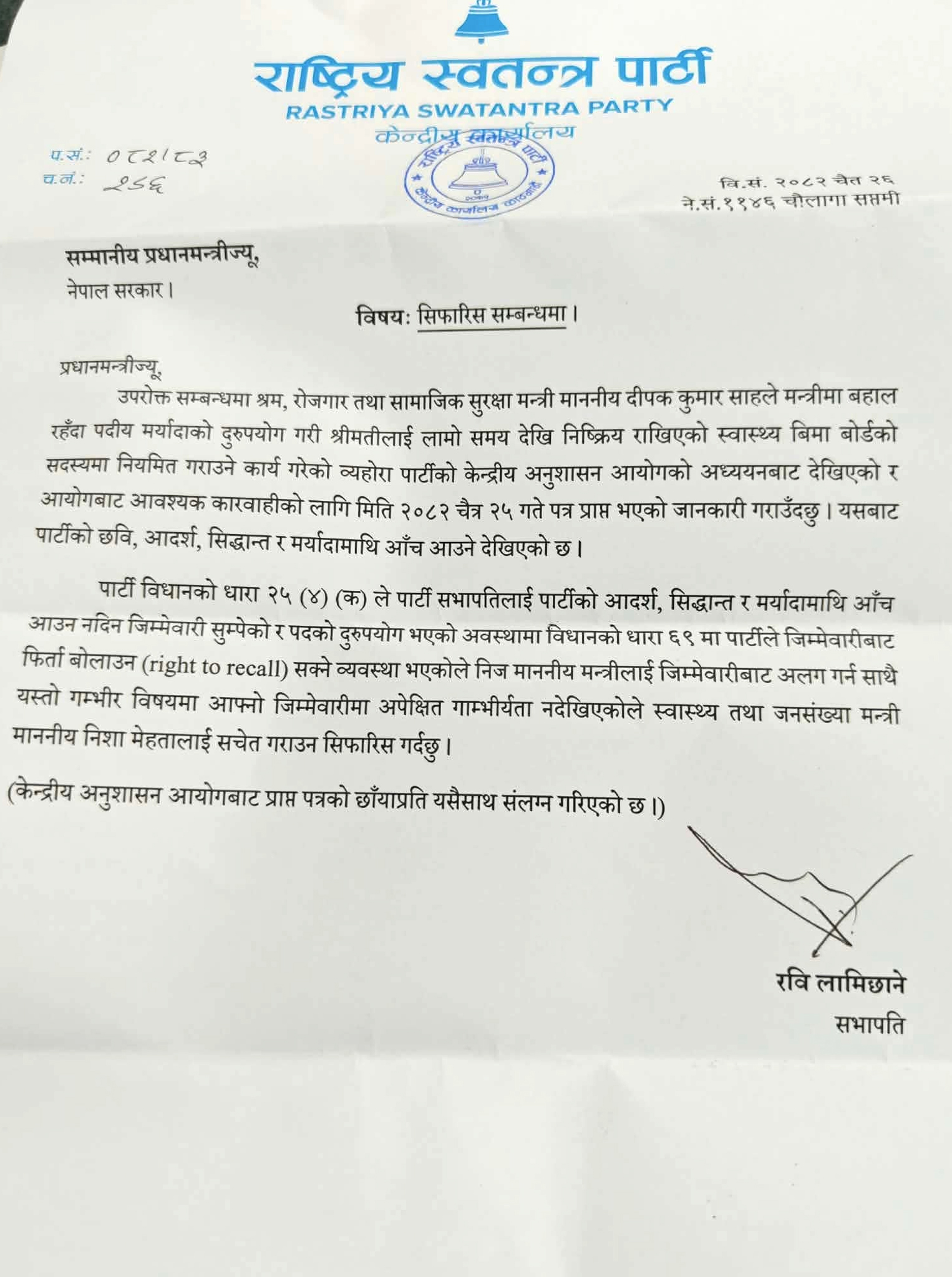
Just last Thursday, Prime Minister Balendra Shah dismissed Labour, Employment, and Social Security Minister Deepak Kumar Sah. Sah was removed within two weeks of his appointment, following a recommendation from Rashtriya Swatantra Party (Raswap) Chairman Ravi Lamichhane.
The chairman’s letter noted that Sah was recalled following Raswap’s ‘Right to Recall’ provisions. However, the Prime Minister holds the authority to remove ministers even without party recommendations.
The Prime Minister has the prerogative to form his cabinet as he wishes. According to constitutional expert Dr. Bipin Adhikar, the Prime Minister may add or remove ministers at any time. He stated, “Whether or not it is written in a party’s statute, the Prime Minister’s authority to alter ministers is not obstructed.”
Raswap’s statute includes that “general members of the party from the concerned area shall have the right to recall a representative if the representative fails in their duties. Upon a decision by a specified number or percentage of members, the central committee will begin the process to remove that representative.”
Moreover, proportional representatives acting against party interests or for other reasons can also be recalled and dismissed through procedures outlined by the central committee’s regulations.
While Raswap’s decision to remove the contested minister is welcomed, associating the ‘Right to Recall’ directly with ministerial dismissals is misguided. The concept is distinct. Dr. Bipin Adhikar said, “A party recalling its own MPs or ministers is not the ‘Right to Recall.'”
As soon as Minister Sah was dismissed, analyst Dambar Khatri commented on social media platform X, “The Right to Recall means voters can withdraw their representatives if they fail to fulfill their mandates; it does not mean the party can recall ministers.”
The authority to decide on recall lies with voters, not party committees. Dr. Adhikar emphasized, “The right belongs to those who voted for the candidate, not party leaders.”
Current laws suffice to dismiss MPs who act against party directives or violate laws.
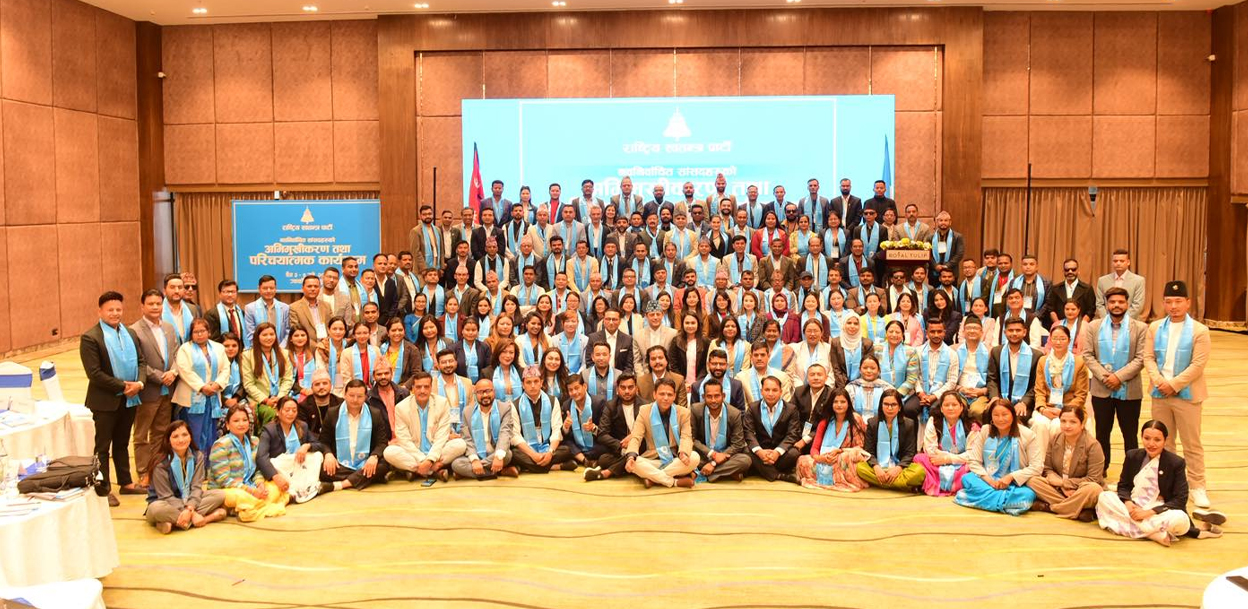
The Right to Recall is exercised by voters, not upper-level leaders. However, the ruling Raswap appears to interpret it differently.
For example, on July 9, 2020 (25 Ashad 2077 BS), Sarita Giri, a House of Representatives member from the Samajwadi Party, was dismissed after violating party whip during the passage of the constitutional amendment bill related to Limpiyadhura and Kanchanpur maps.
The party sent a letter to the parliamentary secretariat based on the Political Parties Act, 2016, and the interim statute of the Samajwadi Party, 2019. Note that this statute does not mention the ‘Right to Recall.’
Section 28 of the Political Parties Act allows parliamentary party chief whips to enforce directives on government policy and budget matters, giving grounds for disciplinary action when violated.
Additionally, Article 89 of the Constitution stipulates that MPs who leave their party lose their federal parliamentary seat.
In 2022 (2079 BS), Raswap expelled MP Dhaka Kumar Shrestha over the Durga Prasai controversy, leading to his removal from parliament.
Furthermore, resignation, death, or absence without leave for ten consecutive meetings also results in loss of parliamentary membership.
In August 2023 (Ashad 2080 BS), the Maoist Centre decided to recall Minister Aman Lal Modi. At that time, the party was preparing to appoint Anita Devi Sah, a proportional representative, as minister in his place.
Various parties have recalled ministers without mentioning the Right to Recall in their statutes, including the Maoist Centre.
Constitutional law and parliamentary experts state that party statutes and regulations cannot supersede constitutional provisions. The 2019 Constitution allowed members of the National Panchayat to be “recalled.”
After the republic was established, a proposal to allow 25% of voters to demand recall of MPs was submitted to the House State Affairs Committee but never adopted into law.
Without legal provisions, implementing recall is not feasible. Dr. Adhikar explained, “Disciplinary action under the Political Parties Act constitutes a form of recall. However, a party decision alone cannot be called a ‘Right to Recall.'”