
Why Did the Army and Police Request Details of Squatter Residents from Local Municipalities?
News Summary
Editorial reviewed.
- On Baishakh 12, the day squatter settlements along the riversides of Kathmandu were demolished, the military was present with arms, raising questions.
- After the Nepal Army and Police requested details of squatters from municipalities in Bardiya, Banke, and other areas, debate has emerged regarding the justification of such demands.
- Hari Prasad Rijal, Chairperson of the Land Issues Resolution Commission, stated that the army and police directly seeking information from municipalities is an overreach of authority.
May 29, Kathmandu – On Baishakh 12, the squatter settlements along the riversides in Kathmandu were demolished, and armed military personnel were also visible around the area. While military officers have described this presence as mere coincidence, the issue has generated widespread questions.
Recently, it has come to light that the Nepal Army and Nepal Police have been requesting detailed information about informal and squatter settlements from various local municipalities, sparking debate about the reasonableness of such actions.
Some critics have termed this an abuse of authority, while others argue that collecting such data is necessary.
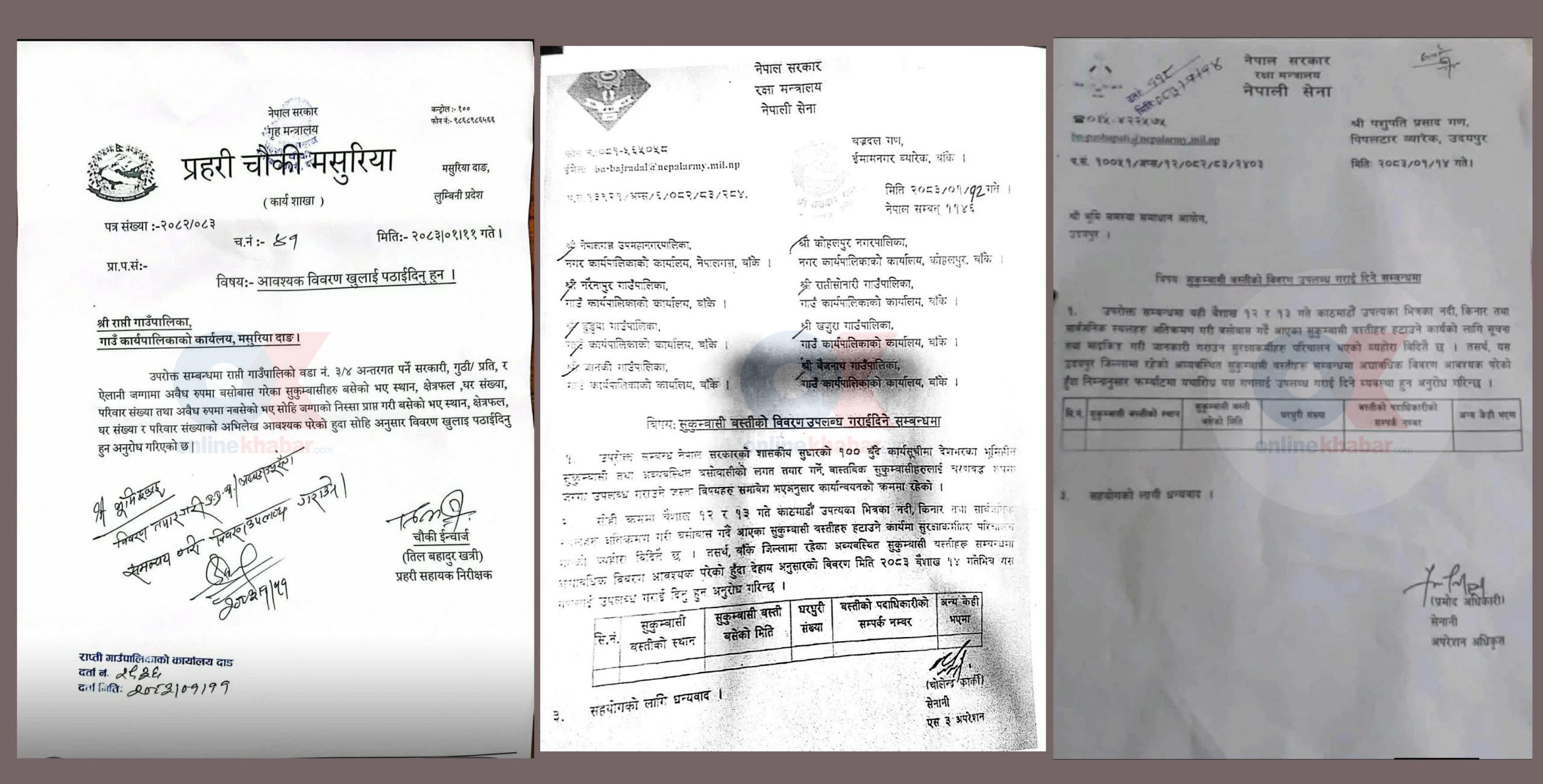
The Vajradal Battalion based at Imam Nagar Barracks in Banke district has sent letters to eight municipalities in Bardiya and Banke requesting details of the squatter settlements.
According to the letter sent by soldier Cholendra Karki, municipalities are asked to provide information such as the location of squatter settlements, date when residents began living there, number of households, and the contact details of settlement representatives.
The letter also mentions a plan under the Government’s 100-Point Agenda for State Reform to prepare data on landless squatters and informal settlers and to progressively provide land to genuine squatters.
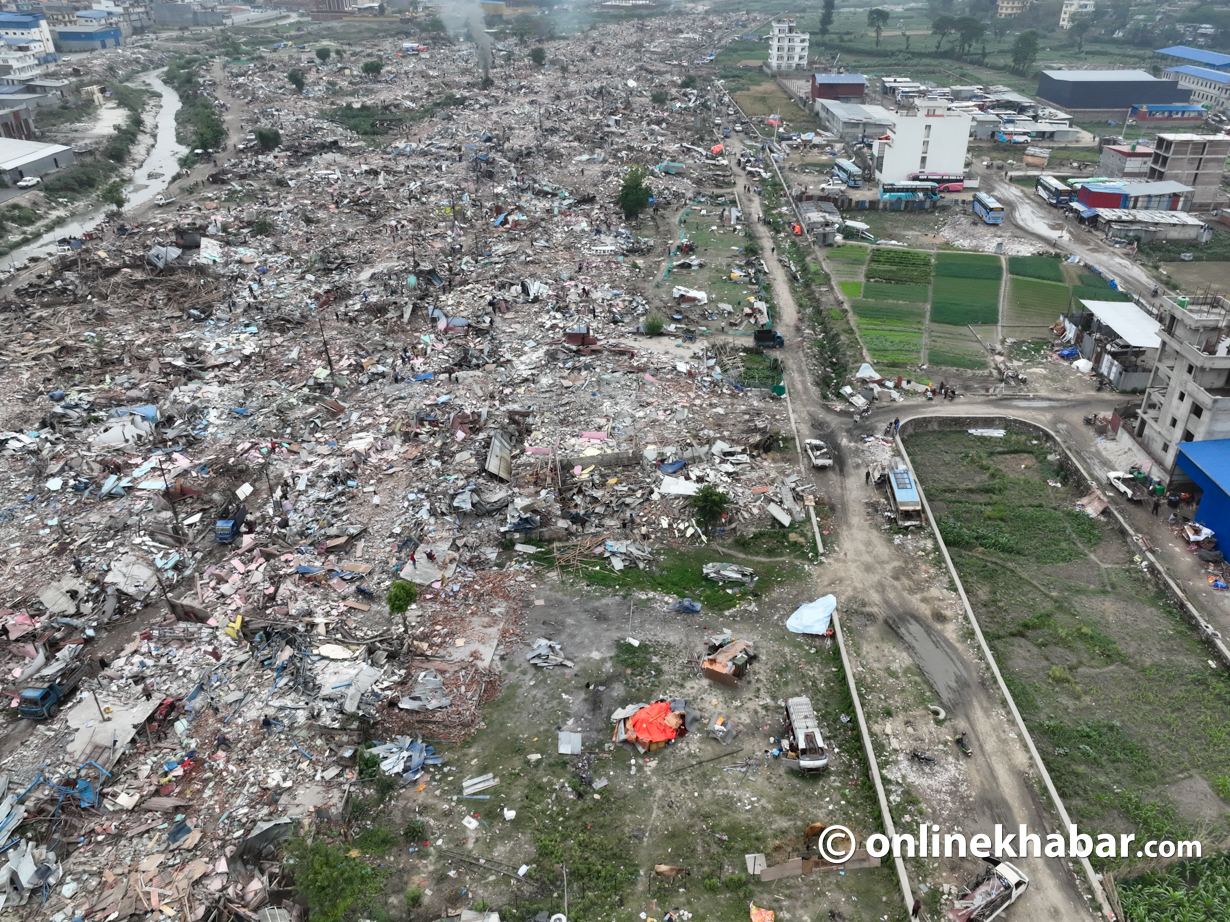
Security personnel were deployed during the removal of squatter settlements along the riverbanks and public lands in the Kathmandu Valley on Baishakh 12 and 13, which has also led to requests for similar information from squatter communities in Banke and Bardiya districts.
Additionally, a Nepali Army major contacted Rapti Rural Municipality Chairperson Prakash Bista in Dang’s Deukhuri region over the phone seeking details about squatters.
The Masuriya police post of Nepal Police has also sent a letter to Rapti Rural Municipality requesting information on squatter residents.
The Pashupati Prasad Battalion based in Piple Tar, Udayapur, wrote to the Land Issues Resolution Commission in Udayapur on Baishakh 14 requesting data on squatter settlements.
Nepali Army spokesperson and assistant Rathi, Rajaram Basnet, stated that the requests were made in line with the agenda to update records in the District Security Committee meetings. “The District Security Committee raised record updates as an agenda item, and accordingly, information requests have been made,” Basnet said.
Nepal Police spokesperson DIG Avin Narayan Kafle explained that specific information is required for security management and the proper administration of squatter communities, which is why units have been deployed.
“While no directive has come from the central government ordering the collection of squatter data, security concerns might have prompted data gathering to understand who resides in which areas,” Kafle stated. “Effective police deployment and adherence to state directives necessitate collecting such information on squatter communities.”
Local Administration Unaware, How Are Elected Representatives Responding?
District Chief Officer of Bardiya, Gogan Bahadur Hamal, claimed he was unaware that the army had requested details about squatters. However, he confirmed that during the District Chief Officers’ meeting on Baishakh 4, a decision was taken to collect information on encroachments on government and public land.
Similarly, Banke’s District Chief Officer, Dil Kumar Tamang, stated he did not understand the reason behind the army’s demands from municipalities. He suspects the barracks are gathering this data following directives from higher authorities.
Emphasizing that removing encroachments is a priority, he added, “In a discussion with public representatives about removing encroachment in Ward No. 11 of Kohalpur Municipality, where a cricket ground is being developed, I committed to ensuring security arrangements. Beyond that, I am not aware of the army’s actions.”
Kohalpur Municipality Mayor Purna Prasad Acharya confirmed that the army asked for information on landless and squatter residents and the municipality is preparing to provide the data.
According to Mayor Acharya, encroachment has occurred over 36 bighas of land around the cricket ground in Kohalpur-11, where there were 751 households a year ago.
In Ward No. 4 of Kohalpur Municipality, out of 6 bighas of land along the East-West Highway, 4 bighas have been subdivided and allocated to 41 individuals. However, these details are not recorded in the land reform or land revenue offices, and currently, about 15 people reside there.
During former Prime Minister Prachanda’s tenure, 1,400 ghaderis (land parcels) were created and distributed in Loknagar, Kohalpur-11. Although the sale of these parcels was not permitted, some were allegedly sold secretly, a matter the municipality has decided needs investigation.
“We will provide all of this information to the army soon,” Mayor Acharya assured.
Chief Administrative Officer Krishna Prasad Jaisi of Gulariya Municipality, Bardiya, confirmed that they have submitted the requested details to the army but declined to provide further information.
Prakash Bista, Chairperson of Rapti Rural Municipality in Dang, criticized the fact that the police post sought data directly from the municipality, emphasizing that local government, not police, should be the one to request such information.
“While it is appropriate for the state to identify and manage genuine squatter residents, it is improper for the police post to demand details from the municipality,” he said.
“There is confusion where those in power exploit the identity of squatters. Public property must be protected, but prioritizing the management of genuine squatters is essential,” Bista added.
‘Abuse of Authority’
The Government of Nepal established the Land Issues Resolution Commission on October 30, 2024 (2081 Ashoj 14) under the Land Related Act, 2021, to provide land to landless Dalits and landless squatters and to manage informal settlers. As per the Commission’s data until Baishakh 14, there are 98,502 landless Dalits, 180,293 landless squatters, and 930,790 informal settlers across the country.
Hari Prasad Rijal, Chairperson of the Land Issues Resolution Commission, criticized the army and police for directly requesting information from municipalities, calling it illegal and an abuse of jurisdiction.
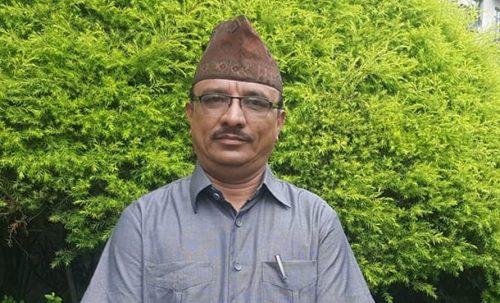
“If the army and police need such information, they must request it through the Ministry of Defence or Ministry of Home Affairs to the Ministry of Land Reform. If the ministry requests, we will provide it,” Chairperson Rijal stated. “But the way the army and police are directly demanding data from municipalities is an overreach of authority.”
Senior Advocate Raju Prasad Chapagain also expressed that the army and police should not be involved in collecting squatter details from municipalities. “This is not a security matter, and army involvement is unnecessary. Everyone should reside within their own jurisdictions,” he commented.
He further warned that unnecessary interference by security forces in matters legally managed by local bodies could undermine institutional legitimacy and public trust. “Such actions could diminish our institutions’ credibility and erode people’s confidence.”