
Ruling Party’s Abuse of Parliamentary Rules Sparks Opposition’s Constitutional Concerns
News Summary
- The House of Representatives passed the House rules by majority vote despite opposition from major opposition parties, including the Nepali Congress.
- Opposition parties have strongly objected to provisions on constitutional amendments and parliamentary privileges included in the passed rules, saying they contradict the spirit of the constitution.
- Gagan Thapa, leader of the Nepali Congress, stated that legal remedies will be sought in court against the violation of limits imposed by the legislature through these rules.
20 Jestha, Kathmandu – The House of Representatives Standing Orders are the primary legal framework intended to govern parliamentary operations for five years. Traditionally, these rules are formulated through consensus among all parties in power and opposition, which lends greater legitimacy and acceptance. In the past, it was common practice for the rules to be established with unanimous agreement.
However, this time the ruling coalition and the Rastriya Swatantra Party (RSP) assumed complete control over drafting the Standing Orders, causing frustration among opposition parties, particularly the main opposition Nepali Congress.
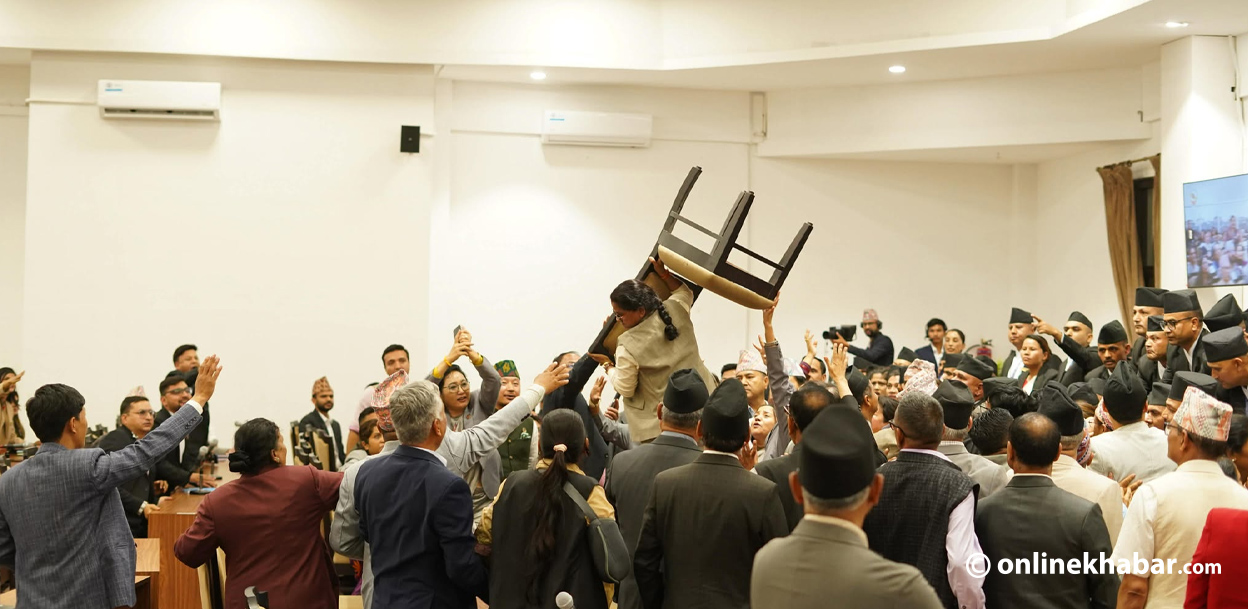
Passing the rules without opposition consensus through a majority vote led to scuffles in parliament a few days prior, including intense struggles to secure the Speaker’s chair.
The opposition has raised serious objections against two key provisions in the rules: those relating to the constitutional amendment process and the protection of members of parliament from laws other than criminal law.
Opposition parties argue that these provisions violate the fundamental spirit of Nepal’s constitution. The Nepali Congress has been the most vocal critic.
The Congress has condemned the government for undermining the generally accepted principles of law-making and has strongly opposed the ruling party’s passing of the rules as superior to the constitution.
The rules, intended to facilitate the operation and management of the federal parliament, have effectively rendered certain constitutional laws ineffective, according to Congress.
The amended rules stipulate that constitutional amendment bills will only be certified if they receive a two-thirds majority of members currently serving in both houses.
Article 140 (11) of the rules states, ‘Constitution amendment bills approved by the House and sent to the National Assembly shall be forwarded by the Speaker to the President for certification only if the total votes in favor represent at least two-thirds of the total current members of both houses.’
Congress has interpreted this as a misrepresentation of the constitutional process for amendments, weakening the authority of the National Assembly and undermining the constitution’s intent.
The party asserts that the rules contradict the constitution and feels this issue must be taken to court.
Gagan Thapa, president of the Nepali Congress, said the legislature has crossed its limits and that the matter should be pursued judicially. “I believe the honored court will make a decision on this matter. It must. When the executive crosses its boundaries, the judiciary must protect those boundaries,” he said.
The ruling party forcefully passed the Standing Orders last Sunday without addressing opposition demands to amend them.
The Congress has expressed serious concerns over three main issues in the rules. They raised objections against the overarching ‘obstruction removal’ provision right in the preamble.
Party spokesperson Devaraj Chalise criticized the provision allowing removal of obstructions as an exception but being made a guiding principle in the preamble, calling it undemocratic.
Chalise commented, “If every parliamentary practice is classified as an obstruction, then why do we need Standing Orders? Why do we need laws? Exceptions are acceptable in democracy, but they cannot become the philosophy.”
Clause 259 of the Standing Orders states, ‘Regardless of what is written in existing laws,’ a phrase that Congress deems contrary to the spirit of the constitution. The opposition believes this provision aims to grant legal protection to certain individuals or parties.
Congress views the Standing Orders as facilitating protection of MPs from suspensions related to serious issues such as corruption and money laundering.
While the law should apply equally to all public officials and citizens, the ruling party has passed rules granting privileges to MPs, the Congress says.
Congress warns that endowing MPs with special privileges that exempt them from legal and public scrutiny weakens accountability. Congress MP Geeta Gurung stated, “According to the regulations, Standing Orders cannot supersede the country’s fundamental laws or criminal laws.”
Gurung questioned the ruling party, “Why does the Standing Orders violate existing laws to grant special privileges to MPs? Is this protection meant to shield MPs even when facing corruption or criminal charges?”
The provision requiring ministers’ mandatory presence during parliamentary committee meetings, except for bill discussions, has been removed from the rules. Gurung said this was against the constitution’s spirit.
Gurung indicated the rules undermine the constitutional mandate that the government must be accountable and answerable to parliament. “The government is not accountable to parliament; it seeks to make parliament a powerless shadow. Holding the government accountable to parliament is a fundamental essence of separation of powers,” she said.
Gagan Thapa described the behavior of the ruling party during the passage of the rules as a dark day in parliamentary history.
He objected to the forceful imposition on a law meant for running parliament.
Thapa said granting special privileges to individuals regardless of what the constitution and laws specify represents extreme abuse of parliamentary power.
The Rastriya Swatantra Party had proposed amendments to the Standing Orders, with opposition parties urging parliamentary committee discussions on the revisions.
However, the ruling party rejected proposals for committee discussions and forcefully passed the rules amid opposition last Sunday. Despite demands to send the rules back to the committee for inclusive dialogue, the ruling party imposed them unilaterally, according to Nepali Congress chief whip Niskal Rai.
After the opposition meeting, Rai stated, “We suggested returning the rules to the committee briefly for further discussion to ensure collective ownership. However, they did not accept. Legal remedies may be the next step.”
Not only the Nepali Congress but the UML has also raised objections to these provisions. UML parliamentary deputy leader Padma Aryal accused the rules of violating the spirit of the constitution. “Why grant special privileges to some in the parliament while treating citizens as ordinary? Including provisions that amend the constitution through shortcuts in the Standing Orders contradicts the constitution’s spirit,” Aryal said. “Regardless of who is in government, the rules to operate parliament should be inclusive for all.”
UML chief whip Yubaraj Dulal expressed concerns about the rules containing a constitutional amendment procedure different from the constitution’s mandate.
Article 274(8) of the constitution requires a two-thirds majority of the total current members in both federal parliament houses to pass amendments.
Echoing this, Dulal said, “The constitution requires a two-thirds majority from both houses, but the rules state certification can occur if two-thirds votes are achieved including the National Assembly’s favorable votes, which contradicts the constitution.”